Over 25% of energy EU used in 2024 came from renewables, 21.8% in North Macedonia

Skopje, 20 December 2025 (MIA) – The EU reached over 25% share of its gross final energy consumption from renewable sources in 2024, around 0.7 percentage points higher than in 2023. This share is 17.3 pp short of meeting the 2030 target (42.5%), which would require an annual average increase of 2.9 pp from 2025 to 2030. In North Macedonia, renewable energy represented 21.8% of the total energy consumed in 2024, up 1.6% compared to 2023.
According to Eurostat data, of the countries in the region, most renewable energy was consumed in Albania (43.1%) and Montenegro (40.8%), followed by Croatia (26.7%), Serbia (25.8%), Greece (25.3%) and Bulgaria (23.2%).
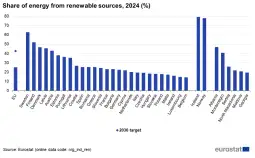
In Europe, the highest shares of renewables in total energy consumption were recorded in Iceland (79.3%) and Norway (77.9%). The lowest shares of renewables were recorded in Belgium (14.3%), Luxembourg (14.7%), and Ireland (16.1%).
Sweden had the highest share among EU countries, with 62.8% of its gross final energy consumption coming from renewable sources in 2024. Sweden primarily relied on solid biomass, hydro and wind. Finland followed with 52.1%, relying on solid biomass, wind and hydro, ahead of Denmark with 46.8%, with most of its renewable energy sourced from solid biomass, wind and biogas.
Among the EU countries, more than 75% of electricity consumed in 2024 was generated from renewable sources in Austria (90.1%), Sweden (88.1%) and Denmark (79.7%). The consumption of electricity from renewable sources was also high in Portugal (65.8%), Spain (59.7%), Croatia (58.0%), Latvia (55.5%), Finland (54.3%), Germany (54.1%), Greece (51.2%) and the Netherlands (50.5%), all of them accounting for more than half of electricity consumed. At the other end of the scale, the share of electricity from renewable sources was less than 25% in Malta (10.7%), Czechia (17.9%), Luxembourg (20.5%), Hungary and Cyprus (both at 24.1%) and Slovakia (24.9%).
In North Macedonia, 40% of the total electricity consumed in 2024 was generated from renewable sources. This is an increase of almost 8% compared to 2023, when electricity from renewables accounted for 32% of the total energy consumed. The country sees a steady increase in the share of renewable energy in the total electricity consumed over the past 20 years, from 14.5% in 2004, to 19.2% in 2014, and 40.07% in 2024.
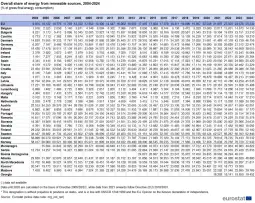
The EFTA countries Norway and Iceland, as well as the candidate country Albania, produced more electricity from renewable sources than the total amount of electricity they consumed in 2024, therefore leading to a share higher than 100%. In some of these cases, the effect comes from higher production than consumption with net exports (Norway) or real share at 100%, but hydro normalisation brings the share result to a higher level (Iceland and Albania).
The growth in electricity generated from renewable energy sources during the period 2014 to 2024 largely reflects an expansion in 2 renewable energy sources across the EU, namely wind power and solar power. In 2024, renewable energy sources made up 47.5% of gross electricity consumption in the EU, more than 2 percentage points higher than the previous year (45.4% in 2023).
Wind and hydro power accounted for almost two-thirds of the total electricity generated from renewable sources (38.0 and 26.4%, respectively). The remaining one-third of electricity generated was from solar power (23.4%), solid biofuels (5.8%) and other renewable sources (6.1%). Solar power is the fastest-growing source: in 2008, it accounted for 1%. This means that the growth in electricity from solar power has been dramatic, rising from just 7.4 TWh in 2008 to 304 TWh in 2024.
Photo: MIA/Eurostat