Siljanovska-Davkova: Gender responsive budgeting allows fair distribution of public funds
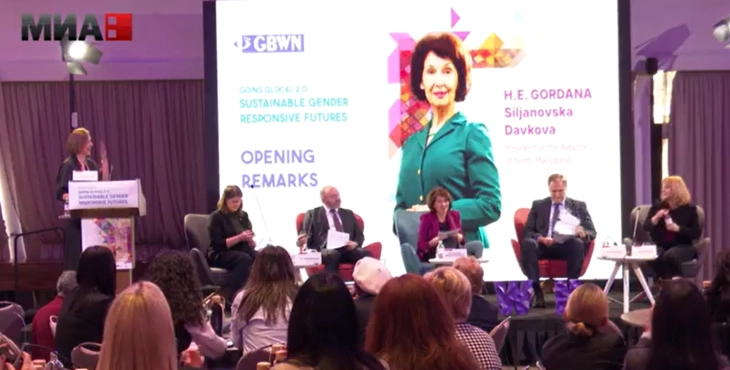
Skopje, 10 December 2025 (MIA) – Gender responsive budgeting is, in fact, good budgeting because it busts inequalities hidden behind budget lines and allows for a realistic assessment and equal distribution of public funds for the needs of women and men, President Gordana Siljanovska – Davkova said Wednesday in her remarks opening the international forum “Going Glocal 2.0: Sustainable Gender-Responsive Futures”, held in Skopje. The event is organized by the Center for Research and Policy Making (CRPM) as part of Gender Budget Watchdog Network – GBWN.
The Council of Europe, she said, defines gender responsive budgeting as mandatory inclusion of the gender perspective in all phases of the budgetary cycle.
“According to me, it’s not only a technical procedure, it’s also a tool to better create policies that offer transparency, accountability and justice in public consumption. Gender responsive budgeting is a transformative instrument allowing systemic change in the way the state sees, understands and settles social needs,” Siljanovska – Davkova said.
Today’s forum, according to the President, brings up a topic that isn’t gender neutral, but it’s crucial for the future – climate crisis.
“Women and men are facing different types of vulnerability: in agriculture, transport, healthcare or in tackling disasters. Therefore, effective climate policy requires deep understanding of these differences. If we don’t analyse the roles, needs and restrictions stemming from gender norms, we risk climate measures to create increasing inequalities.”
“Gender equality and climate resilience are the backbone of sustainable future. Finding sustainable solutions to these challenges will be of key importance for the governments in the entire region,” said Siljanovska – Davkova.
Marija Risteska, GBWN Regional Directress, in her remarks noted that governments publicly champions gender equality but without transparent gender responsive budget and budget practices.
“It means there is a risk of it remaining only a promise, which is why an oversight by civil organizations is necessary and GBWN provides a voice to those who are less included and marginalized,” she added.
Climate change, Risteska said, isn’t gender neutral and rural women, older women, Roma women, marginalized women aren’t equally affected by floods, heatwaves, power outages. This should be taken into consideration when making decisions related to climate change, she concluded.
Austrian Ambassador Martin Pammer said gender equality is necessary and key for transparency in public managements with public funds.
Austria, he added, is one of the strongest supporters of EU enlargement, primarily with Western Balkan countries, and one of the stages is climate financing in terms of climate change and social inequality.
Gender equality is not only a value, but also the driving force of progress, said Elisabet Dalberg Frisk, Deputy Ambassador of Sweden. Gender equality for Sweden, she said, is a core value of the Swedish domestic policy, which is also crucial for the EU integration process itself that is strongly supported by Sweden.
According to Andrej Lepavcov, head of the EU directorate at the Ministry of Foreign Affairs and Foreign Trade, said today’s event shows that our region has the capacity, willingness and vision to progress through policies that put equality at the center of its development.
He said that gender equality is the objective or every sustainable development process and no region can be competitive, resilient or innovative if half of its talent, intelligence and potential doesn’t participate equally.
Photo: printscreen