EU and US strike tariff deal, Trump and von der Leyen announce
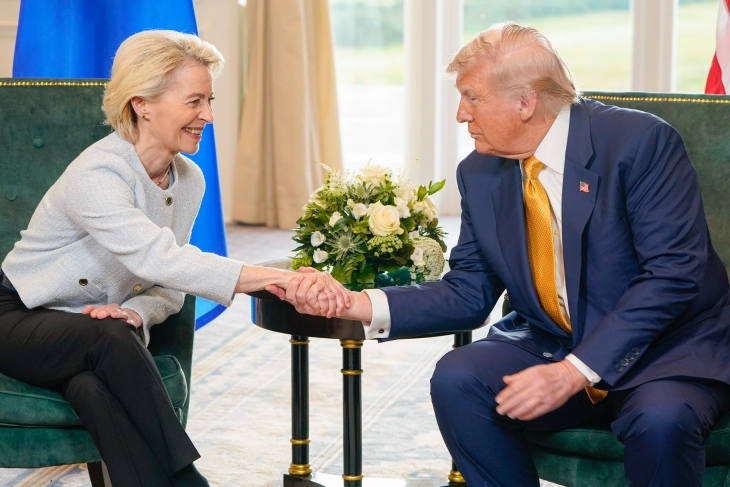
Turnberry, Scotland, 28 July 2025 (dpa/MIA) - The European Union and the United States have reached an agreement to settle a trade dispute over tariff hikes, European Commission President Ursula von der Leyen and US President Donald Trump announced on Sunday.
The tariff rate on most imports will be 15%, including for the automotive industry, according to Trump.
The EU will agree to buy $750 billion worth of energy from the US and invest an additional $600 billion in the US, the US president said.
He described the energy agreement as an important component of the deal. Tariffs on steel and aluminium imports will remain at 50%.
"Today's deal creates certainty in uncertain times. It delivers stability and predictability for citizens and businesses on both sides of the Atlantic," von der Leyen said after the meeting.
"We have stabilized on a single 15% tariff rate for the vast majority of EU exports," she said. "This rate applies across most sectors, including cars, semiconductors, pharmaceuticals."
"We have also agreed on zero-for-zero tariffs on a number of strategic products. This includes all aircraft and component parts, certain chemicals, certain generics, semiconductor equipment, certain agricultural products, natural resources and critical raw materials."
Von der Leyen said the energy purchases are to have a volume of $250 billion annually until the end of Trump's term as US president and is intended to replace remaining Russian fossil fuel imports.
There was great anticipation as to whether the talks would result in an agreement. Trump had threatened the European Union with tariffs of 30% on European imports starting August 1.
"It was tough, but in the end, as we were successful, it's good and it's satisfactory," von der Leyen said about the months-long negotiations.
The agreement aims to avoid even higher tariffs, after Trump had repeatedly threatened to impose high import levies on imports from the 27-member bloc for alleged trade imbalances and to pressure manufacturers to move production to the US. In addition, tariff revenues are intended to at least partially finance plans for major tax cuts.
The commission, which negotiated the agreement on behalf of EU member states, considers the tariffs unjustified and doubts their compatibility with the rules of the World Trade Organization (WTO).
EU countries pushing for compromise
Many capitals, including Berlin, have been pushing for a compromise with Washington to avoid an escalation of the dispute and to avoid even higher tariffs.
"Our goal is and remains to quickly reach a solution that facilitates trade with the United States and provides for lower tariffs again," German Chancellor Friedrich Merz had said previously.
Germany's large automotive sectors and steel and aluminium industries have been impacted by the tariff hikes.
Europe is not only economically dependent on trade with the US, but also heavily dependent on Washington's military capabilities.
Negotiations with the US were to some extent overshadowed by concerns that Trump could again question Washington's commitment to assist European NATO allies if the trade conflict were to escalate. Given the threat posed by Russia, this was seen as a major risk in eastern EU countries.
EU threatened retaliatory tariffs
Despite pursuing a negotiated solution, the EU was prepared to impose retaliatory tariffs on goods with a total trade volume of €93 billion ($109 billion) if talks with the US were to fail.
The listed products included industrial and agricultural goods such as motorcycles, beef, whiskey and citrus fruits.
In addition, EU export restrictions on certain products worth €4.4 billion were considered. These included steel scrap and chemical products, which US companies have been keen to import.
Photo: dpa