Siljanovska-Davkova: Preventing fragmentation of Macedonian society by relearning St. Clement’s virtues that sustain community
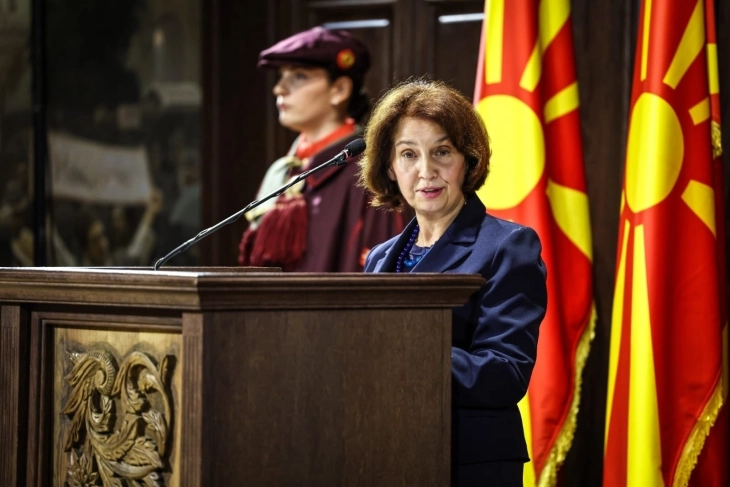
Skopje, 8 December 2025 (MIA) - Our task is to prevent the fragmentation of Macedonian society by reintroducing the virtues that uphold the community. Like in the time of St. Clement, we need a shared, higher purpose around which to build relationships and bridge differences. By upholding the rule of law, fighting corruption, and promoting social justice and mutual care, we can renew the social contract of free citizens, equal before the law and united for the common good, President Gordana Siljanovska-Davkova said late Sunday in her address at the ceremony marking the national holiday St. Clement of Ohrid, held tonight under her auspices.
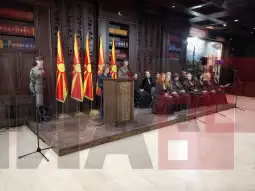
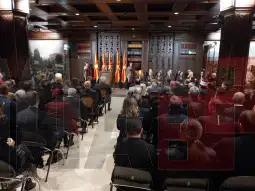
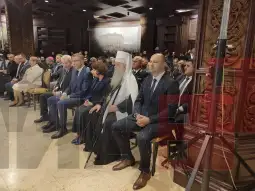
During the ceremony at the Museum of the Macedonian Struggle for Independence, attended by Prime Minister Hristijan Mickoski, the head of the Macedonian Orthodox Church – Ohrid Archbishopric Stefan, ministers, MPs, and public figures, she highlighted that St. Clement of Ohrid is Macedonia’s greatest educator and the most devoted disciple of Saints Cyril and Methodius. She noted that the memory of the Ohrid saint is etched not only in the collective memory of the Macedonian people but across all Slavic nations. His name, etymologically, evokes humility and mercy, and his life shows that he embraced these virtues as his second self and the essence of his identity. These virtues, universal and shared across many religions, form the foundation of St. Clement’s most significant and lasting achievements.
“St. Clement’s promotion of literacy allowed people to understand books and, through them, to better understand themselves. They learned that they are accountable not only for their own lives but also for the life of their community. They realized that the strong must protect the weak, and that personal well-being is linked to the common good. From Clement, people learned to care for widows, orphans, the sick, and the poor, to welcome strangers, and to preserve peace under all circumstances. By fostering a sense of shared ideas, values, and goals, St. Clement transformed the population into a community rooted in solidarity and guided by a moral compass, paving the way for a people capable of creating an authentic culture and pursuing a collective hope,” Siljanovska-Davkova said.
She reminded that the Ohrid Literary School educated 3,500 students who became teachers of the Slavic peoples, and that its scriptoriums produced exquisite manuscripts which, like time capsules, testify to the continuity of the Macedonian language. The Ohrid Archbishopric, she said, became not only a spiritual refuge for the people but also a protector of artists. Under its patronage, renowned builders humanized the space, creating in harmony with nature rather than against it. The brilliant painters, freed from the constraints of convention, became forerunners of the Renaissance. Skilled woodcarvers brought biblical scenes to life.
“We should not forget that the enduring values which have shaped European civilization are the result of lives marked by humility before God and compassion for others. This is why they have persisted for eleven centuries, outliving empires, dynasties, systems, and ideologies. Yet today, if we look around, how many of St. Clement’s values can we see in real life, in our daily interactions, at home, in schools, at work, or on the streets? I ask myself, and I ask you: Do we see them in politics, the economy, and the media? Does Macedonian society today embody the two virtues inherent in Clement’s name? Are we merciful? Do we live in peace? If we are merciful, why is there still so much cruelty among us? Why have we turned words of creation into tools for ad hominem attacks? Why, instead of coming together, have we split over the most important matters of national interest?” Siljanovska-Davkova asked.
According to her, we are among the last in Europe in terms of volunteerism, and we face an epidemic of discouragement and indifference, including toward personal and collective tragedies.
“I am aware that, in part, these conditions are due to decades of injustices we have faced as a people and as a state, particularly in our European integration efforts. Injustice breeds resentment, anger, distrust, pessimism, and cynicism. All of this undermines the foundations of Macedonian society. The example of St. Clement teaches us to resist these negative tendencies,” she said.
She spoke about the challenges of modern technology, mobile phones, digitalization, and artificial intelligence, which can lead to isolation, polarization, and alienation.
“I am not promoting digital asceticism. Digitalization is essential for building a developed European state with quality, transparent public services, a competitive economy, and a modern European education geared toward research and innovation. However, this must be accompanied by digital literacy and responsible use of technology. Without it, we risk becoming disoriented consumers in a world of videocracy and spectacle-driven democracy,” she said.
Without a common goal, there is no true community, only divided groups separated along political, ethnic, religious, or social lines.
“Some might say that seeking humility in an era of distraction and the tyranny of the urgent, when everything happens at once, is in vain. Or that seeking mercy in times of war and numerous economic, ecological, social, and security crises is pointless. Ahead of us lies a great task: to prevent the fragmentation of Macedonian society by re-teaching the virtues that sustain a community. Just as in the time of St. Clement, we need a shared, higher purpose around which we can build relationships and bridge differences. Through the rule of law and the fight against corruption, through social justice and mutual care, we can renew the social contract of free citizens, equal before the law and united for the common good… We should compete in goodness, serving the community and society. And in doing so, make the Macedonian state a decent place to live,” Siljanovska-Davkova said.

At the ceremony, addresses were also delivered by the head of the Macedonian Orthodox Church – Ohrid Archbishopric, Stefan, and the renowned Macedonian author Venko Andonovski.
Photo: MIA/ Siljanovska-Davkova’s Office