Nikoloski: Starting strategic projects on corridors, choosing Europe as partner in implementation
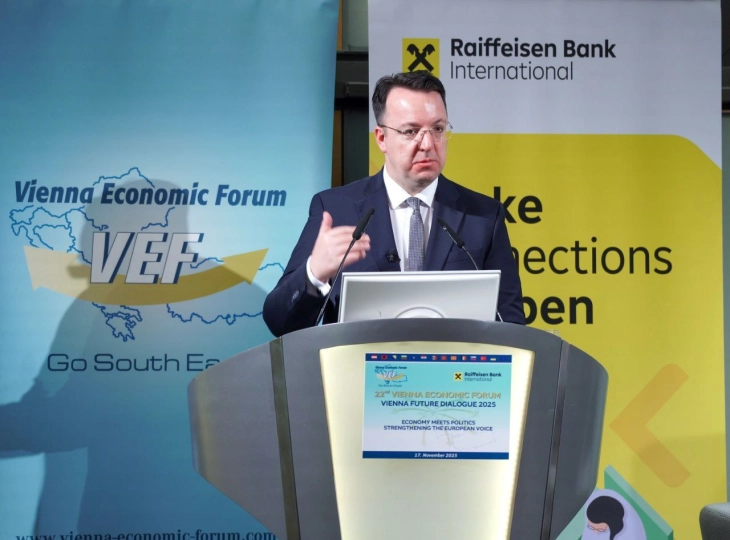
Skopje, 17 November 2025 (MIA) - Addressing a panel discussion as part of the Vienna Economic Forum on Monday, Deputy Prime Minister and Minister of Transport Aleksandar Nikoloski said the largest capital projects in the construction of road and railway infrastructure on the main transport Corridors VIII and X are currently being implemented in the country, noting that the Government has a vision to contribute to regional development, economic stabilization, and fast and reliable transport to Central and Southeast Europe through the development of infrastructure.
Presenting the capital projects, he pointed out that work is underway in the country on the construction of new highways on Corridor VIII, border crossings, as well as modernization of the highway along Corridor X. Nikoloski added that the challenge is development of the railway network through the construction of the high-speed railway on Corridor X, which will have a strong impact on international transport. He mentioned the railway connection with Bulgaria along Corridor VIII, on which he hopes that the activities launched will make it possible to have a regular line from Skopje via Sofia to Burgas by 2031. He also presented plans for a railway connection with Albania.
Nikoloski said that since the incumbent Government was elected in June 2025, it has adopted a very ambitious investment agenda and began developing Corridors VIII and X, making the most of the favourable geographical location even though it is landlocked. "We are lucky that one of the European corridors passes east of our capital Skopje - Corridor X, the longest pan-European corridor that starts in Athens, at the port of Piraeus, and ends in Finland, so that is the entire north-western European corridor, and the second is Corridor VIII, which connects the Ionian and Adriatic Seas with the Black Sea, it is the east-west corridor of Southeast Europe. This is a huge opportunity for us that we want to make the most of, and we have started very ambitiously with the development of these corridors," said Nikoloski.
He pointed out that the condition of the highway section of Corridor X from the border with Serbia to the border with Greece is good, unlike Corridor VIII where development has begun. In addition to existing ones, new highways are being built from the border with Albania to the border with Bulgaria. Work is also underway to reconstruct and upgrade the border crossings in order to reduce waiting times at the border crossings.
"The total investment in highways and express ways on Corridor VIII will be around EUR 1.5 billion, which is really something huge and significant for our economy. We are also developing Corridor Xd – the corridor that shortens the distance between Athens and Skopje. If it currently takes eight to eight and a half hours to travel, this will shorten it to five or five and a half hours. On our side, we are building the largest highway ever built in the country, about 55 kilometres, and on the other side, the Greeks are also building and that is the missing piece of the puzzle, so I hope that travel from Vienna to Athens will take at least three hours less," said Nikoloski.
The railway, he pointed out, is a huge challenge, and a huge opportunity at the same time.
"We have a vision that I was very vocal about when we were in opposition. I remember that in 2022, when Friends of Europe elected me as the most influential person under 40, and now unfortunately over 40, I spoke about this, and it was a completely new story for most of the European metropolises, including Vienna. By developing the railway Corridor X, the high-speed railway, we can shorten the supply time for Europe from 21 to 24 days," Nikoloski said.
He stressed that the Government has an ambitious program to build a high-speed railway.
"There is already a high-speed railway between Athens and Thessaloniki. Between Belgrade and Budapest, it will be operational as of spring, Budapest-Vienna is more or less a good infrastructure and what we are missing is Belgrade-Nish-Skopje-Thessaloniki. We already have an agreement with our Greek friends, I met with the Deputy Prime Minister of Greece a month ago, they will build the part they are missing, from Thessaloniki to our border, and we will start building our project in spring next year. It will be the largest project in Southeast Europe, although we are one of the smallest countries in that region. The investment will be around EUR 2 billion," said Nikoloski.
He pointed out that the country had chosen Europe as a partner in the implementation of strategic projects on transport corridors.
Since we are not EU members, the Deputy PM pointed out, we had two alternatives: "Sign an agreement with the Chinese, it's no secret that they came on the first day the Government took office, and they offered an interest-free loan if we build with them. But we thought that it was of vital importance for Europe, because the corridors, especially the railway ones, use very innovative signalling that can be used for other things, besides railways, and we decided to sign a strategic partnership agreement with Great Britain."
He stressed that the railway section of Corridor VIII, which is very important for security and politics, is also under construction, noting that last week an agreement was signed with Bulgaria for the construction of the cross-border railway tunnel.
"I expect good progress. We have three sections to connect the capital with the border with Bulgaria. The first is already in operation, since January this year, the second will be ready in October next year, and the third, we are cooperating with the European Investment Bank and the European Bank for Reconstruction and Development and I hope that the changes will not take much time, because I gave a political promise that I will announce the tender in December, but it depends on how long the market research will take. I hope it will not be three months and that we will be able to announce the call in December, so I will be able to invite you in the spring at the cornerstone laying ceremony for the third section of the highway that should connect us with Bulgaria," Nikoloski pointed out.
On our part, he noted, we are investing around EUR 800 million, the Bulgarians are investing EUR 1.2 billion, i.e. we will spend in total around EUR 2 billion together to connect Skopje and Sofia – something that has been a dream of many generations, something we learned about in school.
Nikoloski hopes that Albania will also join the investment cycle so that the connection makes sense.
"The next challenge is to develop the western wing of the railway and for Albania to do the same, so we hope that by 2031 we will first have a regular line from Skopje via Sofia to Burgas, and then, depending on our Albanian friends, to connect the Ionian Sea as well," said Nikoloski.
Photo: Ministry of Transport