Mucunski calls for long-term NATO and EU strategy to fully integrate Western Balkans
Skopje, 26 November 2025 (MIA) - The Western Balkan region is seeing intensified actions by malign actors attempting to disrupt democratic processes through economic pressure, political influence, and disinformation. Anti-Western narratives in some areas aim to undermine trust in institutions and challenge the region’s European and Euro-Atlantic path. These developments demand a sustained, coordinated response from NATO and the EU. We call on NATO and the EU to adopt a long-term strategy for the region that ensures full integration of Western Balkan countries into their structures.
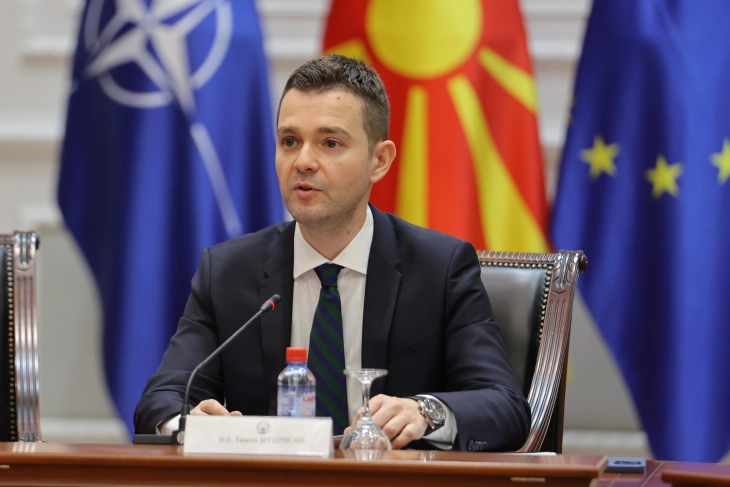
Minister of Foreign Affairs and Foreign Trade Timcho Mucunski said this on Wednesday at the opening of the regional conference titled “Navigating Multipolarity: Strategic Policy for NATO, the EU and Southeast Europe” organized by the Konrad Adenauer Foundation in cooperation with the Ministry of Foreign Affairs and Foreign Trade with support of our sister foundation from Brussel, the Wilfrid Martens Centre for European Studies.
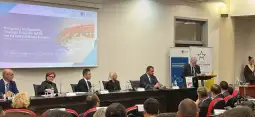
Speaking at today’s event, Mucunski expressed his belief that it would allow us to think with a clear purpose: how to strengthen Euro-Atlantic security at a time when risks are higher than at any other turning point.
“Today, we live in a geopolitical environment where threats are dynamic, interconnected, and often unpredictable. Russian aggressive militarism, reinforced by hybrid and kinetic threats directed at allies, the ongoing threat of terrorism, the systemic challenge posed by China’s rise, as well as hybrid operations and cyberattacks, are redefining the strategic framework on which NATO bases its policies and responses. These factors are not only security challenges but also a fundamental diplomatic challenge for preserving the rules-based international order,” Mucunski said.
The war in Ukraine, Mucunski said, is the most serious challenge to European and Euro-Atlantic security since the Cold War.
“Moscow’s revisionist goals, supported by its enablers, call for a clear, coordinated, and principled response grounded in unity and long-term strategic alignment. Together with our allies, we are coordinating diplomatic, political, and defence efforts to ensure sustainable and credible support for Ukraine while promoting efforts toward a just and lasting peace. These two objectives are complementary, not opposed. We welcome the efforts of the United States and the administration of President Trump, as well as other European allies, to establish processes leading to a long-term peaceful solution for Ukraine,” he said.
However, Mucunski noted, four years after the onset of the invasion, the consequences for European stability are considerable, and in such context, it is the responsibility and a top priority for all democratic nations to show unity and determination.
"The Alliance’s response, through Operation Eastern Sentry, sends a strong message about NATO’s credibility: that every part of allied territory will be protected without exception. In addition to our strengthened military contributions in our region, in the KFOR mission in Kosovo, and the ALTHEA mission in Bosnia and Herzegovina, our country proudly contributes to strengthening NATO’s eastern flank through the presence of our forces in Latvia, Romania, and Bulgaria. This demonstrates that even small allies play a key role in collective security. At the same time, we remain committed to further supporting Ukraine according to our capacities and capabilities. We do this continuously with 15 aid packages already delivered, as well as through training and exercises for Ukrainian forces,” Mucunski said.
At the same time, as Mucunski said, we are also facing a long-term systematic challenge posed by China.
“Their economic growth, technological ambitions, non-transparent military capacities, and specific ties with Russia require careful assessment, coordination, and a unified response within NATO and the European Union. Building joint resilience in energy, critical materials, and infrastructure is becoming a key component of our collective security,” Mucunski noted.
“We must also address threats related to the Middle East, climate change, unstable social developments in countries of the region, migration, as well as the misuse of hybrid tools, cyberattacks, and disinformation operations, all of which are among the challenges contributing to the instability of this important region for all of us in Europe,” he added.
“In a time of global turbulence, strategic unity is not a political choice but a security necessity. Our collective strength stems from solidarity, predictability, and consistency in our policies. I am convinced that now is the moment to demonstrate strategic vision, an integrated approach, and political determination that will ensure a stable and prosperous future for the entire European community,” Mucunski said.
The conference brings together stakeholders and experts in the field of security and international relations from the country, the region as well as the EU, in order to exchange views and to discuss the current challenges for NATO, the EU and the region in light of the constantly changing geopolitical environment.
The event will also feature addresses by NATO Deputy Secretary General Radmila Shekerinska (via video message), U.S. Ambassador Angela Aggeler, German Ambassador Petra Drexler, Deputy Speaker of Parliament and MP Antonio Miloshoski, and Croatian Parliament Member Zdravka Bušić.
As scheduled, the conference will also include the launch of the publication “Navigating multipolarity: Southeast Europe in the EU’s China Strategy”, published by the Konrad Adenauer Foundation, the Wilfried Martens Centre for European Studies, and the Think-Tank ESTIMA. The study examines the stance of Southeast European countries toward China in light of current global geopolitical dynamics.
Photo: MIA