EC Autumn Economic Forecast: Macedonian GDP to accelerate over next two years
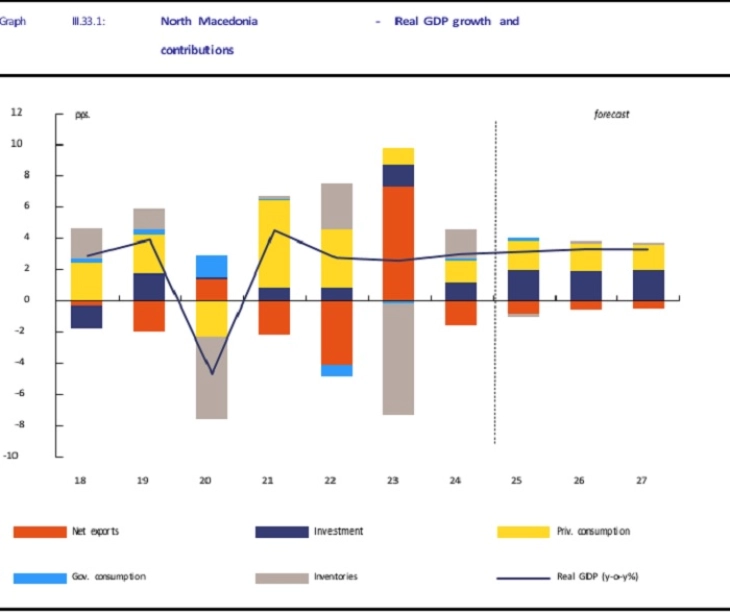
Brussels, 17 November 2025 (MIA) - In the first half of 2025, annual GDP growth picked up to 3.2 percent on average and is projected to
continue to accelerate over the next two years, driven by investment and private consumption, reads the European Commission's Autumn 2025 Economic Forecast released on Monday.
"Despite strong public revenue performance in the first nine months of 2025, reaching the 2025 deficit target of 4 percent of GDP poses a challenge as current spending was higher than initially planned. The deficit is projected to decline gradually but will remain above 3 percent of GDP," reads the forecast.
According to the EC, economic activity was largely driven by investment and private consumption in the first half of 2025, with public consumption remaining flat after significant increases in 2024.
"Household consumption growth picked up from its sluggish performance in 2024, supported by rising real disposable incomes driven by strong pension and wage growth, household credit expansion and easing inflation," reads the forecast.
The EC notes that private consumption is likely to remain robust in 2026 and 2027, with disposable income gradually increasing further, though at lower rates, given some projected abatement in the rise of wages and pensions.
"Gross investment is likely to be the main contributor to growth. Public works on Road Corridor 8 and 10d started in 2025, and their contribution to economic growth is expected to peak in 2027. Private investment benefits from improving sentiment and subsidised funding through loans from Hungary and EIB credit lines," reads the document.
It adds that exports and imports performed better in the first half of 2025 than projected in the spring.
"Even though North Macedonia’s trade links with the US are limited, it is exposed indirectly through its exports of automotive components to Germany, and there was likely some trade frontloading in the first half of the year," says the EC.
Although export growth is projected to slow after a strong first half, and imports rise to meet domestic demand, the negative impact of the external balance on growth is expected to diminish.
The document notes that headline inflation has been rebounding since September 2024.
"This was initially driven by rising food prices, temporarily broken by the government’s price controls at the beginning of 2025, which included limits on gross profit margins of basic food products and expired in April. In 2025, inflation became mainly driven by domestic factors—rising wages and credit
growth—rather than by food and energy prices. This was reflected in the rebounding of headline inflation excluding energy and food over the summer," reads the forecast.
Inflation is projected to be higher in 2025 than previously expected but is set to decline to the central bank’s target of 2 percent by 2027, aided by a more restrictive fiscal policy.
"The central bank lowered the key policy rate in several steps from 6.3 percent in September 2024 to 5.35 percent in February 2025," notes the document.
It adds that despite sustained employment growth in the first half of 2024, and declining unemployment, in particular among women, inactivity among the working-age population remains high.
"Gross nominal wages rose by 12.9 percent in 2024, driven by higher minimum wages, collective agreements and labour shortages in many sectors, but wage growth calmed somewhat in the first half of 2025. Against this background, employment growth is likely to remain subdued, until major structural challenges, such as low labour market participation, are addressed," says the EC.
The Commission says that while tax income increased strongly in the first nine months of the year, a budget revision was needed in July, as current spending spiralled above initial plans in an election year.
"The revision lifted projections for both revenue and spending without raising the deficit target of 4 percent of GDP. Revenue was adjusted for a previously unbudgeted transfer of central bank profits to the government. Spending was increased for pensions, wages, and goods and services. Public
investment has been low in the first three quarters of 2025, raising concerns that unused funds might be redirected to current spending to reach the 2025 deficit target," reads the forecast.
The deficit is projected to decline gradually over the next couple of years, driven by more restrained increases in public sector wages and pensions, focused social spending and robust revenue increases in line with economic growth projections.
"However, meeting the new deficit rule of 3 percent of GDP by 2027 seems unlikely if the government does not outline specific consolidation measures. The government has high financing needs in the forecasting period, amounting to 10-12 percent of projected GDP annually, with a major repayment for a 2020 Eurobond (EUR 700 million) due in June 2026," notes the EC.
It says the short-term growth outlook could be negatively impacted by weaker than expected domestic demand resulting from lower household spending due to a renewed flare-up in inflation – such as through sustained wage growth or fiscal slippages.
"Ongoing public infrastructure works and their projected positive repercussions on the domestic economy might be compromised due to implementation problems. Conversely, swift completion of structural reforms, as agreed under the EU’s Growth Plan, would improve prospects for productivity and growth," concludes the EC Autumn Economic Forecast.
Photo: Screenshot, MIA