123rd anniversary of Goce Delchev's death

Skopje, 4 May 2026 (MIA) — The country is marking the 123rd anniversary of the death of Macedonian revolutionary and freedom fighter Goce Delchev.

Numerous delegations and citizens are gathering to lay flowers and pay respects at Delchev’s tomb at the Church of St. Spas. The Macedonian Orthodox Church will hold a memorial service at the church, which will be attended by Prime Minister Hristijan Mickoski.
A parliamentary delegation including Velika Stojkova Serafimovska and Fatmir Bytyqi is also scheduled to lay flowers at Delchev's tomb.

To commemorate the anniversary, the government is hosting a panel discussion titled "The Foundation of Statehood: A Vision for the Future." Participants include Minister of Education and Science Vesna Janevska, Minister of Foreign Affairs and Foreign Trade Timcho Mucunski, Minister of Culture and Tourism Zoran Ljutkov and National University Library director Jovica Nikchevski.
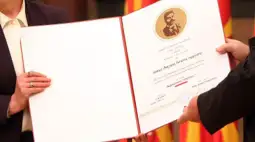
In a special ceremony at noon, Parliament will present the 2026 Goce Delchev State Award, which recognizes significant scholarly achievements. This year’s recipients are professors Mihajlo Markovikj and Sonja Novotni for their work titled "Continuity of the Macedonian Language I."

In Shtip, Goce Delchev University and the Municipality of Shtip will hold their traditional memorial event in the courtyard of the university rectorate in Novo Selo. The event will open with the Macedonian anthem performed by the Music Academy’s academic choir, conducted by Toshe Mitrev. It will also feature a folk instrument recital by students of Marjan Jankoski. The event will end with a flower-laying ceremony at Delchev’s memorial bust.

Delchev, who famously envisioned the world as a "field for cultural competition among nations," was killed by the Ottoman Army on May 4, 1903, in the village of Banica.
Born in Kukush on Feb. 4, 1872, Delchev was educated in Thessaloniki and Sofia before becoming a teacher in Shtip. As a central figure in the anti-Ottoman resistance, he helped build a network of revolutionary committees, represented the Internal Macedonian Revolutionary Organization at its Thessaloniki Congress in 1896 and served as a foreign representative of the organization in Sofia until 1901.
His remains were moved several times following his death — from Banica to Xanthi to Sofia — before being permanently interred at the Church of St. Spas in Skopje on Oct. 11, 1946. mr/


