Religious calendars
11 November 2025 (MIA)
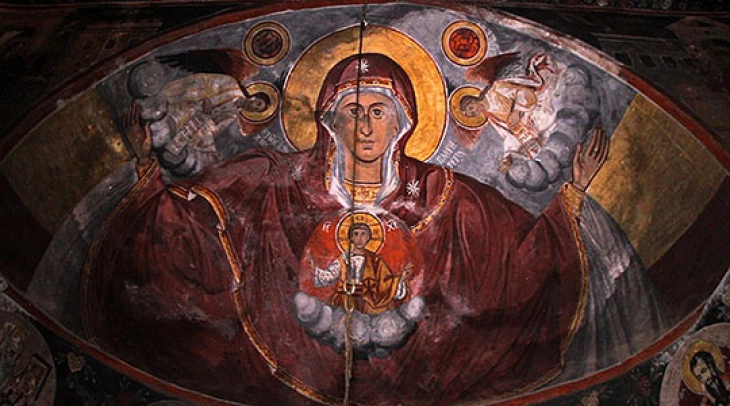
Macedonian Orthodox Church Calendar
Our Holy Mother, the Martyr Anastasia the Roman
She was born in Rome of well-born parents and left an orphan at the age of three. As an orphan, she was taken into women’s monastery near Rome, where the abbess was one Sophia, a nun of a high level of perfection. After seventeen years, Anastasia was known in the whole neighbourhood, to the Christians as a great ascetic and to the pagans as a rare beauty. The pagan administrator of the city, Probus, heard of her and sent soldiers to bring her to him. The good Abbess Sophia counselled Anastasia for two hours on how to keep the Faith, how to resist flattering delusion and how to endure torture. Anastasia said to her: ‘My heart is ready to suffer for Christ; my soul is ready to die for my beloved Jesus.’ Brought before the governor, Anastasia openly proclaimed her faith in Christ the Lord and, when the governor tried to dissuade her from the Faith, first with promises and then with threats, the holy maiden said to him: ‘I am ready to die for my Lord, not once but – oh, if it were only possible! – a thousand times.’ When they stripped her naked, to humiliate her, she cried to the judge: ‘Whip me and cut at me and beat me; my naked body will be hidden by wounds, and my shame will be covered by my blood!’ She was whipped and beaten and cut about. She twice felt a great thirst and asked for water, and a Christian, Cyril, gave her a drink, for which he was blessed by the martyr and beheaded by the pagans. Then her breasts and tongue were cut off, and an angel of God appeared to her and upheld her. She was finally beheaded with the sword outside the city. Blessed Sophia found her body and buried it, and Anastasia was crowned with the wreath of martyrdom under the Emperor Decius (249-251).
Catholic calendar
Saint Martin of Tours
Born in 315 or 316 in Pannonia, a Roman province that includes modern Hungary, Martin came into a world in transition. Christians were no longer persecuted by the Roman empire but Christianity was still not accepted by all. Martin’s father, a Roman army officer who had risen through the ranks, remained faithful to the old religion and suspicious of this new sect, as did Martin’s mother. Therefore it was Martin’s own spiritual yearning and hunger that led him to secretly knock on the door of the local Christian church and beg to be made a catechumen — when he was ten years old. In contemplative prayer, he found the time to be alone with God that he ached for. In the discussion of the mysteries, he found the truth he hoped for. Martin died when he was over 80 years old on November 8. Historians disagree on the year and place it anywhere from 395 to 402. His feast is November 11, the day he was buried, at his request, in the Cemetery of the Poor.