One in three citizens gives bribes for various purposes: report
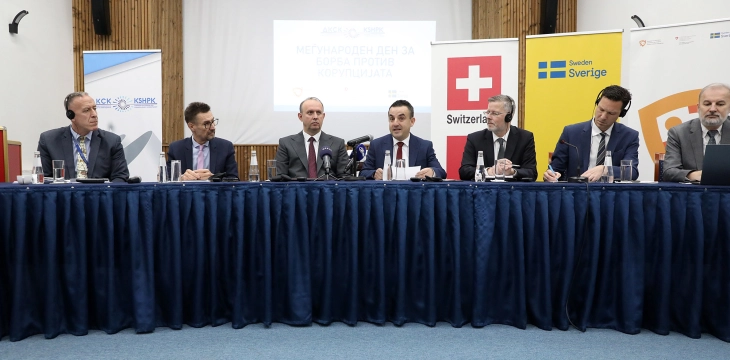
Skopje, 4 December 2025 (MIA) - One in three Macedonian citizens gives bribes for various purposes, shows the latest report on the perception of corruption by the Macedonian Center for International Cooperation (MCIC), ahead of December 9-International Anti-Corruption Day.
MCIC director Aleksandar Krzhalovski said that unlike previous years, when corruption was perceived as the primary problem in society, it now comes second, while adding it is "a difficult problem, widespread and unfortunately broadly accepted."
The report, which is set to be released in full in the coming days, says that 37 percent of citizens were asked to a give bribe, with 31 percent giving the bribe for various purposes.
Judges and prosecutors find themselves at the bottom of the list of trusted individuals, with the judiciary the least-trusted institution. Trust in lawmakers and politicians is low but the Parliament is perceived as a trusted institution.
Regarding institutions fighting corruption, the State Commission for Prevention of Corruption (SCPC) is trusted by 32 percent of respondents, while the trust in the Ministry of Interior has risen to 50 percent.
Deputy Head of the EU Delegation, Ben Nupnau, highlighted the Union's continued support to the country in the fight against corruption for the rule of law, adding that political leaders play a key role in the process.

"The fight against corruption requires strong political commitment and continued work, using a top-to-bottom approach, across the entire political spectrum and all institutions, in the society as a whole," said Nupnau.
He added that no country is immune to corruption, while referring to the latest developments in the European Union, with former European Commission vice-president Federica Mogherini and former executive secretary general of the European External Action Service, Stefano Sanino, suspected of corruption.
"Rule of law and fight against corruption are fundamental in the EU accession process," said Nupnau and referred to the recent Progress Report that noted no progress in the country's fight against corruption for the third year running.
After the elections, he added, the country needs to show progress in implementation of reforms, adopt a new Criminal Code and observe international standards in the field.
"Political stakeholders must refrain from interfering in the judiciary," said Nupnau and stressed that courts, prosecutor's offices and other bodies should get sufficient funds to efficiently do their job.
Swiss Ambassador Christoph Sommer said corruption remains to be a point of concern, being a societal phenomenon that hinders sustainable development.
"The fight against corruption requires a systematic approach. Corruption contributes to the citizens' lack of trust in institutions. Certain progress has been noted in recent years, but fundamental changes are needed to build mechanisms for prevention of this phenomenon," said Ambassador Sommer.

Swedish Ambassador Ola Sohlström said his country is strongly committed to the need for continued prevention of corruption.
"Corruption is a disease of the society, it sucks resources from health, education, reforms, better life, investments, people, economy, future. That is why it is essential to not do this once a year or partially," said Ambassador Sohlström and added that every day should be anti-corruption day.
Photo: MIA