Nikoloski opens Vienna Economic Forum: Economic cooperation, investments, and prosperity policies needed as regional development priorities
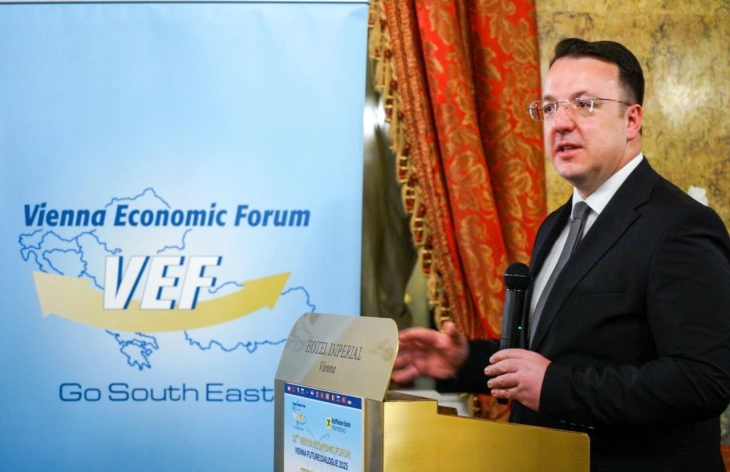
Skopje, 17 November 2025 (MIA) – The Western Balkan countries need stronger economic cooperation, more investments, expanded trade exchange, and larger business presence, key factors for advancing democracy, prosperity, the rule of law and regional cooperation. No one expected that, in the 21st century, a war would break out on European soil, instead of discussing economic matters, we are discussing conflict. This is a warning to all of us, Deputy Prime Minister Aleksandar Nikoloski said in his speech at the opening of the 22nd Vienna Economic Forum.
He underlined that the perception of the advantages of EU membership remains high, yet he cited Macedonia as an example of continued uncertainty on the path toward accession. He added that economic cooperation is a key element for stabilizing relations and fostering cooperation among the states.
The Deputy Prime Minister’s full speech follows:
“Thank you for the invitation and the opportunity to speak. I’d like to start with most pressing issue today – what is happening in Europe. The Federal Minister mentioned that she was born in 1994, and Austria joined the EU in 1995. My story is a little different: I was born in 1984, and by the time I was in high school, our country became the first in the region to sign the Stabilization and Association Agreement, as it was called then, and became an associated member of the EU. Since that time, we have had agreements on free trade, freedom of movement and more. By 2008, during my first term as the youngest MP in Parliament, we received the first recommendation to start accession negotiations. In 2009, we received the first veto on opening those negotiations, and that veto still continues.
First it emerged at our southern border, and now it has come from the eastern border. Unfortunately, we are confronted with the very situation Winston Churchill described during World War II: ‘The Balkans generate too much history, and Europe cannot process it.’
I think no one believed that in the 21st century there would be war on European soil. I also think that the perception that only positive things would happen in Europe, that there would be constant economic growth, that we would only talk about issues like food, created room for the European Union to be relaxed, to let the process run by itself: if it happens, fine; if it doesn’t, no problem. Of course, we are all part of the continent, and now I am speaking about the entire Western Balkans. But what happened in 2021, I consider a warning for all of us, because we thought we had left certain things behind, and they are coming back to us. We are once again talking about nuclear tests, missile systems, radars, drones, anti-drone systems, we are talking about war, about millions of lives lost so far, which brings us to the reality that the European continent represents only a small part of freedom, democracy, and economic prosperity. Unfortunately, some of the major players perceive the world differently from us, they do not share our values or common goals, they do not live as we do, and they prefer conflict over prosperity. Therefore, I believe that if we need to ask which the weakest part of the European continent is, some might say Georgia, some Moldova, but I would say it is the Western Balkans.
And that is why I believe focus is very important - a clear focus and a clear vision. What worries me, and I will be honest, is that we might wake up in 2029, here, if you invite us, and still be talking about enlargement, saying it will be good and that it will happen. This is not the first time we have been in this situation, hoping for momentum. In 2000 there was the Thessaloniki Summit, then in 2007 when Bulgaria and Romania joined, we were told we were next. Not to mention all the open windows we have heard about and all the key moments. The positive aspect is that energy in the region is still high, public opinion favors EU accession, and other powers are still not competing with the EU. But the question is whether that will last forever, and that is why I believe we need to be wise and brave, but also speak openly, directly, and fairly: if there is no enlargement, then let us see what will happen; if it is a package, then we should discuss whether it can work or not. It is better to tell people the truth than to constantly lie to them, make false promises, or raise expectations that will not be fulfilled. That is why I believe economic cooperation is at the core of the region’s priorities.
I am not speaking as the Chair of the Government’s Economic Council or as Deputy Prime Minister or Minister of Transport, but also as someone with experience in this world. That’s why I believe that the most important thing is the economic growth of the region. We can see a large number of people leaving the region. Let me give you a small example: one month ago we had local elections, and some municipalities do not have a mayor because they could not reach the 33% voter turnout threshold. Why? Most of the people are not here, they have moved to Central or Western Europe. That is why I believe it is important to focus on the economy. Austria plays a huge role in the region. Many Austrian companies are present here, they operate well, and they are welcome. I believe this is the best thing we can do together - to bring in more investments, to increase trade, to have more businesses, which I think will in turn contribute to other shared goals: democracy, prosperity, the rule of law, and cooperation among us. We will discuss more tomorrow. Once again, thank you very much; it is truly an honor and a great opportunity. I also thank everyone and wish us all success and fruitful discussions.”
Link to the video: https://we.tl/t-NnMKsG0q6o
Photo: Ministry of Transport