Kawahara for MIA: Nine global companies of Japan to join March 11 business seminar, boosting potential Japanese investment in the country
Skopje, 8 March 2026 (MIA)
Ana Cvetkovska
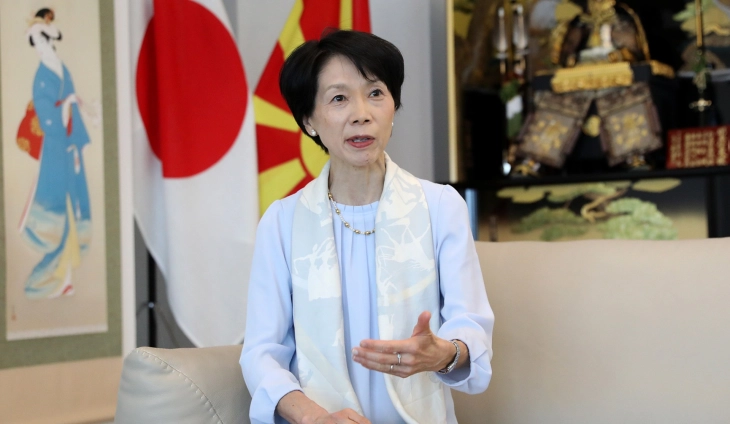
Over the last thirty years, North Macedonia and Japan have steadily developed bilateral ties, supported by political dialogue, development assistance, cultural programs, and economic collaboration. However, trade growth and Japanese investment remain below their potential, largely because of insufficient communication between the business sectors. In an interview with MIA, Setsuko Kawahara, the fourth Japanese ambassador to North Macedonia, discussed prospects for business cooperation and the entry of Japanese companies into the Macedonian market.
Kawahara announced that the Japan–North Macedonia business seminar will be held on March 11. She said it will be a valuable opportunity to establish new and close business cooperation between the business communities of both countries. Nine global companies of Japan will participate in the event, including Mitsubishi and Hitachi.
The Japanese ambassador also spoke about North Macedonia’s EU integration and that of the wider region, as well as the recent geopolitical upheavals following developments in the Middle East.
She noted that Japan supports North Macedonia’s EU integration as part of a broader strategy to strengthen a stable and strong EU.
- Japan concluded the Economic Partnership Agreement with the EU in 2018, which greatly promoted trade and investment. However, Japan considers EU not just a trade partner, but a reliable strategic partner based on our shared values, such as rule of law and democracy. Therefore, both sides maintain extremely close cooperation and coordination both in global politics and economy and work together in overcoming global challenges. The reason why Japan consistently and strongly assists EU accession of the Western Balkan countries including North Macedonia, is, simply put, Japan needs a strong and stable EU in such a turbulent world. Without doubt, the integration of North Macedonia into EU will be a great benefit for North Macedonia, EU as well as Japan-ambassador pointed out.
In the context of the latest developments in the Middle East, she noted that they have been paying great attention to the recent developments in the Middle East and making diplomatic efforts to prevent escalation in coordination with other countries.
- Peace and security in the Middle East is essential for stable supply of energy as well as the maintenance of the global non-proliferation regime. Non-proliferation is extremely important for Japan, as North Korea, our immediate neighbor, has been developing nuclear weapons and ballistic missiles against a number of the UN Security Council resolutions. In view of the cooperation of North Korea with Russia in the Ukraine War, it is evident that we can’t separate the security situation in Europe and Indo-Pacific, she noted.
She underscored that facing increased global security challenges, they need to strengthen their cooperation among countries which share the basic common values, such as rule of law and democracy.
In the interview with MIA, the ambassador also highlighted Japan’s development assistance, through which numerous projects have been implemented in North Macedonia in health, education, and environmental protection. She also commented on Japan’s support priorities, including sustainable tourism, the green transition, and natural disaster risk management.
In the interview, Ambassador Kawahara also touched on cultural diplomacy, the study of the Japanese language, and the Macedonian public’s interest in Japanese culture and traditions. She further discussed the role of women’s leadership and the representation of women in politics and society.
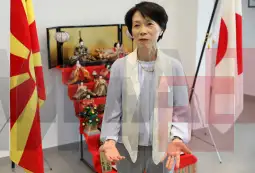
The full interview with Japan’s Ambassador to North Macedonia, Setsuko Kawahara, is presented below:
Your Excellency, two years ago Japan and North Macedonia marked the 30th anniversary of the establishment of diplomatic relations. How would you assess the overall development and current trajectory of bilateral relations over the past three decades? Which areas, in your view, still hold untapped potential?
I am glad to say that our relationship experienced remarkable development in a variety of fields. Concerning international politics, both countries share the common basic values and closely coordinate each other through periodical policy consultations. The most recent consultation was held on 17 February between State Secretary Kuzmanovska and the Japanese counterpart, which I found extremely meaningful and constructive. In addition, our assistance for capacity development through JICA (Japan International Cooperation Agency) have been making great contribution to reform and development of this country and is highly appreciated. Furthermore, a great number of cultural events were held in 2024 to celebrate the 30th anniversary of our diplomatic relations. This anniversary greatly increased the visibility of Japan in the country, strengthening our bilateral ties. What I wish more is to facilitate trade and investment between both countries.
In 2018, Japan launched an initiative to enhance cooperation with the Western Balkan countries that are not members of the European Union, including North Macedonia. Despite this framework, there have been no significant Japanese direct investments in the country to date. What factors most strongly influence Japanese companies when considering investment decisions, and how would you assess their current level of interest in the Macedonian market?
In general, global companies carefully observe business environment, investment conditions as well as political stability. One of the reasons for lack of major investment from Japan, in my view, may be explained as lack of communication and exchange between two business communities. Without such communication and regular information exchange, it is difficult to find reliable business partners and to identify in which field business chance is available.

During your recent address on the occasion of Japan’s National Day, you announced a Japan–North Macedonia Business Seminar. Could you elaborate on the objectives of this event, the sectors that will be prioritized, and whether you expect it to generate concrete partnerships or investment opportunities?
As I explained, in order to make a breakthrough, I am convinced that we need to start with creating network between the business communities of both countries. In fact, many large companies of Japan made direct investment in the neighbouring countries, such as Serbia and Czech Republic and established branch offices there. Most of them are responsible for the entire region including North Macedonia. That’s why I invited them to come to Skopje and present their activities as well as business interests. It would be a precious occasion to establish a new and personal business network. Nine global companies of Japan such as Mitsubishi and Hitachi are participating in the event, the seminar will be held from 2PM, on 11 March, in Hotel Holiday Inn. If you wish to participate, please register by email at contact@sk.mofa.go.jp
Through the Japan International Cooperation Agency (JICA) and the Grant Assistance for Grassroots Human Security Projects (GGP), Japan has supported numerous initiatives in healthcare and environmental protection. What will be the key priorities of Japan’s development cooperation in the coming years? Are new areas such as digital transformation or the green transition being considered?
As for the Grant Assistance of our Embassy, we continue to cooperate in the field of health, education and environment. We have implemented nearly 200 projects across the country, and we are now paying special attention to challenges, such as wildfire and waste management. Therefore, we recently decided on donation of fire-fighting vehicles and waste collection vehicles for vulnerable municipalities. JICA’s assistance covers a variety of fields, and I can refer to three important projects which started last year or start this year. They are projects for sustainable tourism, sustainable agriculture and emergency medical care. I believe that these sectors are of crucial importance for the development of North Macedonia.
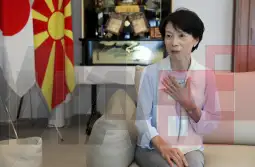
North Macedonia received a Silver Award at Expo 2025 Osaka Kansai in the category “Shared Pavilions (Type C) – Improving Lives.” To what extent do global platforms such as this contribute to advancing economic diplomacy and enhancing a country’s visibility among Japanese and international audiences?
I wish to extend my heartfelt congratulations to the EXPO team of North Macedonia for their great success in presenting its culture and society. It contributed to increasing the visibility of North Macedonia both in Japan and in the world, as nearly 30 million people visited the EXPO site from all over the world. North Macedonia also dispatched groups of artists to conduct cultural performance such as traditional dance and opera. The performance fascinated a huge audience. I hope these cultural events increased interests of Japanese and foreign visitors to the country’s rich culture and history.
Japan possesses extensive expertise in disaster risk reduction and resilience. In light of climate change and growing environmental challenges, is there scope for enhanced bilateral cooperation in disaster prevention, early warning systems, and crisis management?
JICA has been assisting CMC (Crisis Management Centre) in the field of disaster reduction for many years. Through cooperation with experts of both countries, they could establish an early detection and prevention system of wildfire, and this system is being shared with the neighbouring countries as a success model. As is pointed out, climate change is an enormous challenge for the entire world, and the new project of JICA for sustainable agriculture is exactly intended to mitigate negative impacts of climate change in agriculture by development of integrated policy and an adequate administrative structure.
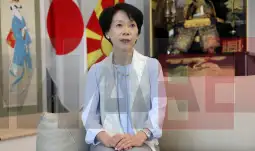
Cultural diplomacy represents an important pillar of Japan’s engagement in North Macedonia — from film festivals and origami workshops to Japanese language course. How would you assess the receptiveness of Macedonian society to Japanese culture, and where do you see the greatest potential for deepening people-to-people exchange?
It was a big and lucky surprise for me that so many people in this country showed great interest in Japanese culture. All the cultural events organised by our Embassy receive great resonance. Not only Manga or Anime, but also traditional music, Japanese cuisine, Matcha and even martial arts such as Judo and Karate were loved by many citizens, young and old. This year our Embassy is going to present unique facets of Japanese culture, such as Bunraku, Japan’s traditional puppet theatre developed in 17th century, which was inscribed as UNESCO intangible heritage. A special exhibition is also being planned to feature the diversity and landscape and architecture of all the prefectures of Japan. We also identified huge demand for learning Japanese. Just after we announced an opening of a new Japanese language course, it was immediately full. Through learning Japanese, you can understand culture, custom, society and philosophy. I hope that those who learn Japanese in North Macedonia would facilitate our people-to-people exchange.
Japan has consistently expressed support for North Macedonia’s European integration, what message does Japan convey to North Macedonia and the whole region considering reforms in different areas?
Japan concluded the Economic Partnership Agreement with the EU in 2018, which greatly promoted trade and investment. However, Japan considers EU not just a trade partner, but a reliable strategic partner based on our shared values, such as rule of law and democracy. Therefore, both sides maintain extremely close cooperation and coordination both in global politics and economy and work together in overcoming global challenges. The reason why Japan consistently and strongly assists EU accession of the Western Balkan countries including North Macedonia, is, simply put, Japan needs a strong and stable EU in such a turbulent world. Without doubt, the integration of North Macedonia into EU will be a great benefit for North Macedonia, EU as well as Japan.
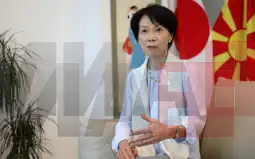
In the context of the latest developments in the Middle East involving Iran, Israel, and the USA, the global security architecture is changing even further. Japan is becoming increasingly active in positioning itself on security matters. How do you see Japan’s role in relation to Euro-Atlantic security and its cooperation with NATO—of which North Macedonia is also a member—amid the new global challenges?
We have been paying great attention to the recent developments in the Middle East and making diplomatic efforts to prevent escalation in coordination with other countries. Peace and security in the Middle East is essential for stable supply of energy as well as the maintenance of the global non-proliferation regime.
Non-proliferation is extremely important for Japan, as North Korea, our immediate neighbor, has been developing nuclear weapons and ballistic missiles against a number of the UN Security Council resolutions. In view of the cooperation of North Korea with Russia in the Ukraine War, it is evident that we can’t separate the security situation in Europe and Indo-Pacific.
Facing increased global security challenges, we need to strengthen our cooperation among countries which share the basic common values, such as rule of law and democracy. The importance of such close cooperation was demonstrated by the visit of Mr. Rutte, Secretary General of NATO, to Japan last year, as his first visit outside the NATO member states. Ms. Shekerinska, Deputy Secretary General, visited Japan this week and had a meeting with our Defense Minister on 5 March. I believe that our partnership with NATO can be further strengthened.
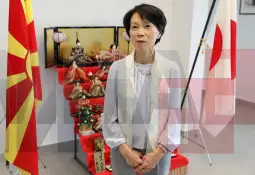
Japan recently appointed its first female prime minister. What symbolic and practical significance does this development hold for Japanese society, and do you believe it may encourage greater woman participation in politics and leadership?
It was a big news not only in Japan but also in the world. In spite of our country’s continued efforts for promoting gender equality in all the fields, the participation of Japanese women in politics has been stagnating. I believe that the first female prime minister will contribute to breaking up potential physiological barrier of women and encouraging them to take leadership positions. I believe it is extremely important that women take an active part in a decision- making procedure, regardless they become politicians or not.
As a distinguished woman diplomat, how have you navigated the balance between professional responsibilities and personal life throughout your career?
To be a diplomat is not just a job, but a lifework. It is much tougher as usually thought. We have to be on alert for emergency around the clock and live in different countries throughout the career. In my case, I have been working in European countries for many years, separated from my husband and daughter. I am grateful for great support and understanding of my family and convey my gratitude to them. Even though we can’t live together, there are many ways to support each other and keep good contact. In my view, good communication is the key to attain professional career and happy family life. With the advancement of IT technology, global communication is fast and affordable, and we are making the best use of it. In addition, it is essential to respect each other’s role and keep sense of appreciation in mind.
Photo: Darko Popov