EU welcomes agreement on Corridor VIII cross-border railway tunnel
Skopje, 7 November 2025 (MIA) - The European Union has welcomed yesterday's signing of the agreement on construction of a Corridor VIII cross-border railway tunnel between North Macedonia and Bulgaria.
The Ministry of Transport said on Friday that European Council President António Costa posted on X that the new railway would boost regional prosperity and enhance common security.
"I welcome the signing of the Corridor 8 cross-border tunnel agreement between Bulgaria and North Macedonia - a big step forward in the cooperation between the two countries and promotes good neighbourly relations. Besides developing bilateral bonds, the new railway will boost regional prosperity, and enhance our common security," said Costa.
European Enlargement Commissioner Marta Kos also welcomed the agreement signing.
"Bulgaria and North Macedonia agreed to advance work on Corridor VIII. A key project connecting the Adriatic Sea with the Black Sea via road and rail. This is an important step to build trust through regional connectivity, shared prosperity and people to people contacts," said Kos on X.
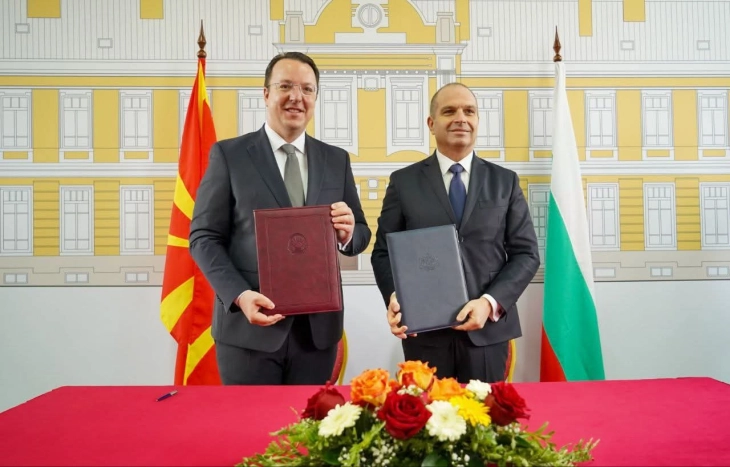
Deputy PM and Transport Minister Aleksandar Nikoloski and Bulgarian counterpart Grozdan Karadjov signed Thursday the agreement on the construction of the railway tunnel, in the attendance of representatives of the European Commission, NATO and the United States, the European Investment Bank, the European Bank for Reconstruction and Development, and the World Bank.
The 2.4km-long railway tunnel will represent the cross-border point between the two countries, evenly split on both sides.
The Skopje–Sofia railway, which construction began in 1994, is being built in three phases. According to estimates from relevant institutions, the railway is expected to increase freight transport by over 30 percent and passenger traffic by 20–25 percent in the initial years after completion. The construction and reconstruction of the first section, Kumanovo–Beljakovce, spanning 30.8 kilometers, has been completed (costing EUR 40.5 million). Currently underway is the construction of a new and reconstruction of the existing section from Beljakovce to Kriva Palanka, 34 kilometers long and valued at over EUR 155 million, with 35 percent of the work completed and a deadline set for the end of 2026.
For the third section, from Kriva Palanka to the border with the Republic of Bulgaria, which will include the tunnel, a call for the selection of a contractor is expected next month. This section, 23.4 kilometers long, will feature 22 planned tunnels, including the cross-border one, and 52 bridges, making it the most challenging part of the project. A previous tender that failed, at the beginning of the new government's term in 2024, saw the initial estimated cost rise from EUR 340 million to EUR 560 million.
After several months of delay, North Macedonia and Bulgaria reached a ministerial-level agreement at the end of June to advance work on the railway connection. This was followed by a meeting of delegations from both countries on July 16 in Brussels, where priorities were identified, including the reissuing of the tender for the railway section between Kriva Palanka and the entrance to the cross-border tunnel by the end of 2025.
Photo: MIA