Developments in Bulgaria have impact on current issues, says President Siljanovska Davkova
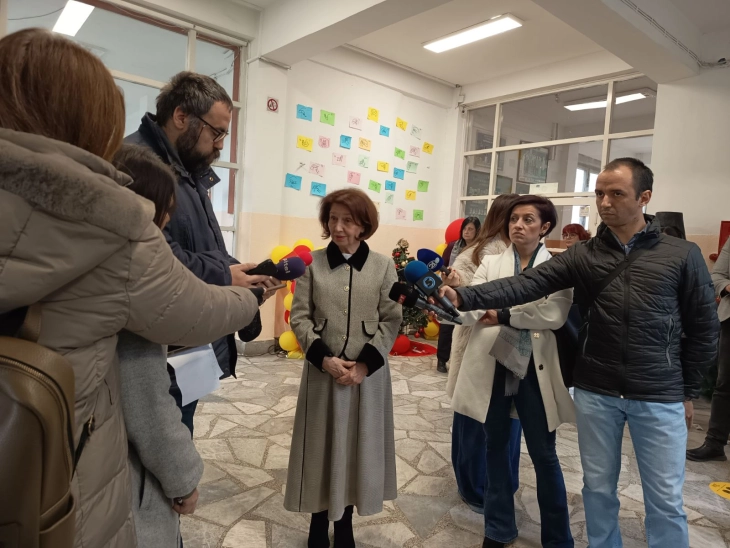
Skopje, 3 December 2025 (MIA) - All Bulgarian governments have faced problems and the current one led by Rosen Zhelyazkov gave everyone hope there is finally a chance for stability. However, the budget vote triggered fresh problems that affect current issues, including the one involving us, said President Gordana Siljanovska Davkova on Wednesday.
Regarding the protests and political turbulence in Bulgaria and its reflection on their demands for constitutional revision, President Siljanovska Davkova told reporters that "unlike us, Bulgarian political parties and lawmakers adopted several documents and a declaration that is binding for everyone."
"I hope problems will be solved there. I don't know how, be it through snap elections or reshuffling of the ruling coalition, but having a government is an imperative. When it comes to us, I heard the repeated position of the European Council regarding the implementation of the constitutional changes as a prerequisite for the second intergovernmental conference," said Siljanovska Davkova.
On seeking exit solutions, the President said it is sufficient to take a look at the constitutional guarantees in the Bulgarian constitution and compare them with those in ours, "and you will see enormous inconsistencies".
"I would be the first to seek for constitutional revision if the rights of the Bulgarian minority in our country are under threat. But the body set up by the Council of Europe - the Venice Commission - which decisions are cited by the European Commission and the European Council, clearly says that we don't have any constitutional problems related to the protection of minority rights, since we have incorporated the highest standards in our Constitution, through integration of the Ohrid Framework Agreement in the Preamble, which is not the case with our neighbor," said Siljanovska Davkova.
My dilemma is, she added, the human and political aspect of not being able to establish a cultural club there or not be included as a community in the census, just like there are Turks, Roma, Serbs, but no Macedonians, they are put under 'Others', while we have to incorporate the Bulgarians in the Preamble.
"Bulgaria had a census in 2021, with 3,500 people declaring the Macedonian language as their mother tongue, and about, as they put it, 1,300 declaring themselves as Macedonians. In their response to the European Commission against Racism and Intolerance (ECRI), the Bulgarian authorities say that when it comes to Macedonians, which by the way are put in inverted commas, it is an insignificant number that is not eligible for special protection," said Siljanovska Davkova.
The President also referred to the statements by the Bulgarian Helsinki Committee, which says that the post-monitoring process in the country should not have ended due to the open room for disregard of rights, primarily of the Macedonian minority.
"I cannot abstract myself from this. I have said many times that the EU has promoted creativity on many occasions but never when it comes to us. Having a protocol was one of the possible solutions. We also need guarantees because we must protect ourselves," said Siljanovska Davkova.
She also recalled on the statement of Council President Antonio Costa during his visit to Skopje, in which he mentioned the constitutional changes and the need for guarantees.
"This came as a result of many discussions with us, because we are the representatives of this country and we must defend its interests and present facts. There is an option of adopting a statement or an act at the second intergovernmental conference, noting that history, culture and language cannot be subject of negotiations or requirements, because otherwise it will open the Pandora Box," noted Siljanovska Davkova.
According to her, the claims that Ukraine and Moldova have made fantastic changes regarding the Copenhagen Criteria are also invalid.
"As university professor, I have not come across a situation when you ask a candidate country to change the constitution in order to start the accession negotiations. This is really strange, because the EU itself guarantees the observance of Article 4 of the Treaty regarding the equality of Member States before the Treaties as well as their national identities, inherent in their fundamental structures, political and constitutional," said Siljanovska Davkova.
She added that the country must self-defend and expect guarantees, both legal and political.
"Yes, it is true we were getting the messages that discussions would take place after the elections. That is why I was surprised by the announcements reported by media that the Council expects a constitutional revision first, followed by the start of negotiations. I don't know who - President, PM, Speaker - can guarantee in advance that the constitution will be changed. The MPs don't represent us, they represent the citizens and vote according to their own belief. Therefore, the question is - what kind of democracy are we talking about if you ask for guarantees in advance that changes will occur. I find this issue very serious," underlined Siljanovska Davkova.
Photo: MIA