Nikoloski to MIA from Athens: With Greece, we have opportunity to become region’s best economic partners

Athens, 25 September 2025 (MIA) –
Sanja Ristovska, MIA correspondent from Greece
If we give a political impulse, I believe cooperation with Greece will rise significantly, and we can truly have excellent economic cooperation and definitely become the best economic partners in the region, because we have that opportunity, Deputy Prime Minister and Minister of Transport Aleksandar Nikoloski said in an interview with MIA’s correspondent in Athens following meetings with senior Greek government officials.
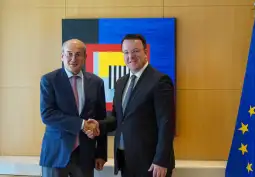
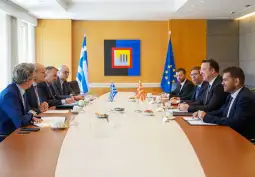
Economic cooperation, Corridor 10, the high-speed railway, and regional connectivity were the focus of the Minister’s meetings with Greek Deputy Greek Deputy Prime Minister Kostis Hatzidakis, Minister of Infrastructure and Transport Christos Dimas, Alternate Minister of Infrastructure and Transport and MP Konstantinos Kyranakis, as well as with the management of the Port of Piraeus.
This was the first meeting between the Deputy Prime Ministers of the two countries, emphasizing the significance and promotion of economic cooperation and regional infrastructure projects. The meeting also reaffirmed both countries’ commitments to enhancing regional cooperation in infrastructure, transport and services.
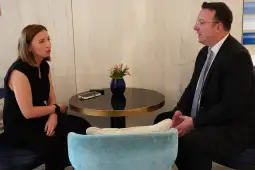
In a conversation with MIA’s Athens correspondent, Deputy Prime Minister Nikoloski discussed the current projects with the southern neighbour, as well as potential for further strengthening economic cooperation.
He analyzed in detail the advantages of the high-speed railway from Athens via Skopje and Belgrade to Budapest and Vienna, which is expected to increase revenues tenfold and boost the economy by linking Greek ports with Central Europe.
He also noted that Corridor 10-D will cut travel dime from Skopje to Athens from eight hours to five and a half hours.
Minister, on your first working visit to Athens, your meetings focused on regional connectivity and economic cooperation. Which messages did you convey, and which did you receive from the hosts?
This is practically the highest-level meeting between the two governments. I had the honor of meeting the Greek Deputy Prime Minister, my colleague, and as deputy prime ministers we discussed cooperation between the two countries. We focused primarily on economic and infrastructure connectivity, a link that is both regionally and naturally determined. A major Pan-European corridor, Corridor 10, including the alternative Corridor 10-D, passes through both countries. It is natural for us to develop this corridor in terms of highways, where progress is significant, and railways, where we aim to construct a high-speed railway from Athens through Thessaloniki to Skopje, and northward to Belgrade, Budapest, and Vienna, which will fundamentally transform the economy and business structure of the entire region.
At the same time, we are constructing a gas connection with Greece - the interconnector. It is only a matter of time before we activate the pipeline, or rather the oil pipeline. By doing this, we demonstrate our ability to cooperate, which I think strongly reflects on political relations, since good economic ties also enhance political relations.
Is there a specific timeline for the high-speed railway?
On our side, we plan to build it from border to border, meaning from the Serbian border to the Greek border. I hope we will start work next year, and the timeline would be five years from the start of construction, which means it should be completed around 2031–2032. On the Greek side, the situation is a bit more advanced. Athens–Thessaloniki already has a high-speed railway running north from Thessaloniki toward Axios. From there to the border with Macedonia, to Gevgelija, there are about 50 kilometers left, for which I received a promise in both meetings with the Transport Minister and the Alternate Minister responsible for rail, that they will start work and construction next year. In this way, the two countries will be connected. We also agreed on a five-party agreement that we want to sign between North Macedonia, Greece, Serbia, Hungary, and Austria for cooperation on Corridor 10. This agreement was ready to be signed last year, but due to political instability in Serbia, it was postponed. We are now bringing it back on the agenda and would like to sign it, formalizing cooperation among the five Corridor 10 countries.
During your recent visit to Thessaloniki, you spoke about the port of Thessaloniki, and in Athens, you met officials from the largest Athenian port. How crucial is this cooperation for us, regarding trade, the economy, and the movement of goods, considering our central location in the region?
These two ports are key for our economy, they are natural ports, which is very close to our country and our economic entities. Infrastructure development, especially rail, will significantly strengthen Macedonia’s economy. The construction of the high-speed railway, in particular, has the potential to generate this effect, as we anticipate a large economic zone developing along the corridor of the railway. Additionally, the high-speed railway is vital for southern European ports, specifically Piraeus-Athens and Thessaloniki, because if travel from Piraeus to Budapest or Vienna can be done in two and a half days, it will completely transform business, creating a fundamental shift in business philosophy.
Just to give you a comparison: currently, Macedonian railway companies, railway infrastructure, and rail transport generate around €12 million in revenue. Experts predict that with the construction of the high-speed railway, this could rise to €120 million, ten times higher. A tenfold increase would also mean much more activity for the ports of Athens and Thessaloniki. In the medium term, we are also considering cooperation with the port of Kavala, the port of Igoumenitsa in western Greece, and the port of Alexandroupoli in the east, so there are numerous opportunities for cooperation.
The part of the highway linking Thessaloniki to our border is in poor condition; traffic accidents happen frequently, and residents of nearby Greek towns have raised the need to upgrade the road. Was this topic discussed?
Regarding the highway connection, as you know, the entire Corridor 10 on the Macedonian side, from the Serbian border to the Greek border, is completed. Naturally, some repairs and reconstruction are needed, which is normal for highway maintenance and which we carry out regularly. For next year, we have a major plan for extensive reconstruction. It is true that north of Thessaloniki, there is no highway, only an express road, but we received assurances that full highway connectivity will be provided. This will help connect not only with us but also with other countries, which is especially important for tourism.
The second topic we discussed is Corridor 10-D, which runs from Skopje through Gradsko – Prilep – Bitola – the Medzitlija border crossing, and on the other side reaches Lerin and Kozhani, then descends toward Athens. This means that instead of the current eight-hour journey from Skopje to Athens, travel time would be around five to five and a half hours. On our side, we are working extensively. We have already opened the expressway from Gradsko through Drenovo to Farish. Currently, we are working on the Farish–Prilep project, the Prilep–Bitola highway is already under construction, and the next phase, designing the Bitola bypass and border connection, is complete. On the Greek side, there is already a highway to Lerin, from Lerin to Kozhani there is an expressway, and further down they are connecting to the main highway linking Thessaloniki and Athens. In this way, Corridor 10-D will open, serving as an alternative to Corridor 10, but providing a much faster connection between Athens and Skopje.
The projects you referred to are specific, concrete developed projects for cooperation with Greece. Is there further potential that has not yet been utilized, which the two neighbouring countries could exploit in the future?
Absolutely. I believe many Macedonian companies are already seeing opportunities to invest in Greece, including in tourism, where many Macedonian firms are investing. Numerous Greek companies are already present in the Macedonian market, and many more are announcing their entry. We have a presence in almost every sector, and if we give a political boost, I believe this cooperation can rise significantly, allowing us to have excellent economic collaboration and become the best partners in the region, definitely, because we have the opportunity to do so.
Photo: Ministry of Transport


