MIA's comparative analysis: Macedonian judges and prosecutors work less, have the lowest public trust in Europe and yet they are paid on average as much as German judges

Skopje, 16 November 2025 (MIA)
MIA’s newsroom reporters
One of the key battles against the government and Finance Ministry’s draft budget, which has been sent to Parliament, is waged by judges and prosecutors. They are demanding a lot more funds to do their job, which has a mere 2-percent public trust - they even told off the prime minister for bringing that up – as well as absolute independence in spending the money and retaining the two-percent public trust. It seems in the end they will get it under the set of laws in the judiciary, due to be adopted by the end of the year.
Do they deserve it? That’s the first question. The second is – are they really paid less and work more than their European colleagues. This is what an analysis by CEPEJ says, which is a Council of Europe expert body. Established in 2002, it is tasked with analysing the results of judicial systems in European countries aimed at improving them.
It’s not the first time that a solution to better judiciary is sought through the prism of money. Following demands by the judiciary, backed by EU experts, legal frameworks were introduced for the budget of courts and the prosecution. For courts, it stands at a high 0.8 percent of the state budget, and at 0.4 percent for prosecutors. It means that about 1.2 percent of the taxpayers’ money would be spent for this purpose.
For now, this is the celling that is yet to be reached (and it seems it shouldn’t because we’re not so bad compared with many other judicial systems in the Western countries), but the courts and prosecutors insist on getting it and they get mad when they aren’t getting it. Now, the judicial reforms, demanded by Brussels – and eagerly awaited by judges and prosecutors - require more of the taxpayers’ money for the judiciary to perform well.
In recent years, courts have been given 0.66 percent of the budget – 44.7 million euros. Most of them, as high as 38.3 million, are spent on salaries. According to data from the proposed budget, from 2021 until present day, salaries in the judiciary have almost doubled. It’s similar in prosecution offices – they get 0.21 percent of the taxpayers’ money (14.4 million euros). Of those, a bulk is singled out for salaries – 10.6 million euros.
The basic salaries of prosecutors and judges range from around 86 thousand denars, up to that of the state prosecutor or the supreme judges, whose salary according to the legal coefficients is around 122 thousand denars (from 17 to 24 thousand euros per year). This is from 2.3 to 3.2 average salaries in the country.
In addition to the Macedonian data, there are also comparative analysis painting a detailed picture of how much is spent and how much works has been done. One of these analyses is CEPEJ of the Council of Europe (also accepted by the EU’s European Commission). Released in 2024, it refers to 2022.
According to CEPEJ, every resident in Macedonia spends 24.6 euros for the judiciary, which is 0.39 of the GDP singled out for court and prosecution offices. This is above EU median, whose members spend from 0.33 to 0.35 percent of the GDP.
In the past decade, the number of prosecutors in Macedonia ranges from 170 to 200. According to Public Prosecutor’s Office reports, there were 179 prosecutors in 2021 and 169 prosecutors in 2024. Compared to the 2021 census, these are 9.7 and 9.2 prosecutors per 100,000 inhabitants, respectively. The Council of Europe presents a slightly lower figure of 8.5 prosecutors per 100,000. Germany has 7.6 prosecutors per 100,000 inhabitants. The European average is 11 to 12 prosecutors per 100,000 inhabitants, but in general, the average is higher in Eastern European countries, while Western European systems have a lower number.
Let’s see how much Macedonian prosecutors worked compared to their European colleagues?
According to CEPEJ, in Macedonia a prosecutor from 2012 to 2022 worked, on average, on somewhere between 170 and 200 cases, which is below or within the European median of nearly 204 cases per one prosecutor. Similar figures are included in the annual reports of the Public Prosecutor’s Office sent to Parliament. For example, a 2023 report says that one prosecutor, on average, worked on 180 cases a year.
Although the prosecution according to the volume of work is just below or within the European median, the Public Prosecutor’s Office in all of its reports has been noting a shortage of prosecutors to be able to work more efficiently. They insist that the prosecutors have had their authorisations increased according to the new law on criminal procedure. The prosecution has estimated that Macedonia should have as many as 261 prosecutors, which would constitute 14.2 prosecutors per 100,000 inhabitants, which is rare in any country.
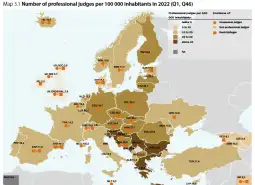
The number of judges, according to informal sources, is somewhere around 460 – 25 judges per 100 thousand inhabitants. The Council of Europe says that our country has 22.3 judges per 100 thousand inhabitants, and the European median is somewhere around 17 judges, meaning it has been exceeded.
For comparison, per 100,000 inhabitants, here are several countries that have fewer judges:
North Macedonia-22.3 judges
Netherlands-15
Belgium-14.6
Italy - 12.2
France – 11.3
Spain – 11.8
Albania – 114,
England and Wales only 3 judges per 100,000 inhabitants.
However, there are also countries with over 40 judges per 100,000 inhabitants. According to the CEPEJ, these inequalities can be explained, at least to some extent, by the diversity of European judicial organisations and legal systems, which are the product of long historical processes. Thus, the low number of professional judges per capita in Great Britain - England and Wales, Great Britain - Northern Ireland and Great Britain - Scotland can be explained by the very high proportion of cases falling within the jurisdiction of magistrates' courts composed of lay judges. The map shows all the countries that have both part-time professional judges and lay judges in some countries.
BALKAN SYNDROME
What is evident from the Council of Europe study is that there is some kind of Balkan syndrome showing in the judiciary – the number of judges and prosecutors isn’t that much above compared to the European median (except for Albania), even through it seems justice comes slow in this part of Europe. Funds spent by these countries for the judiciary as part of the GDP of the state budget exceed the European media, but it’s similar to the Macedonian. Croatia and Slovenia set aside for the judiciary 0.38 percent of the GDP, Serbia as high as 0.54 percent of its GDP and Albania – 0.29 percent of the GDP.
For example, in Croatia there are 42.4 judges and 16.2 prosecutors per 100 thousand inhabitants. That is almost twice as many judges and more prosecutors than the European average by a third. One prosecutor there works only 67 cases per year, which is incomparably less than in other European countries, and almost a fraction for a German prosecutor who works over 700 cases. Salaries range from 28 to 57 thousand euros per year. However, compared to the average salary that our prosecutors and judges have as a basis, Croatian judges earn the same as their Macedonian colleagues - from 2.5 to 3 average salaries.
In Serbia there are 39.1 judges and 10.4 prosecutors per 100 thousand inhabitants. The number of judges is also twice as high. One prosecutor there works 114 cases per year, but there were years like 2018 when one prosecutor had to work up to 500 cases per year. Salaries range from 20 to 49 thousand euros per year. Compared to the average salary in Serbia, that is 2.3 average salaries, which is again the same, and even less than the salaries of Macedonian prosecutors and judges.
Slovenia also has a lot of judges. The figures there are as follows: 40.7 judges and 9.8 prosecutors per 100 thousand inhabitants. Although the number of prosecutors is small, it seems that they work more efficiently than their Balkan colleagues – 289 cases per year. The salary of Slovenian judges ranges from 34 thousand euros per year for lower-ranking judges and prosecutors, to 66 thousand for more experienced and higher-ranking ones. Slovenian judges start with 1.1 the average salary, and end their careers with 2.7 average Slovenian salaries.
Serbia and Croatia record low trust in the judiciary with just over 20 percent. Of all the Balkan countries, Slovenia with 41 percent record the highest public trust in the judiciary.
In our country, public trust stands at 2 percent. And, we say that trust in the judiciary is low in Serbia and Croatia, where it is 20 percent.
GERMANY’S JUDICIARY DATA
Germany seems to have the most effective spending in terms of output. In Germany, in the federal budget there are no separate items for the prosecution and courts, but there is an item that refers to the Ministry of Justice and the judiciary at the federal level. According to the official budgets of Germany, from 1.01 to 1.16 billion euros are allocated for this purpose from 2022 to 2025, or from 0.2 to 0.24 percent of the total federal budget of Germany, which is not different compared to our country.
These aren’t the only funds at disposal for the judiciary. According to CEPEJ, the German judiciary costs a staggering 10.9 billion euros, or a total of 0.3 percent of Germany's GDP, but this does not only include judges and prosecutors, but also all services, and there is no data on whether this also includes the prison system. This percentage has been almost unchanged since 2016 and is quite modest in relation to the workload.
But absolute numbers are incredibly big, because Germany is also big. Here is an analysis of how many prosecutors and judges work in Germany, on how many cases and how much they earn.
According to the same study, there are slightly less than 21 thousand judges and 6,503 public prosecutors working in Germany. For comparison, that is 24.7 judges and 7.7 prosecutors per 100 thousand inhabitants (we have 22.3 judges per 100,000 inhabitants and 9 prosecutors per 100,000 inhabitants). According to official German statistics, these prosecutors complete 5.5 million cases per year or on average, each prosecutor completes as many as 846 cases per year (another informal source says that a German prosecutor on average works around 770 cases per year). This is four times more than the European average.
There is no summarized data on the courts, but according to CEPEJ and official German statistics, 4 to 5 million cases (civil, criminal, administrative) are concluded in the courts annually. This means that a German judge works on an average of 214 cases per year.
How much are they paid for doing this? According to CEPEJ, the annual salary in the judiciary in 2022 was 56.3 thousand euros. The average annual salary according to official statistics was 49.2 thousand euros. This means that judicial salaries have a coefficient of 1.08 of the average German salary, which is incomparably less than the 2.5 to three average salaries that our judges and prosecutors receive. True, some judges in Germany at the peak of their judicial careers end up with an annual salary of around 120,000 euros, but that is also around 2.5 times more than the average German salary in general, and our supreme judges also receive 2.5 times more than the national average. Prime Minister Hristijan Mickoski has said on several occasions that their goal is to receive net salaries of 300,000 denars, which would be more than 7 times the average salary in the country, which does not exist in any European country.
The German judicial system, according to the latest OECD report on public trust in the public sector, enjoys a 58-percent trust. Here - let us repeat – public trust is only 2 percent. 58 percent in Germany vs 2 percent in our country.


