Regional cooperation in higher education one of most powerful but oftentimes unused opportunities, says World Bank official

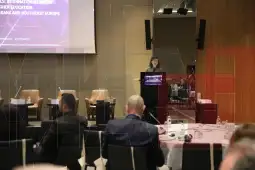
Skopje, 26 March 2026 (MIA) - The standard of living in the Western Balkans is lower compared to that in the EU and overcoming of this gap and preventing brain drain requires internationalization of universities, as well as good regional cooperation that would ensure quality education, which is applicable in the real economy, World Bank Division Director for the Western Balkans, Xiaoqing Yu, told regional conference “Bridging Futures: Internationalisation of Higher Education in the Western Balkans and Southeast Europe” in Skopje on Thursday.
"Higher education lies in the core of this ambition. The region is facing complex challenges, from ageing population to migration. Furthermore, some countries have double-digit percentage of declining young population compared to 2010," said Yu.
She added that migration might not result in brain drain, with evidence showing that specific policies, incentives, well-designed mobility schemes turning into circulation and even brain influx.
Yu said the World Bank supports countries worldwide in higher education reforms, in order to ensure quality.
"Our engagement reflects our conviction that regional cooperation in the field of higher education is one of the most powerful but oftentimes unused opportunities that leads to development, growth, better jobs and larger convergence with the European standard of living," noted Yu.
According to her, mobility should turn into an advantage for the region, "but pathways for return need to open, something that will attract people to come back to their homeland and be productive."
"Countries in the Western Balkans have small economies that find it difficult to compete with global powers. Regional states can open up higher education that is attractive for students, researchers and employers," noted Yu.
She said higher education should be more relevant in the context of present and future economies.
"The region must strengthen its STEM capacities, digital capacities and applied research. Universities need stronger partnerships with industries. In addition, finance management aimed at ensuring quality should be a self-sustainable mechanism. There is a need for performance-based financing, strong quality mechanisms and data transparency," underlined the World Bank official.
The two-day regional conference, held under the auspices of the Ministry of Education and Science and co-organized by the Regional Cooperation Council (RCC) and the World Bank, is a high-level dialogue that brings together ministers, university leaderships, academia, researchers, policy creators, industry, employers, experts and students.
Photo: MIA


