Pappin for MIA in Budapest: Brussels doesn't like Orbán because Hungary is successful and he doesn't like the war in Ukraine

Budapest, 12 April 2026 (MIA)
Cvetin Chilimanov, MIA's Budapest special correspondent
American foreign policy expert Gladden Pappin is considered as being one of the people playing a key role in building relations between Hungary and the Trump administration in the United States. In a conversation with MIA, Pappin, who is the president of the Hungarian Institute of International Affairs, expressed his views regarding the Hungary elections, the EU’s attempts at helping the Hungarian opposition and Washington’s reaction.
Hungary has been causing problems for Brussels in a couple of ways. First, Prime Minister Orbán is an example of successful governance in Europe that has avoided the catastrophic mistakes of Western European governments. So, they want to hide the success of Hungary and they don't want you to see that it's actually a successful country. If there's a [EU] country that avoided their problems, then it's an indictment of their decisions. And second, they're trying to make a more federal European Union. They have in Brussels that there's really no way to grow their economies anymore and their only strategy is to continue to support the war in Ukraine basically as a business. Those are their two reasons, and I think it's unfortunate that they're doing this, but that's the reality.
Several days ago, Hungary welcomed US Vice President JD Vance, who came to show support for PM Orbán.
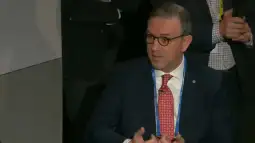
The American vice president was here earlier this week and many liberals said this constitutes a kind of foreign interference. But the real foreign interference is blackmailing Hungarian voters with their own money. Ever since Covid, the European Union has withheld funds from a variety of different formats, Covid recovery funds, cohesion funds for the Eastern more developing economies. And then also these negative punishments for failing to implement the migration pact. The migration pact is almost a perfect example of this because here you have Hungary that made the correct decision that during the migration crisis in 2015-2016 and so it doesn't want to participate in the intra-EU migrant resettlement program. Why should it be punished for making the correct decision? And yet that's exactly what is happening with fines of one million euros per day.
During the crisis, Hungary had helped the Macedonian government a lot to close the southern border.
Prime Minister Orbán is extremely important for all the Western Balkans countries, supporting particularly their patriotic governments, helping them financially, when possible, to make the right decisions and speaking up for the importance of, the Western Balkans countries in the European Union. What's happened to North Macedonia is almost a perfect example of the kind of blackmail that they engage in - you do everything that they ask, you change the name of your country. And then they still try to hang a knife over your head, threatening you that unless you adopt all of their other policies, maybe in ten or twenty years, they will acknowledge you.
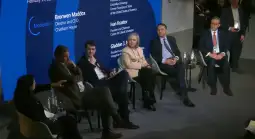
Has Trump and Vance’s support come on time to thwart EU’s meddling or it perhaps isn’t enough and came too late?
This is a pro-American country, and ever since the end of the Cold War, it's had a strong pro-American sentiment. It was very regrettable that the Biden administration was so harsh on the country, and I think every Hungarian wanted that relationship to get back to normal. I think recognition is all that the Trump administration has brought. I mean, it's brought a lot of investments and other deals. But, within the European Union, the liberals have tried to make Hungary into a black sheep. They've really tried to make Hungarians ashamed of themselves when, in fact, Hungarians have much to be proud of. They turned around the country after terrible 20th century. In the 1990s they really lost sovereignty in their major business sectors. Eighty percent of the energy companies were foreign. Eighty percent of the financial firms were foreign. Eighty percent of the media was foreign. Eighty percent of the retail was foreign. Really what national sovereignty means in Hungary is getting those businesses and industrial sectors and strategic sectors back. And that's what the Fidesz government has actually done the last fifteen years. MOL, the Hungarian, energy and, and gas company, actually is an important part of the social safety net Hungary. These companies help to fund basic elements everyday life. The American visits, I think, were really important because the main message that Vice President Vance brought was that he admires what the Hungarian people have done over the last fifteen years, and he thinks it's very important for the American vision of Europe to continue. And so that was a positive message. Nothing's going to stop the Brussels forces from trying to hurt the country. The United States offered this recognition after a year of building up to it, I think. So actually, I think it came at the perfect time. The vice president wasn't intending to pressure Hungarians to vote one way or the other. There was no financial blackmail whatsoever from the United States, unlike Brussels. It was just an open hand of friendship and, and admiration.
Photo: Private archive and YouTube


