One in five people use AI tools in the country, nearly one in three in the EU

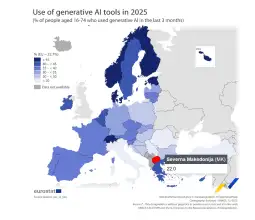
Skopje, 18 December 2025 (MIA) – One in five citizens (22%) aged 16 to 74 in the country used generative artificial intelligence (AI) tools this year. The majority used them for personal purposes (15.76%), 8.55% for work-related tasks, and almost one in ten (9.4%) for formal education.
In 2025, 32.7% of people aged 16-74 in the EU used generative artificial intelligence (AI) tools. Most people used them for personal purposes (25.1%), while 15.1% used them for work and 9.4% for formal education, according to the data on the use of ICT in households and individuals published by Eurostat.
The most frequently cited reason for not using AI tools was a lack of need, mentioned by 43% of citizens in North Macedonia, followed by a lack of knowledge on how to use them (11%) and concerns about privacy and security (2%).
Norway leads Europe in the use of AI tools (56.32%), while the lowest share was recorded in Turkey, where 17.19% of citizens used them.
Among countries in the region, the highest use of generative artificial intelligence tools was reported by citizens of Greece (44.09%) and Slovenia (37.56%). They are followed by Croatia (27.52%), Bulgaria (22.5%) and North Macedonia (22.03%). The lowest usage was recorded in Serbia (18.64%) and Bosnia and Herzegovina (20.26%).
Among EU countries, the use of generative AI tools was most widespread in Denmark (48.4%), Estonia (46.6%) and Malta (46.5%). In contrast, the lowest shares of people using generative AI tools were recorded in Romania (17.8%), Italy (19.9%) and Bulgaria (22.5%).
In the EU, 94% of the individuals used the internet in the last 3 months in 2025 while 4% spent the whole year without using the internet.
Mobile devices were used to connect to the internet by almost 9 out of 10 individuals in the EU in 2025, while 74% of the individuals ordered or bought services or goods online in the EU in 2025.
In the country, 91% of households had internet access last year, a substantial rise from 69% in 2015. About 6.86% of citizens did not use the internet at all throughout the year.
Most people accessed the internet using a mobile device (91.5%), followed by laptops (35%), desktops (around 20%) and tablets (9%).
In the country, 86% of people used the internet for phone or video calls, 78% for social media, and 41% for sending and receiving emails. In addition, approximately 42% of citizens purchased or ordered goods or services online last year, compared with 21% in 2020.
Photo: MIA archive/Eurostat