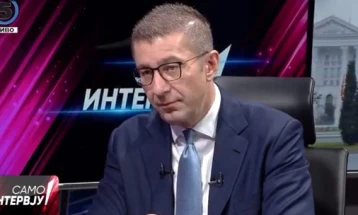
Mickoski: Unions rejected 40% pay rise over four years due to political capture
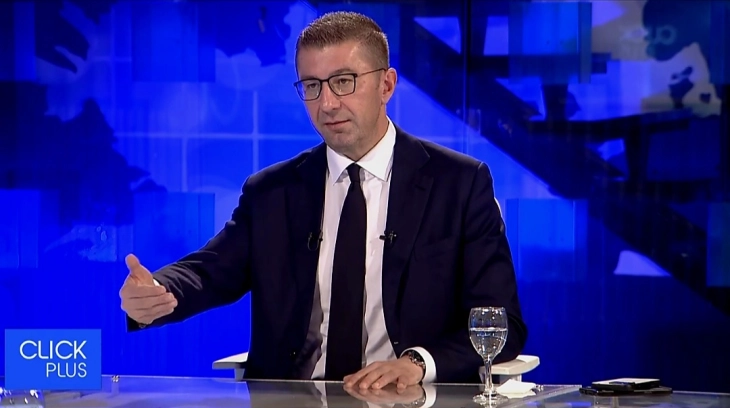
Skopje, 28 January 2026 (MIA) – Prime Minister Hristijan Mickoski told TV 21's Click Plus late Tuesday that that in talks over unions’ demands for higher wages, negotiations were also held to increase the salaries of administrative staff by 8 percent per year, or by a real 40 percent over four years. He noted that this followed the same model applied since the beginning of this government, when collective agreements were signed with education and healthcare unions, salaries were raised in the Interior Ministry and Defence Ministry, and measures affecting employees in social work centers. He added that the talks with representative unions failed because, as he noted, someone was politically captured.
“When this is all taken into account, over 90 percent of employees whose employer, in practical terms, is the government have a collective agreement with the government for a four-year period ending in 2028. Why 2028? Because we did not wish to assume obligations beyond our term in office. We wanted the agreement to end with the mandate of this government. Should we form the next government as well, we would then negotiate a new collective agreement. The only remaining collective agreement concerned administrative employees, around 7,700 to 7,800 workers for whom the government is effectively the employer. We proposed an agreement and held talks with the two representative unions. Our final offer was that, in addition to legally mandated adjustment in line with the minimum wage, administrative employee’ salaries would rise by an extra 8 percent each year,” he said.
He added that the government’s only condition applied to the part regulating wages in the General Collective Agreement signed by the current leadership of the Federation of Trade Unions of Macedonia (SSM) and the former Minister of Social Policy and Labour, which is unclearly written and may be interpreted differently.
“We had one condition. The General Collective Agreement, the part that regulates wages, is unclearly written and was signed by the current leadership of the Federation of Trade Unions (SSM), by the current president of SSM together with the former minister at the Ministry of Labour and Social Policy, as it used to be called, but it has expired. Since we agreed at those meetings with them that this part is unclear and can be interpreted in different ways, we proposed signing collective agreements at branch or institutional level stating that the part of the General Collective Agreement regulating wages would not apply. Thus, the General Collective Agreement has expired; nevertheless, its transitional and final provisions stipulate that, until a new agreement is adopted, it remains in force despite its expiration. We proposed that the provision regulating wages should cease to apply and that the new provision we offered should apply instead. Over the next two to three years while a collective agreement is in effect, given that they were satisfied with the proposal and the envisaged salary increases, we would negotiate a new General Collective Agreement that would build on what is agreed now, starting from 2029 onward, thereby unifying the system of salary determination in the public administration. They accepted our proposal, but rejected the part requiring amendments to the General Collective Agreement, because someone was politically captured and wanted to cause damage,” Mickoski said, adding:
“All administrative employees should know that the government is offering this and that it is still on the table.”
Photo: Government