Dr Patrick Soon-Shiong: Relations between turbo cancers and spike protein is no coincidence, I've never before seen pancreatic cancer in 13-year-old boy
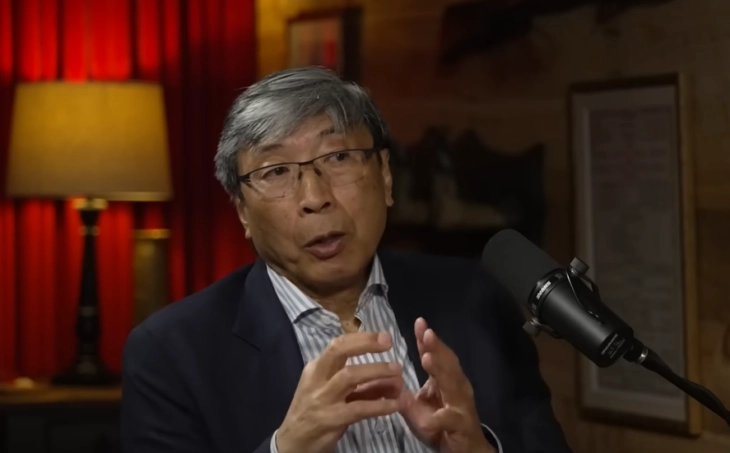
Skopje, 5 October 2025 (MIA) - I never saw pancreatic cancer in children, and the greatest surprise to me was a 13-year-old with metastatic pancreatic cancer that the family called us to help. And to me, that was not only devastating, it emphasized the idea that we're seeing people with higher incidence of pancreatic cancer, and younger. Right now in our clinic, we have 45-year-old, 50-year-old. And what was sad about this young boy, by the time he came to see us, he had exhausted all standard of care, and he came from Butler, Pennsylvania, and all the major medical centers really, had exhausted all their therapy by the time he came to see us. His body was ridden, and he passed away. So seeing cancers now in younger people, and almost a rise almost like a, I don't want to call it a non-infectious pandemic, but this is what I think is worrisome in the world, not just in United States but largely in the United States, we're beginning to see this, and it's really worrisome, says Dr Patrick Soon-Shiong, one of the world's leading oncology experts who has earned over 10 billion dollars from selling his inventions and claims he has found the cure for cancer - his Bioshield.
In an interview with Tucker Carlson he adds:
I don't know how to say that, without saying it. It scares the pants off me because I don't think it's virus versus man now. You're right. This is existential. I think when I talk about the largest non-infectious pandemic that we're afraid of, this is it. Because while there was an increase rise in cancer in our country because of the idea of the toxins and everything else, this immunosuppression that has occurred now globally, and more importantly, the immunosuppression tied to inflammation, chronic inflammation, which is asymptomatic in some times and sometimes it's not. There's 15 million Americans with long COVID. And they're not psychiatric when they have memory loss. They're not psychiatric when they have instantaneous heart attacks. It's not psychiatric when you have an 80-year-old, 10-year-old with colon cancer, a 13-year-old with pancreatic cancer. So, the idea was, is there a solution?
Doctor, thanks a lot for coming on.
Sure.
So you spent your life, you know, 50 years working on treatments for cancer, and when you started, it seemed like we were moving in the west toward the elimination of cancer. Smoking was a huge emphasis, get rid of tobacco, and cancer rates will drop. Obviously smoking does cause cancer, and we got rid of it basically, but cancer rates went up, and that is a very rarely remarked upon mystery that really bothers me. Tell us, since you made billions of dollars selling your companies but you're still involved in medical research, which I admire, where are we now with cancer? What are you seeing in cancer rates?
Well, what's, what's really worrisome to me now is not just the rate but the population in which it's increasing, i.e. the younger people. So we are clearly seeing, an increase in certain types of cancer like pancreatic cancer, ovarian cancer, and we're seeing it, colon cancer, and we're seeing it in younger people.
Just to set a baseline, what's the 10-year survival rate for pancreatic cancer?
It's horrible. I think, you know, if you have pancreatic cancer today, I don't think there is a 10-year survival rate, so to speak.
Yes.
What there is, however, if you have patients who are what we call failed all standard of care, survival rate is in months. You know, measured in two months.
Yeah. That's certainly my understanding having watched a lot of people die, advanced pancreatic cancer is a death sentence. Where are you seeing it now?
Well, I got to tell you, a really concerning story is not only am I seeing it now, I'm seeing it in younger people, and for the first time in my career. You know, when I left UCLA, I was doing all the Whipples, which is a surgery to actually remove most of the pancreas. A very big operation.
You're a surgeon as well?
I'm a surgeon, yes. And I was also doing pancreas transplants for type 2 diabetes, and islet cell transplants, and stem cell transplant. So I had this diverse activity as a UCLA assistant professor. But I never saw pancreatic cancer in children, and the greatest surprise to me was a 13-year-old with metastatic pancreatic cancer that the family called us to help. And to me, that was not only devastating, it emphasized the idea that we're seeing people with higher incidence of pancreatic cancer, and younger. Right now in our clinic, we have 45-year-old, 50-year-old. And what was sad about this young boy, by the time he came to see us, he had exhausted all standard of care, and he came from Butler, Pennsylvania, and all the major medical centers really, had exhausted all their therapy by the time he came to see us. His body was ridden, and he passed away. So seeing cancers now in younger people, and almost a rise almost like a, I don't want to call it a non-infectious pandemic, but this is what I think is worrisome in the world, not just in United States but largely in the United States, we're beginning to see this, and it's really worrisome.
A non-infectious pandemic of cancer, including deadly cancers.
Correct.
Like pancreatic. In your career, which I think is about 50 years of working on this, how many 13-year-old pancreatic cancer patients have you seen?
Never.
Never?
I inquired around because it bothered me so much now, why this is happening. So Dr. Steven Day who was, uh, a good friend who, who was trained with me at UCLA when I was at UCLA, he's now at the Angeles Clinic, and I called him and he said, "Listen, Patrick, I'm now seeing an 8-year-old, a 10-year-old, an 11-year-old with colon cancer." We've never seen that. We're seeing now 30-year-old, 40-year-old ladies, young ladies with ovarian cancer. So this is a real phenomenon of a rise of cancer in young people, and we really need to get to the bottom of that.
Do you notice a difference in the virility of the cancer, the speed with which it moves?
Well, I'm getting reports from... They've even called it turbocharged cancers.
Yes, I've heard that phrase.
Right? I'm getting reports of that now, that people that have been in remission before are now getting back the cancers and very rapidly progressing. So if you really think about what the cause of cancer is, you know, and I did a piece with Sanjay Gupta many, many years ago on 60 Minutes, and I said, you know, the cause of cancer is its inability... It's not the rapidity of its growth, but it's inability to die. And its inability to die is because it either hides from the cells that matter, i.e. your natural killer cells or T-cells, or, and this is what I'm really worried about, your body and the cancer has found a way to suppress your killer cells. And once they do that, once they activate what are called the suppressor cells, and you call yourself immunosuppressed, then I think you see this rapid progression because there's nothing stopping them.
What could possibly be causing this?
Well, I think if you look back of causes, you know, ironically when I was doing at UCLA, I was working on pancreas transplant where I want to immunosuppress the patients.
Yes, you have to.
Yeah. Because you prevent it. And then I was working on cancer where I don't want to immunosuppress. So, I needed to understand the body's mechanism and we have a crazy, wonderful, exquisite balance in our body. You have the yin and the yang, uh, of the killer cells and these things called natural killer cells and T cells.
Whose job is to kill anything that threatens the body.
It's, whose job is to kill... Quite right, anything that threatens the body, whether you, the body has infection, if you have TB, you have HIV, if you have hepatitis, you have COVID, these cells are there to recognize these infected cells and kill it. As you and I are sitting here today, our stem cells are growing in order to replenish parts of your body, your heart, if you didn't have that, you wouldn't have a heart. At the age of 14, you need those stem cells. But mathematically, there are some cells that are transformed and your body recognizes that through these natural killer cells and kills it. I call that nature's first responder. And that's your mechanism, that's how we are all protected and we are in this state of equilibrium or balance. On the other hand, the moment either the tumor finds a way to hide from these cells or the tumor causes these cells to be suppressed, and that's why they're called the suppressor cells. And there are certain cells in your body called T reg cells or myelo-derived suppressor cells, these are all technical, that when they get up-regulated, you've lost your protection. And so the question then is how do we understand this balance? How do we increase the killers and how do we decrease the suppressors? So that's been 50 years of my challenge of... And how do we expose the tumor? So on the one hand, you need to expose the tumor because it hides from the killers. On the other hand, you got to activate the killers. And the other hand, you have to suppress the suppressors. So we're truly playing a good game of chess. And I think like an astrophysicist where you're looking for God's particle, where all these molecules are floating around talking to each other, all the cells are floating around talking to each other, and this dynamic interaction. And how do you understand all of that? You know, the, one of the best, uh, most fun lectures I gave, I've given a lot of lectures on this and try to be non-technical because it's basic, what I call basic immunology. And the problem with cancer is it's being treated by oncologists and not immunologists. And immunologists don't see patients because they look at basic immunology. And then when you have infection and you have virology, so these cross disciplines of virology, immunology, oncology, all these ologies don't talk to each other.
So you're saying, just big picture, for non-specialists, of which I'm, of course, one, you're saying that cancer is, to some extent, a problem with your immune system.
It is everything about your immune system.
Okay. So you've got all kinds of defective cells that could become cancer or are cancer in your body at all times.
At all times.
But your body is zapping them.
Correct.
Right. And that's the fundamental balance of the human body.
Correct.
And when that body gets out of balance, when the killer cells become suppressed or less effective, that's when you get cancer.
Correct.
Okay. Sorry, I'm sorry to interrupt.
No, I love it because that's the perfect interpretation that I couldn't do in a non-technical way because I think I get too nerdy. And so I'm glad.
Well, you are a doctor.
So, but that's I think is what's happening in our body. We have these perturbations, but we're in equilibrium, you know? And that's a good thing. The moment you knock yourself out of equilibrium, now what could knock you out of equilibrium? And that's why when, you know, Bobby Kennedy is talking about and standing up about the toxins in our food, the toxins in PFAS, the processed food, and viral infections, and really what knocks you out of balance basically is inflammation. If you have inflammation in your body, there's this, now I'm gonna get nerdy again, these cells called neutrophils that actually see an infection and tries to kill it, which it does, but if there's persistent inflammation, these neutrophils actually flip into a suppressor cell. So what people don't realize is that we have the yin-yang in our body that every cell has a counter cell. And that's where I was about to go there. I said the most fun conversation I had where I was asked by astrophysicists or physicists to give a lecture is I named this concept of cancer a quantum theory like a physicist. And that in our body, we have cells that can be in two states. It can be a killer or a suppressor. And like the Schrödinger's cat, it could be alive or dead, and it depends what you do with it. And so I named this thing quantum oncotherapeutics just to be controversial so the doctors could understand what I'm talking about, is that we need to understand the fact that you have a killer T-cell and you have a killer suppressor cell. We have an M1 macrophage that actually chomps things up, an M2 macrophage that blocks that. You have an NK cell that kills and NK cells that inhibits. And we need to have that balance, otherwise you'll get into autoimmune disease. But there's a thing called quantum entanglement that, is this cat alive or is this cat dead? If somebody interacts with that... And the person that interacts with that is the doctor. So you as a doctor could either be enlightened enough to activate just the activators and suppress the suppressors and change the dynamic towards the cure. But it's very complex because it's now quantum, because all those changes are happening in minutes in your body. These molecules, like God's particle, where they're colliding with each other, and the cells are colliding and interacting, happens within minutes. So you need to have a theory of how do you interact at that level. And in so doing, the first thing you need to understand is, how does cancer happen, and then how does it grow? How do you stop it? This idea of a vaccine, a cancer vaccine, do you radiate that cancer? Do you remove that cancer? Do you remove the lymph nodes? Do you give chemotherapy? And crazy enough, over the last 50 years, I figured out that everything we're doing is not, the word wrong, because that's a bad statement, a pejorative statement, it's not enlightened, a better way to say it, because everything we're doing is tipping the scales towards the suppressor cells. We're activating the suppressor cells. We're not activating the killing cells. And we can go into this conversation where I can explain that. So the key system, which you just said, is cancer's all about the immune system. So if you activate the immunosuppression system, you get more cancer. So then the fundamental root cause is what's activating that immune system on the other way. And that's inflammation.
Something is suppressing people's immune systems, including the poor 13-year-old boy who died of pancreatic cancer. And the question is, what is that? And maybe there are a lot of causes, but you know, we're not the first people to notice there's been an increase in scary cancers in populations that didn't used to get them. It's very obvious just from living here. And a lot of people have pointed to both COVID, the virus, and to the mRNA COVID vaccines as potential causes. Do you think that they're related?
The best way for me to answer that is to look at history. What we know about virally induced cancers is well-established. We know that if you get hepatitis, you'll get liver cancer. Hepatitis is a virus infection. And we know if you get human papilloma virus, HPV, you get cervical cancer.
Certain kinds of throat cancer are caused by viruses as well, right?
Correct. If you get HIV, you get Kaposi's sarcoma. So, we call that oncogenic viruses, in medical terms, meaning viruses that are induced carcinogenic. And the fundamental basis for that are threefold. The hallmarks of an oncogenic virus is, one, it must persist. And why? Because it continues to create inflammation. And why? With inflammation, you get suppression, because your body's trying to suppress it. It must inhibit this thing called p53 that's in your body to try and protect your body from not having cancer. And if it persists and causes inflammation and inhibits p53, it begins to have the hallmarks of an oncogenic virus. So then the question is, does COVID, whether it come from the vaccine, which is the spike protein vaccine, or from the infection, which is spike driven, that gets into every cell of our body.
Every cell of the body?
It goes wherever you have this thing called the ACE2 receptor, which is in the blood vessels. So wherever you have a blood vessel in your body, it's where it's going to go. And if it has an ACE2 receptor on that blood vessel, that's where it can go, because that's the purpose of the spike protein, to penetrate, to hijack that ACE2 receptor and get into their cells. So that's why it gets in the pancreas. That's why you have brain fog, because it, it disrupts the blood vessels of the brain and causes mitochondrial dysfunction. In the GI tract, there's a high ACE2 receptor, the pancreas has ACE2 receptor, in the, in the heart, you have dysfunction. You've seen young people have sudden heart attacks all of a sudden. You see young people with pancreatic cancer all of a sudden. You see young people with colon cancer all of a sudden. So is it by coincidence that post-COVID infection, post-COVID vaccine, we're seeing all these events where we know the spike protein goes there? I don't think so. I think it's not a coincidence. So the question is, can we prove is this what I call long COVID virus persisting? And the group at University of California, San Francisco, has now definitively proven that and published that in papers like Nature. Can we also prove that once you have the persistence of the virus, does that COVID virus suppress the natural killer cell? Does the natural killer cell actually not only go to sleep, becomes what we call anergic? That's now been published. The natural killer cell's gone to sleep.
So, by your definition, we just solved the mystery right there.
I think so.
Well, but wait. I mean, billions of people, literally billions of people had the COVID virus. Over a billion got the spike protein vaccine. So, that's like we're talking like a huge percentage of the Earth's population. Unless I'm missing something.
Now you understand what keeps me awake at night. It's kept me awake at night for two years, two and a half years, and that's why I sort of abandoned everything just to focus on, how do we clear the virus? Because the answer is to clear the virus.
From the body.
From the body. The answer is to stop the inflammation, because it's chronic inflammation.
So, can I ask a dumb question? How long does the virus remain in the human body?
So far, we've found three years, four years.
Is there any reason to believe it'll naturally go away?
Not if your body's immunosuppressed. So, it's a circle. You asked what causes cancer. Because your body's immunosuppressed. You have, in your body, nature's compound, and if the tumor or the infection or the inflammation suppresses it, you have to find a way to reactivate it and clear the virus. It's literally as simple as that. And that's the missing link.
So, it sounds like you're describing what could be, like, the worst human health crisis in history.
I don't know how to say that, without saying it. It scares the pants off me because I don't think it's virus versus man now. You're right. This is existential. I think when I talk about the largest non-infectious pandemic that we're afraid of, this is it. Because while there was an increase rise in cancer in our country because of the idea of the toxins and everything else, this immunosuppression that has occurred now globally, and more importantly, the immunosuppression tied to inflammation, chronic inflammation, which is asymptomatic in some times and sometimes it's not. There's 15 million Americans with long COVID. And they're not psychiatric when they have memory loss. They're not psychiatric when they have instantaneous heart attacks. It's not psychiatric when you have an 80-year-old, 10-year-old with colon cancer, a 13-year-old with pancreatic cancer. So, the idea was, is there a solution?
Well, I certainly hope so. Because you spent your life around scary diseases. Like, that's been your life. And if you're scared, then that's not a good sign.
I'm scared, but hopeful. I think it's important for me to have this conversation with you. Okay, I'll share with you a conversation I had. I got invited by the CEO of the Henry Jackson Foundation to come to DC, I think October, November of last year during the election phase, and just to have a conversation about what I'm doing. And there, he brought, the leader from Walter Reed, the BARDA, the DoD, the NIH, the NIAID all into that room, and it was just me. And I said, "It is time. It is time for me to reveal to this learned group of leaders about what I'm scared about." And I spent, I think it was three hours, no slides, just me speaking alone on the stage and all of them in the audience. When I first started the conversation, the first sentence was, "I think COVID is oncogenic." One of the members of the audience said, "That's nonsense." I said, "Okay. Let me explain to you what we've been doing in our research." At the end of three hours with him, he says, "You've got to publish this. This is so important." And I said, "Yes, we are processing the publication," and what came out was this paper that they biopsied the colon of young people temporarily when no COVID to COVID and showed the persistence of replicating viruses in the colon tissue two years out.
Replicating COVID viruses?
Replicating COVID viruses. Asymptomatic replicating in the tissue, meaning there's inflammation. And when you have this inflammation, these neutrophils, now getting geeky again, plasticize, flip from a protective neutrophil to a suppressive neutrophil. It's called an N2. It's called a myelo-derived suppressor cell, that's its official name. So now you have suppression in your body. And it's no wonder that then converts into colon cancer.
Have you had COVID?
No.
Lucky man.
Not lucky man, T cell man. I have a T cell in my body that protects me from the nuclear capsid.
Where do I get one?
That trial was held up by the FDA and by Collins & Fauci.
But you never got COVID because your protector cells were so strong?
Not only are protector cells, if I do get COVID, the virus clears. You want to clear the virus. Get the hell out of my body. Get it out.
Wait, I just want to pause here. I know you're in the midst of a much larger story, but this is something I think everyone can understand, so I think I'm in good health, I am in very robust health.
Did you have COVID?
I did.
How many times?
One. I never took the vaccine. But I got COVID, knocked me right on my butt. It was a bad three days, fine. But I don't understand. You're older than I am. How did you never get... Well, it's just, I wanna get very specific-... like, how did, I mean, everyone on the planet got COVID at some point.
Okay. So let me, let me give you some idea, okay? One, because we understand the implications, my wife, touch wood, also never got COVID. So this is the story. Unfortunately I relate this, it's a painful thing to me because I relate it to Kobe's death. It was during Kobe's time when he passed away.
Kobe Bryant who you were, you were close to.
Correct, very close to. And at his funeral, all the people in the room, in this, I think November, and I turned to Gavin Newsom and I said, "Listen, this is one virus I'm worried about," because I was studying this virus, you know, I understand HPV very well and I understand hepatitis. I said, "This is not a respiratory virus. This is a dangerous virus." So I went back, and I shut down our organization so that we could actually do nothing else but COVID. My entire team of hundreds of scientists on Zoom, and everything else around the world, and I said, "We must go after this virus with a vaccine that clears the virus." And the only way to clear the virus is to have what we call a T cell, an NK cell, the cells that kills cancer cells. And I wrote a paper with Carlos Codron who says, "COVID's like cancer, and cancer's like COVID," meaning its immune suppression that causes its spread. And it's the immune suppression by the COVID virus that allows it to persist. So the only vaccine that's important is a T cell vaccine. But, that's why I'm telling you, virologists think about antibodies versus cellular therapy. It's foreign to them to have a vaccine that stimulates T cells.
It's a little weird since in 20 minutes you explained it to me, not particularly high IQ, not a scientist, I understand exactly what you're saying. Why isn't it obvious to virologists, why isn't that, like, day one lesson in virology school that the T cells, that the cells that protect you against all potential internal harm, like they're the key?
Because every vaccine so far is antibody based. Dogma.
Dogma.
Blind spots.
Okay. Now I understand what you're talking about. Dogma, blind spots, nicely put. Okay. I'm sorry, I keep stepping into your story.
No you're not stepping because you're allowing, you're actually interpreting, it's pleasure to me because I don't know what I'm saying sometimes, whether it's going to be so geeky it gets lost. It's important for the audience for you to interpret. This was what Sanjay did for me in the 60 Minutes, he was brilliant in this, he spent two years with me, by the way, doing a little 15-minute piece. Like, we'd come to LA, we'd do this through shoot, shoot, shoot, shoot, shoot.
So you figure out early everyone's panicked about COVID, okay? But your position is they're panicked for the wrong reasons. And actually, maybe they're not quite as panicked as they should be, because this virus could pave the way for cancer, because it will suppress the immune system of the human body.
Right. So, by March 2020, we had the vaccine.... March 2020, because I had built a full GMP facility for cancer using the same vaccine that NCI had retested for HPV and for colon cancer with thing called CA. So I created this, this vaccine in which we would educate your body, prior to COVID, for the treatment of cancer, to educate the T-cells to recognize a cancer cell to kill it. That's called a cancer vaccine but which, by the way, is the only vaccine in clinical trials today to prevent cancer that the NCI is running using our technology.
Is there any way you can take the word vaccine out and call it something else?
I'm calling it Bioshield.
Good, because vaccine just scares the crap out of people at this point.
Because it's not a vaccine in that general sense of an antibody-based vaccine, it's your body's bioshield. So, we'll announce it on the show, we're going to call this Project Bioshield, which by the way, in 2004, there was a Bioshield Act for national preparedness for, against radiation, against pandemic or infectious diseases. So we have the worst thing that could happen to you is to have a one dose of radiation will wipe out your NK cells and your T-cells. That's how you die.
Yes.
That's how you get cancer.
It saps your immune system.
It saps your immune system. So we wanted to create a bioshield, and the bioshield is to educate your body to have these T-cells called memory T-cells that go and hide in your bone marrow and come out when they're needed and kill that cell, so it can never do damage. That's the concept, and it's not a foreign concept. We published it with the National Cancer Institute. So by March 2020, I took all my, our resources, thank God we had the resources.
Was, was this your money?
All my money.
Okay. So I should just say, I alluded to it earlier, but you had a couple of companies making cancer drugs, you owned all of them. I mean, you own, I think, 100% of the companies, you sold them for $10 billion or something. So, but rather than buy a vineyard, you continued in your work.
You know as I said to you over breakfast, I had no idea about stocks. So when the two companies were bought, and they were bought for the right reasons, so one company was American Pharmaceutical Partners, and we were making literally close to a million vials a day in United States, manufacturing of 150 different SKUs for every part of the hospital, and was, say, for heparin, so Fresenius said, "We want to buy you." We said, "Great." And then I developed this molecule that was feeding the tumor that could activate the immune system to activate the macrophages called Abraxane, and Celgene said, "We want to buy you." I said, "Great." And the purpose for my selling them was not for the money, clearly it was for the money, but the purpose of the use of the money to pursue this dream of this astrophysics to find God's particle in your human body to activate your immune system. That was the purpose of this money, and that's what I've done with the money. I spent about $3 billion of this money. I've not gotten one penny from the government, not even one dime.
Watch Tucker Carlson's interview with Dr Patrick Soon-Shiong here