Éric Allard for MIA: Macedonian Front breakthrough first step toward WWI armistice
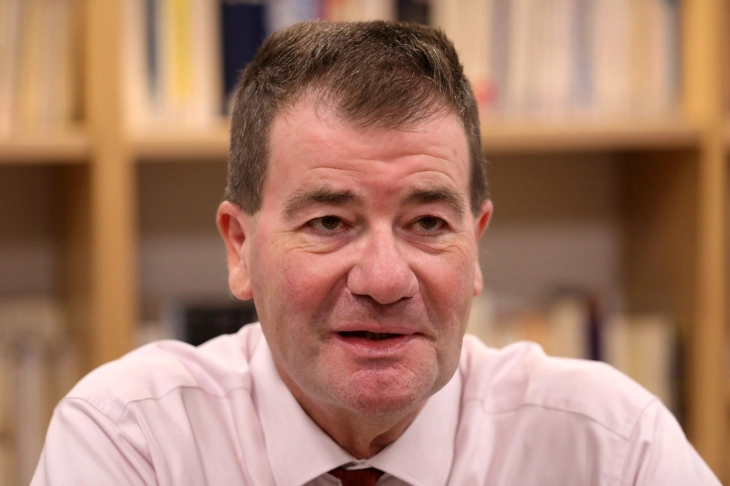
Skopje, 11 November 2025 (MIA) — The Macedonian Front breakthrough on Sept. 15, 1918, was the key event in World War I triggering a cascade of events that led to the armistice on Nov. 11, 1918, French historian and Macedonian Front expert Éric Allard told MIA in an interview. He is visiting the country on Nov. 11, Armistice Day, to give a lecture on the Macedonian Front.
The Macedonian Front, in Balkan and world historiography, is also known as the Salonica Front, the Orient Front, the Balkan, Southern or Forgotten Front. It started in October 1915, when the Entente powers arrived in the city of Thessaloniki, followed by the Central Powers' military formations in December 1915. The main line of the front stretched from Lake Ohrid to the Orfano Gulf in the Aegean Sea, with a smaller, strategic line from Ohrid to Vlorа in Albania with a total length of 600 km. On Macedonian territory today, on the Dojran – Bitola – Ohrid route of about 220 km, there are still visible traces of battles at the front. Many complex military operations and difficult battles were fought there, including at Crna Reka, Gornichevo, Kajmakchalan and Dobro Pole. The Macedonian Front was the first front the Allies broke through on Sept. 15, 1918, in the Battle of Dobro Pole, which heralded the capitulation of the Central Powers.
In an interview with MIA, Allard discussed the significance of the Macedonian Front in World War I, the French and the Macedonian perspectives on this period in history, the lessons learned as well as the use of historical commissions in overcoming historical disputes between countries.
"Undoubtedly, the Macedonian Front breakthrough was the first event that led to the armistice. French military researchers and historians have recently confirmed the fact the armistice began then, and this fact has been largely neglected throughout history," Allard said.
According to the French historian, the British and the French approaches to the Macedonian Front were different. The British invested less, not so much in terms of troops but primarily politically — because they were active in the Palestinian territories, Egypt, Arabia — and the French engaged far more.
"From a demographic perspective, the millions of casualties on the Western Front during World War I have deeply marked the collective memory of the French people. Still, the number of soldiers who lost their lives here is not negligible either. There were many casualties, especially from the French and Serbian armies," he said.
Admittedly, he said the topic of the Serbian armies was sensitive, because they certainly included many Macedonians, bearing in mind that Macedonian fighters were recruited into the Serbian as well as into the Greek and Bulgarian armies.
Immediately before World War I, Macedonia was divided into three parts, and the Macedonian people were under the rule of Serbia, Bulgaria and Greece. After World War I began, all three states mobilized the Macedonian population into their armies, with around 200,000 people being mobilized; some 50,000 in Serbia, some 120,000 in Bulgaria and some 20,000 fighters in Greece.

Historical commissions help bring countries closer together, but it takes time
The "ghosts" of the two Balkan wars remain in the region and reflect in relations between neighboring countries. According to Allard, forming the Macedonian-Bulgarian Commission for Historical and Educational Issues was beneficial in bringing together views on historical events. He said historical commissions could only have a positive role in bringing countries closer together, albeit it was a long-term process. He mentioned the example of France and Germany, which had also reconciled history through commissions.
"It is great there is a joint commission. The Germans and the French had three wars. In the past, when I would talk to older people, I remember this vivid hatred, a vivid feeling of intolerance toward Germans. Today, thanks to historians, but above all to education, the difference between a German and a Nazi is clear," Allard said.
Speaking about the length of the reconciliation processes, he said France and Germany tried to bring their views closer immediately after World War I.
"In the 1920s and 1930s, there were large pacifist movements in both France and Germany, but neither managed to prevent the emergence of Nazism," he said. "However, the post-World War II rapprochement of the two nations is a reality we live in."
He stressed that many nations took part in the Macedonian Front, adding that after 1912 and the Second Balkan War, the Macedonian population lived in abject poverty.
The French historian said he did his research on the Macedonian Front in French archives, but also collaborated with Italian, Macedonian and Bulgarian colleagues. Asked whether the French and Macedonian views on this period of history were different, Allard said he and his fellow historians, including Macedonians, had almost identical methods and almost all of their research and conclusions were objective and neutral.
"What we are trying to do is to discover the traces and remains of this period. We are doing all of this together, however. I do not speak Macedonian and I cannot really understand people's testimonies and what they are saying," Allard said.

Education and culture are our main weapons to stop history from repeating
Allard believes that education and culture can prevent the repetition of history.
"Education and culture are the basic and main weapons to oppose the cynics and the senseless," he said, referring to new geopolitical developments that suggest humanity has not learned any lessons from the World Wars.
Speaking about education and science, Allard—who has worked at the National Institute for Archaeological Research as a research archaeologist as well as taught history in high schools—organized several archaeological and oral history research expeditions with French and Macedonian colleagues in the Bitola region, along the Crna River, between 2009 and 2018.
They did archaeological surface surveys, supported by oral history research done through conversations with locals.

"We took photos of the entire region, made maps and plans, using drones for that purpose," he said.
"We also found a lot of military material, which had been subsequently used by the population living there. The poverty at that time, in this region in particular, or rather the kind of isolation the population was put in, led to the fact that this region became a kind of conservatory over time, preserving some things. We were lucky we started working on this research just when a branch was developing in France called Archaeology of Recent Conflicts," Allard said.
He presented the research results at several international conferences and published several studies in specialized historical journals, he said.
"What we did was a modest thing. Modest but precise research," he said, adding that it was also one of the first research projects done between the two countries.
Ana Cvetkovska
Photo: Frosina Naskovikj