Next week’s Economic and Social Council session to discuss minimum wage
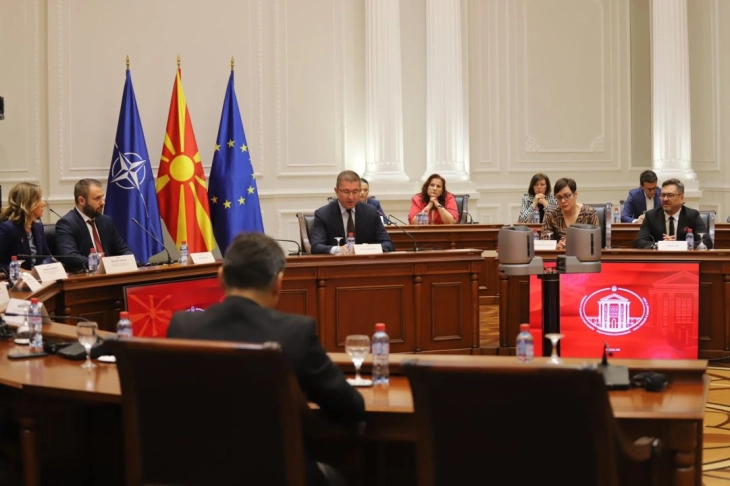
Skopje, 18 December 2025 (MIA) – The Economic and Social Council will hold a session next week to discuss the minimum wage. The government reiterates its position that it will support whatever solution unions and employers agree on, while the business sector hopes their proposal to ease contribution payments will be approved in connection with the minimum wage rise.
Deputy Minister of Economy and Labor Marjan Risteski Thursday reiterated the government’s position that it will respect any solution reached by consensus between employers and unions, and until an agreement is made, the minimum wage law will apply, meaning any increase will follow the well-known formula.
“This is a law, passed with the broad consensus of all three sides in the social dialogue, and must therefore be respected. Any decisions going forward should also be reached by consensus among all three parties,” Risteski said today, answering reporters’ questions ahead of the “Decent Work – Real Path to a Just Society” conference.
The Business Confederation emphasizes that while there is always a need to raise wages, such increases should come from those who are realistically able to do so.
“The economy is not equally developed across our country. The center of economic activity is concentrated in Skopje and the Skopje region, while other cities still lack significant volume, large revenues, and substantial profits. It is therefore important to be aware of the economic situation and to find a common agreement with the unions,” President of the Business Confederation of Macedonia, Mile Boshkov, said.
The Business Confederation is hoping for approval of their proposal: a wage increase with contributions remaining unchanged.
“A reduction in contributions corresponding to the increase in wages. For example, if the minimum wage rises to MKD 25,000 (€406) or MKD 30,000 (€488), the increase should be eased, while the other contributions, which have so far been paid based on the previous wage level, should remain unchanged,” Boshkov said.
The increase in the minimum wage is being requested by the Federation of Trade Unions of Macedonia (SSM), citing rising living costs as the main argument. In a survey conducted by the SSM in November, the majority of respondents said the minimum wage should be €600.
In a survey of 1,613 people asked about the minimum wage, 45.2% said it should be €600, 42% suggested more than €700, and 12.8% said €500.
The Confederation of Free Trade Unions (KSS) hopes that the Economic and Social Council will address questions concerning public sector pay supplements.
“There are many matters we need to discuss. Although a session of the Economic and Social Council has not yet been held, I hope the discussion will cover the minimum consumer basket, the minimum wage – raised by the unions – and other key topics. Issues regarding allowances and public sector salaries, which have remained static for years, must be addressed to ensure no one is left behind or disadvantaged. This demonstrates that all urgent labor issues can be resolved through social dialogue,” Blagoja Ralpovski, President of the KSS, said.
According to November data from the State Statistical Office, the annual cost of living rose by four percent.
Photo: MIA archive