Clear victory for Kosovo's ruling party in snap election

Pristina, 29 December 2025 (dpa/MIA) - Kosovo's Prime Minister Albin Kurti has won a clear victory in snap parliamentary elections, the country's electoral authority said on Sunday.
Kurti's left-leaning Vetëvendosje (Self-Determination) party took home 49.4% of the vote with almost all ballots counted, falling just short of an outright majority in the Balkan nation's second election of the year.
However, the incumbent is likely to receive enough backing from parties representing small ethnic minorities to secure a governing majority in parliament, news portal koha.net said.
Supporters of the ruling party drove through the capital Pristina in motorcades, blaring their horns as fireworks lit up the sky.
The snap election was called after February 9 polls produced no workable parliamentary majority.
Although Vetëvendosje finished first in that vote, coalition talks with opposition parties collapsed, prompting President Vjosa Osmani to dissolve parliament and call new elections.
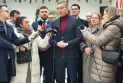
"After fair, democratic and free elections, we are even more victorious today than we were at the beginning of February," Kurti said in a short speech broadcast on television.
The centre-right Democratic Party of Kosovo (PDK) came in second with 21%, while the centrist Democratic League of Kosovo (LDK) won 13.6% and the conservative Alliance for the Future of Kosovo (AAK) 5.7%.
Under the Kosovan parliamentary system, 20 seats in the 120-seat Assembly are reserved for ethnic minority groups: 10 for Serbs and a further 10 for others including Bosniaks, Turks and Roma.
Formerly a province of Serbia, Kosovo declared independence in 2008 following an uprising and a NATO intervention in 1999. It has been recognized by more than 100 countries but not by Serbia or Russia, and is seen as a potential candidate for European Union membership.
The country's path to EU membership is complicated by the fact that five member states - Spain, Greece, Cyprus, Romania and Slovakia - have not recognized its independence.
Kurti's reform agenda
Kurti, who has led Kosovo since 2021, has pursued an ambitious reform agenda with mixed results.
He has eliminated parallel institutions supported by Belgrade in the north of the country, which borders Serbia and is inhabited almost exclusively by Serbs.
The move drew condemnation from the European Union, which advocated a cautious approach and imposed sanctions on Pristina that were partially withdrawn this month.
The reforms promised by Kurti have so far only partially taken shape. Critics complain that new laws designed to curb corruption have not yet been effectively implemented.
Observers attributed Vetevendosje's success to the party's successful mobilization efforts.
The election date between Christmas and New Year is also believed to have helped, with many Kosovars who work abroad - many of whom are seen as supporting Kurti's party - returning home to visit relatives over the holidays.
Photo: epa