Toshkovski for MIA: Claims that Macedonia will become a migrant hub are baseless
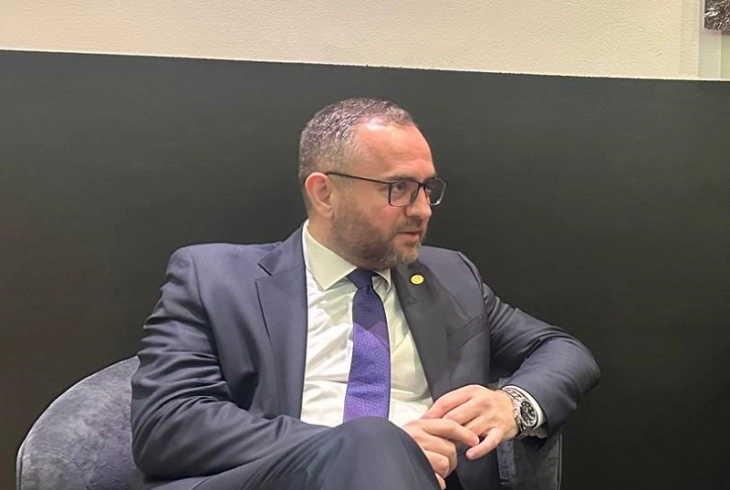
Brussels, 10 December 2025 (MIA) - Macedonia is neither considering nor has any possibility of agreeing to become a hub for receiving migrants or opening migrant camps, Interior Minister Panche Toshkovski told MIA Wednesday evening, who attended the second International Conference of the Global Alliance to Counter Migrant Smuggling in Brussels today.
“There has been a wave of speculation lately, especially from the opposition, claiming, without any basis in reality or logic, that Macedonia is becoming a hub or a suitable ground for accepting migrants who would be unacceptable to the EU or to countries traditionally friendly to Macedonia, such as the United Kingdom,” Toshkovski stressed.
He pointed out that the Ministry of Interior has neither thought about nor discussed anything of this kind, and it would not be acceptable for the country.
“I would just like to underline what the President and the Prime Minister said today, and what the Foreign Minister stated earlier: Macedonia has not considered, is not considering, and has absolutely no possibility of accepting in the future to become any kind of hub or to open migrant camps. Such a thing has never existed, nor will it ever exist,” Toshkovski stressed.
On the EU’s legal framework tied to the Pact on Asylum and Migration, Toshkovski emphasized that as part of the accession process, the next step for the country will be to harmonize its legislation with the relevant EU directives.
The Global Alliance to Counter Migrant Smuggling is a global forum bringing together all countries affected by and interested in addressing legal and illegal migration, countries of origin, transit countries like Macedonia, and destination countries where migrants ultimately aim to arrive.
“This was the second conference held under the Global Alliance, with discussions focused on the preventive measures that these three types of countries need to undertake, and on how to respond to the challenges each of them faces, especially the destination countries, such as EU member states,” Toshkovski said.
He noted that the conference was attended by representatives of the countries participating in the Global Alliance, primarily ministers responsible for interior affairs and migration as well as representatives of international organizations and agencies.
The Conference adopted a Declaration which, as Toshkovski stressed, outlines the future goals of the Global Alliance’s member states aimed at improving the fight against migrant smuggling and, more broadly, illegal migration.
On the sidelines of the Conference, Toshkovski met with the EU Commissioner for Internal Affairs and Migration Magnus Brunner, with whom he discussed Macedonia’s EU integration process, the importance of coordinated European border-management policies, and the challenges we face as a transit country for migrants, illegal migration, and human smuggling.
“I briefed on some of the activities we are undertaking in the fight against migrant smuggling. I shared certain statistical data indicating a reduction in the number of illegal migrants transiting through Macedonia, both from the southern to the northern border from Greece to Serbia and in the opposite direction,” Toshkovski said.
He noted that the data also indicate a decrease in the number of illegal migrants from Syria transiting through the country, while, on the other hand, there is an increase in the number of Afghan migrants.
“Overall, the number of illegal migrants transiting through Macedonia has decreased by about 10 percent,” Toshkovski added.
The Interior Minister also briefed Brunner on operations targeting illegal drug trafficking, noting that in the first ten months of this year, the Macedonian police seized over two tons of marijuana, around 11 kilograms of amphetamines, and about seven kilograms of heroin. “This demonstrates that as a country, we are capable of responding to such challenges,” he emphasized.
Toshkovski also held a bilateral meeting with Pakistan’s Minister for Interior and Narcotics Control, Mohsin Raza Naqvi. This was the second such meeting between the heads of the two ministries, during which a draft Memorandum of Cooperation was shared to strengthen the fight against terrorism and enhance police collaboration on illegal migration, considering that Pakistan is a country of origin for migrants.
Moreover, Toshkovski also met with the Director General of the International Centre for Migration Policy Development (ICMPD), Susanne Raab, discussing current migration challenges and opportunities to deepen future cooperation.
“Overall, I can conclude that today’s discussions were very productive, and I hope that in the future we will intensify the fight against migrant smuggling and respond appropriately to these organized criminal groups, which carry out the entire process of exploiting migrants and commit transnational crimes, some of the greatest challenges of the 21st century,” Toshkovski told MIA.
Photo: MIA


