European future of W.Balkans, political integration and economic challenges in focus of Pan-European Union of Macedonia conference
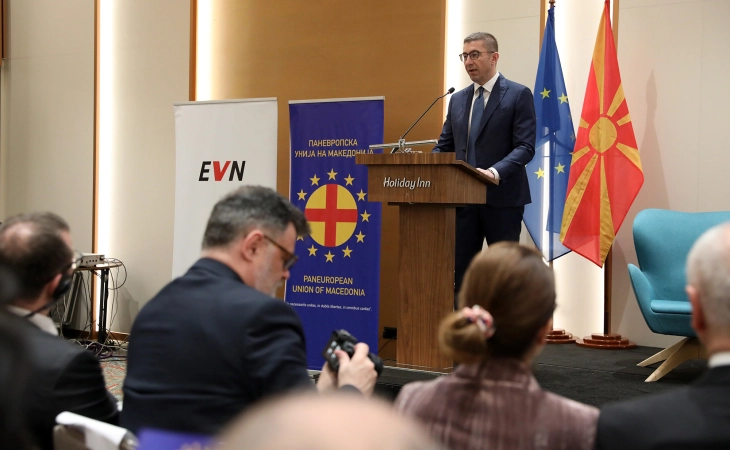
Skopje, 21 February 2026 (MIA) - The European future o the Western Balkans, political integration and economic challenges resulting from global processes are discussed at international conference organized by the Pan-European Union of Macedonia on Saturday.
Conference speakers sent a joint message that the region is part of the European architecture, not its periphery, adding that the continent is facing demographic challenges, migratory pressures and need for new energy sources.
Prime Minister Hristijan Mickoski said Europe is entering a stage in which demographic challenges stimulate illegal migration.
"Demography is a serious problem and a challenge for Europe and the world in the coming years. The problem of demography incorporates the issue of emigration, which is often illegal. This leads to a catch-all policies in societies - both right and left leaning political structures trying to mobilize votes by promoting radical positions. This radicalization is not good for Europe and the for the United States as well. U.S. Secretary of State Marco Rubio said 'We are a child of Europe'. Therefore, if two of the three biggest global powers - Europe and United States - then it is not good for humanity as well," said Mickoski.
He also referred to the paradox of having the Western Balkans, especially Macedonia, on EU's external borders and managing migration originating from member-states.
"Why are these migrants needed and why are they tolerated by political structure in Europe? Because of the low fertility levels and global challenges, Europe needs fresh workforce, most often people coming from third countries, other continents, different cultures. This brings its own challenges and specifics. We often witness violence on streets, messages that have nothing in common with European values that we believe in and share. This creates radicalization, and radicalization is a herald of bad times. The faster the continent becomes aware of this, the better for us all," he added.
Mickoski also focused on energy and the historic opportunity for the region in the context of technological change.
"The whole world is talking about AI, which is generated by electricity. Over the next decade, the world will need additional 40,000 TW, which might sound abstract but this is the amount that US, Canada, EU and Japan use today," he said.
In this context, the PM announced the Skopje Electricity Connectivity Initiative, uniting the Western Balkans Six in attracting a portion of the incoming big investment wave.
"We are not attractive alone, but together we can attract at least 0.1 percent of those 40,000 TW installed over the next decade, bringing about US$ 400 billion of investments in the region, i.e. double the nominal GDP of all six WB countries. It depends on us whether we transform our countries and societies or continue to drown in our Balkan political swamp. It's up to us to tailor our own future or allow others to make it for us," underlined Mickoski.
Pan-European Union of Macedonia President Andrej Lepavcov said Europe is facing issues that touch upon the essence of the European project and that is why the integration of the Western Balkans is a strategic, not a peripheral topic.
"Europe is facing issues in the core of the European project - unity, solidarity and capacity. In such circumstances, the issue of enlargement and integration of the Western Balkans should not be marginalized, this is a strategic issue for the stability of the entire continent. As part of the international Pan-European movement, our organization is continuing the tradition of the visionary European thought - Europe as a community of values, not only a market or institutional framework. Our position is clear: we are not on the sidelines of Europe, but part of its history, culture and security architecture, and our strategic commitment for EU membership is not an issue of daily politics but a generational decision," he added.
International Pan-European Union President Pavo Barisic said Macedonia has become a litmus test of EU's credibility, because the country has been among the most committed candidates for years, but has been blocked by bilateral disputes.
"We are meeting amid a decisive moment for our continent - in a time when thinking about the future of integration and the European destiny of the Western Balkans and Southeast Europe is again in the focus. In a recent resolution, the International Pan-European Union called for sooner accession of those countries that clearly show their commitment to European values and meet the criteria. The resolution highlights that functional or regional integration cannot serve as a replacement of real membership. Macedonia, despite all obstacles, has remained committed on the European path, and that makes it a litmus test for the consistency and credibility of European policies," said Barisic.
He added that accepting bilateral blockades by European institutions undermines the enlargement process, revives negative association for Balkanization and creates instability that goes beyond the region, but "active diplomacy, reforms and alignment with European law must be properly acknowledged and valued".
Photo:MIA