Nearly half as many births in 2024 compared to 60 years ago, fertility rate 1.34 in EU, 1.44 in Macedonia

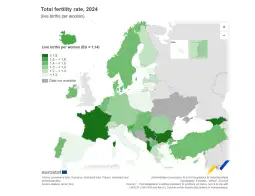
Skopje, 12 March 2026 (MIA) - In 2024, 3.55 million babies were born in the EU, a 3.3% decrease from the 3.67 million in 2023. The total fertility rate for 2024 was 1.34 live births per woman in the EU, down from 1.38 in 2023. In Macedonia, the fertility rate has also been declining over the past decade, dropping from 1.52 in 2004 and 2014 to 1.49 in 2023 and 1.44 live births per woman in 2024.
This fertility rate is significantly below the level of 2.1 live births per woman needed for natural population replacement, meaning that Europe, as well as our country, is already entering serious demographic challenges.
According to Eurostat, in 2024, Malta had the lowest fertility rate in the EU at 1.01, and Bulgaria the highest at 1.72.
In 2024, the average age of women having their first child in the EU is 29.9 years, varying from 26.9 in Bulgaria to 31.9 in Italy. In Macedonia, the average age for first-time mothers is 27.8 years.
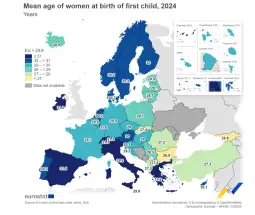
Over the past twenty years, women have been having their first child later on average. In 2014, the average age was 26.6 years, compared to 25 years in 2004.
In 2024, Bulgaria recorded the highest total fertility rate in the EU with 1.72 live births per woman, followed by France with 1.61 and Slovenia with 1.52. By contrast, Malta had the lowest fertility rate at 1.01 live births per woman, together with Spain at 1.10 and Lithuania at 1.11.
Eurostat data show that nearly half as many children were born in the EU in 2024 compared to six decades ago.
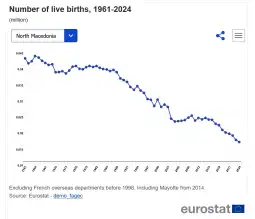
In 2024, 3.55 million children were born in the EU, corresponding to a crude birth rate (the number of live births per 1,000 people) of 7.9. For comparison, the EU’s crude birth rate was 10.5 in 2000, 12.8 in 1985, and 16.4 in 1970.
In Macedonia, the number of live births has been steadily declining since 1960, when 44,095 children were born, to 37,862 in 1970, 35,401 in 1990, 29,308 in 2000, 24,296 in 2010, 19,031 in 2020, and a record low of 16,061 in 2024.
Photo: MIA archive/Eurostat


