Toshkovski: Every police officer will do their utmost to prevent violence, but a more effective institutional response is needed
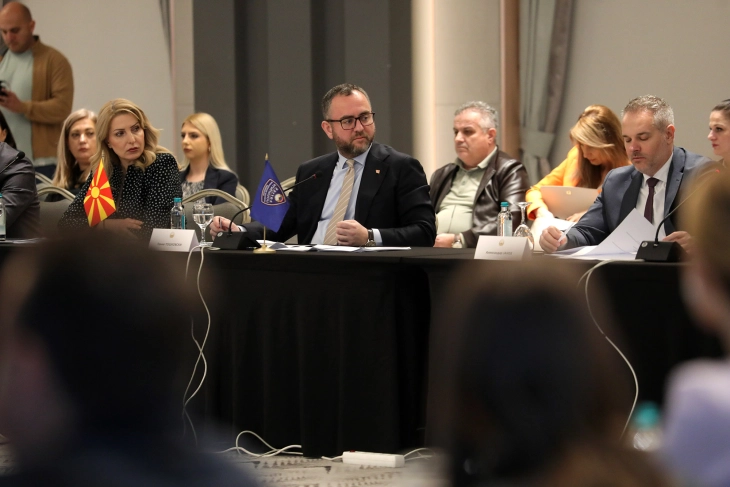
Skopje, 6 March 2026 (MIA) - Every police officer will do their utmost to prevent any form of violence, especially violence against minors, Interior Minister Panche Toshkovski said ahead of the roundtable discussion on providing support and protection of victims of violence against women and domestic violence.
He noted that one of the biggest challenges in dealing with domestic violence arises when the victim withdraws the statement previously given to the police.
Toshkovski said mechanisms exist within the current regulatory framework, but stressed the need for continuous and stronger coordination among all institutions involved in the system. He added that institutions still have much work ahead to improve, but that joint engagement is essential for the timely protection of victims and the prevention of further tragedies.
At the roundtable, Deputy Minister of Social Policy, Demography and Youth Gjoko Velkovski presented data and regional developments from social work centres across the country, highlighting trends and challenges within the protection system.
Velkovski said that in 2026 a total of 35 proposals had been submitted, 10 of which have already been completed. According to statistics for 2025, social work centres registered 1,754 new cases of domestic violence. Of these, 1,012 victims were women, 257 were men, while 228 children were registered as secondary victims.
There were 729 cases of physical violence, 1,091 psychological, 12 sexual and 50 economic. Velkovski said the numbers are increasing annually and that centres for social work are handling more complex cases, noting that protocols introduced in 2020 require stronger interinstitutional coordination.

Criminal Court President Daniela Dimovska said the tragic events that shocked the public this week are a clear signal that institutions must react more systematically and with greater sensitivity to domestic violence victims.
She stressed that the loss of two lives in a matter of days must not be minimised, adding that domestic violence is not only a legal but also a broader social issue. Dimovska stressed that domestic violence is not a private issue but a criminal offence requiring a swift, coordinated and decisive response.
Acting Public Prosecutor of the Republic of North Macedonia Anita Topolova Isajlovska said that since early 2024, authorities have recorded 1,715 cases of bodily injury related to domestic violence, with 798 halted after victims withdrew their requests for prosecution. She noted that this is a major challenge, as there is no way to determine whether the withdrawal is voluntary or due to fear, dependence or family pressure.
According to Topolova Isajlovska, the January 2026 amendments to the Criminal Code represent a major step forward, allowing prosecutors to continue prosecution ex officio even when victims withdraw.
“Victims may forgive their abusers, but the state must not,” Stojanka Mircheva, professor at the Faculty of Security said, highlighting serious weaknesses in the institutional response to violence against women.
She added that despite more than two decades of developing the legal and institutional framework, painful and tragic consequences persist due to gaps and inconsistencies in the laws.
She identified the most critical problem as the police’s more than 15-year refusal to enforce emergency protection measures, removing the abuser from the home and imposing restraining orders, which fall under police authority.
Mircheva stressed this is the only measure the state can impose immediately without the victim’s consent and warned that in practice, over 36 hours are often lost while the proposal reaches the judge, who must reissue the order.
Mirchevska also pointed to a “culture of incompetence” in institutions, which she said stems from a lack of gender awareness of violence, absence of institutional policies, and insufficient professional training.
She stressed that society shows solidarity only in moments of tragedy, but institutions must provide systematic, timely, and consistent protection. Unlike the victim, the state has no right to forgive violence and must fully enforce all protective and accountability measures.
Photo: MIA


