Slovenian PM's liberals win election but lose governing majority
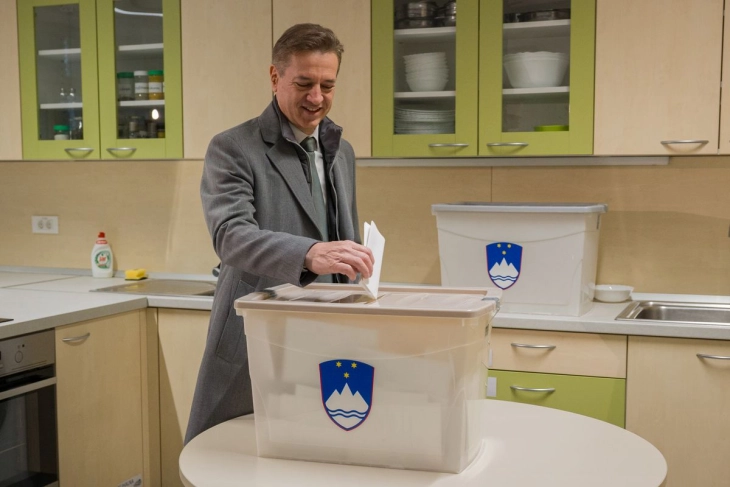
Ljubljana, 23 March 2026 (dpa/MIA) — Slovenian Prime Minister Robert Golob narrowly won Sunday's parliamentary election but lost his governing majority with left-leaning coalition partners, preliminary official results showed.
Golob's liberal Freedom Movement (GS) secured 28.54% of the vote and 29 seats after nearly all ballots were counted, the state election commission said. The opposition Slovenian Democratic Party (SDS), led by right-wing former prime minister Janez Janša, took 28.17% and 28 seats.
The result leaves Slovenia facing a difficult coalition process, with neither left- nor right-wing blocs reaching the 46 seats needed for a majority in the 90-seat parliament.
Golob nevertheless claimed the right to try to form a government, telling supporters on election night that his party had renewed its mandate and that difficult negotiations lay ahead.
Golob in power since 2022
Golob has been in power in Ljubljana since 2022, at the head of a coalition between his GS, the Social Democrats (SD) and The Left (Levica). The SD won 6.7% of the vote and six seats, while Levica, which ran this time in alliance with the Green Party Vesna, took 5.6% and five seats.
Janša signalled he could challenge the narrow outcome, saying every vote would be recounted, according to the STA news agency.
SDS's traditional coalition partner, the conservative New Slovenia (NSi) party, secured 9.3% of the vote and nine seats. The new Democrats party, led by former Janša ally Anže Logar, received 6.7% of the vote and six seats.
Janša has served as prime minister on three separate occasions, from 2004 to 2008, 2012 to 2013 and 2020 to 2022. He has led the SDS since 1993. During his time in government, he displayed authoritarian tendencies, endeavouring to restrict media freedom and allowing opposition demonstrators to be harassed by the police.
Golob's government is pro-European, but if Janša were to return to power, Slovenia could join the eurosceptic Central European group of right-wing populists, led by Hungary, the Czech Republic and Slovakia. Slovenia is a member of both NATO and the European Union.
Election campaign overshadowed by corruption allegations
In the last two weeks, the election campaign has been overshadowed by allegations of corruption, launched with fake videos.
The clips posted on an anonymous website showed ex-politicians and lawyers from Golob's circle talking about alleged corruption in the left-wing and liberal government camp.
The independent weekly newspaper Mladina identified Israeli lobby agency "Black Cube" as the originator of the campaign.
The group was founded by high-ranking Israeli former military and intelligence officers, and officials from the agency are said to have visited Ljubljana several times and met Janša at the SDS party headquarters.
The Slovenian intelligence service SOVA largely confirmed the media reports.
Janša denied having commissioned Black Cube, but admitted to having received the Israeli ex-general Giora Eiland, an advisor to the agency, at the SDS headquarters.
Social Democrat Foreign Minister Tanja Fajon spoke of an "attack on democracy in Slovenia."
Photo: dpa


