EU, Australia clinch free trade deal after eight years of talks
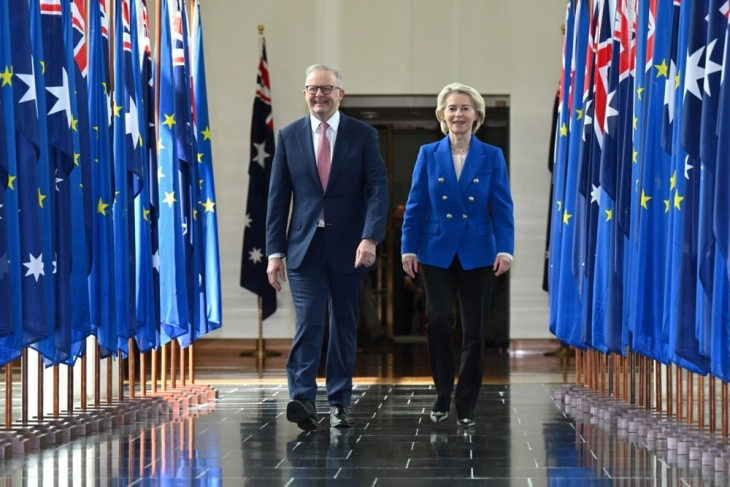
Canberra, 24 March 2026 (dpa/MIA) - The European Union and Australia have concluded negotiations on a free trade agreement, European Commission President Ursula von der Leyen and Australian Prime Minister Anthony Albanese announced on Tuesday.
The announcement comes eight years after negotiations on the deal first began. The agreement aims to remove tariffs and commercial barriers on both sides to boost trade in goods and services.
The conclusion of talks is part of an EU push to diversify trading partners as tensions with China over alleged market distortion persist and relations with the United States have become tense under President Donald Trump.
"Today, we are telling an important story to a world that is deeply changing, a world where great powers are using tariffs as a leverage and supply chains as vulnerabilities to be exploited," von der Leyen told journalists in Canberra.
"In our story, open, rules-based trade delivers positive outcomes. Trust matters more than transactions," she said.
"We are sending a strong signal to the rest of the world that friendship and cooperation is what matters most in times of turbulence."
Albanese said the agreement would benefit both sides.
"I am proud that we have been able to secure this deal, which will deliver benefits for both Australia and the European Union for generations to come," he said.
Albanese and von der Leyen also presented a new Australia-EU security and defence partnership.
The Australian government said the "wide-ranging partnership" would boost cooperation across the defence industry, cyber, economic security, counter-terrorism and hybrid threats.
Approval still required
The deal needs to be approved by EU member states and the European Parliament, as well as by Australia, before it can be signed.
It is yet to be determined when the deal would enter into force, which will also depend on whether it is approved in the EU without delay.
The agreement provides for the abolition of more than 99% of tariffs on EU goods exports to Australia, which would save companies of all sizes around €1 billion ($1.15 billion) annually in duties, according to Brussels.
The agreement is also intended to make it easier for EU professionals to work in Australia.
According to the commission, industrial sectors that could particularly benefit from the agreement include mechanical engineering, chemicals, the automotive industry and agriculture.
The EU is also set to gain improved access to Australia's strategically important raw materials such as rare earths and lithium.
For Australia, the removal of tariffs on exports such as wine and seafood is significant, while more agricultural products such as beef could be exported to the EU in future.
'Prosecco' dispute did not derail deal
One of the sticking points in the negotiations was the treatment of certain agricultural products whose names are protected in Europe and must meet specific production criteria, such as feta cheese, Gruyère and Parmesan. The use of the name "Prosecco" for Australian-produced wine was also a point of contention for the EU.
However, both sides ultimately showed willingness to compromise. Australian wine producers will be allowed to continue producing and selling Prosecco under that name domestically, but will not be permitted to export it under that label, Albanese said.
To address concerns from Europe's agricultural lobby, the EU said the agreement would remove tariffs on key exports such as cheese, meat preparations, wine and sparkling wine, as well as some fruit and vegetables, including processed products, chocolate and confectionery.
At the same time, tariff-free or reduced imports from Australia for sensitive products such as beef, sheep and goat meat, sugar, some dairy products and rice will be limited.
The EU expects exports from its member states to Australia to grow by around one-third to up to €17.7 billion annually over the next decade. Growth potential is seen particularly in dairy products, motor vehicles and chemicals. EU investment in Australia could increase by more than 87%, it said.
Other major EU trade deal being reviewed
A landmark free trade agreement between the EU and the Mercosur states Argentina, Brazil, Paraguay and Uruguay was recently referred to the European Court of Justice for a legal review by EU lawmakers, threatening to derail the deal even after a provisional implementation date has been set for May 1.
The EU-Mercosur deal, which was negotiated for over two decades, is viewed critically by European farmers as they fear increased competition.
Ahead of Tuesday's announcement, the European Commission tried to dispel EU farmers' concerns about the possible removal of protective measures by stressing the EU's big trade surplus in agricultural goods.
According to EU figures, the bloc was Australia's third-largest trading partner after China and Japan in 2024.
For the EU, however, Australia is a relatively minor partner, ranking 20th in terms of trade volume.
The difference is also due to the market sizes. The EU's 27 member countries together have a population of over 450 million, while Australia has just under 28 million inhabitants.
Photo: EPA


