Mickoski: Macedonia among top three European countries with comprehensive measures against price shocks, fuel prices to drop
Skopje, 19 April 2026 (MIA) - Prime Minister Hristijan Mickoski said Sunday that Macedonia is among the three European countries implementing the most comprehensive measures to ease the impact of price shocks, adding that gasoline and diesel prices are expected to decrease by 1.5 denars starting Monday.
As Mickoski said at a press conference, according to data from the International Monetary Fund published on April 15, the country ranks third in Europe in terms of the scope of measures taken as a percentage of GDP to mitigate the effects of the energy crisis, despite claims by the former SDSM and DUI government that the measures were either delayed or unnecessary.
“It is important to underline that our policies are not isolated, but fully in line with global trends. According to the latest IMF analyses at European level, we are among the top three countries in Europe that have introduced the most changes and implemented the most measures to deal with price shocks. “This is precisely what can be seen on the slide. As you may remember, in the past period SDSM and other coalition partners from the former government, such as DUI, claimed that the measures were delayed and insufficient. However, according to IMF data published on April 15, four days ago, we are ranked third in Europe in terms of measures implemented as a percentage of GDP. They lied about migrants, they lied that we would go bankrupt, they lied that there would be no pensions, and many other things. They also lied about the measures we implemented, while we prepared for the energy crisis, which I will repeat does not depend on us, but on geopolitical and global developments. From the slide you can see that as a country we are practically in third place, something that in the past under the SDSM and DUI government was considered impossible. The effects of these policies are clearly visible today,” Mickoski said.
He said the energy crisis was caused by global geopolitical developments and is not a result of domestic policies, adding that the effects of government measures are clearly visible today, particularly amid corrections in prices on global markets.
He noted that the country is experiencing a period of heightened global uncertainty and that energy price shocks are not caused by domestic policies but by geopolitical conditions, especially crises in the Middle East and volatility on global markets. In these circumstances, he emphasized, the government’s duty is to react promptly and safeguard citizens and the economy.
Mickoski said that the Energy Regulatory Commission is expected to adopt a decision Monday to reduce gasoline and diesel prices by around 1.5 denars. The measure agreed with the company OKTA also remains in force, under which gasoline prices will be discounted until the end of April.
“At the same time, the measure previously agreed with OKTA remains in force, under which gasoline prices will be reduced by two denars per litre and diesel by three denars per litre until the end of April. This again shows that we are a country with the lowest fuel prices,” Mickoski said.
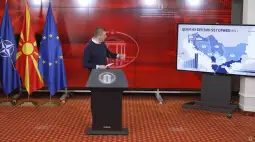
According to Mickoski, these measures make Macedonia the country with by far the lowest fuel prices in the region and among the lowest in Europe. He noted that the price of 95-octane petrol in the country ranges between €1.27 and €1.31 per litre. By comparison, he said that in Greece and Albania the price exceeds €2 per litre, while higher prices are also recorded in Serbia, Bulgaria, Montenegro, Bosnia and Herzegovina, Croatia and Slovenia.
He assessed that the effects of government policies are already visible and that, in addition to interventions on VAT and excise taxes, the government is taking a long-term, holistic approach to stabilizing the economy. He said this approach also includes measures to strengthen the domestic economy, increase competitiveness and create conditions for sustainable growth.
“We will continue to closely monitor the situation and respond accordingly. Our approach remains the same, without euphoria, but with a clear strategy, facts and results. Our obligation is one: to ensure stability, security and a higher standard of living for the citizens,” Mickoski said.
Asked by journalists, Mickoski explained that the decision to amend excise taxes and VAT was taken following the expiration of the first set of measures, which applied during the initial two months of the energy crisis.
Mickoski said that at Saturday’s government session the first intervention package of measures was completed, which included reductions in excise taxes and VAT on fuel. He added that VAT on diesel has been returned to 18 percent from the previous 10 percent, explaining that diesel had seen a stronger price increase compared to gasoline in the recent period.
On value added tax for diesel, we implemented VAT at 18 percent instead of 10 percent, as the period of that measure has ended, Mickoski explained. He said that, considering the movement of diesel prices on the market, it was concluded that with the return of VAT to 18 percent there would again be a reduction in diesel prices, taking into account last week’s average.
For gasoline, the government has decided to keep the reduced VAT rate of 10 percent for this and the next two weeks, in order to prevent further price increases and maintain stable prices for this fuel.
Photo: screenshot


