Regional Anti-Corruption Initiative hosts training for police and MoI staff
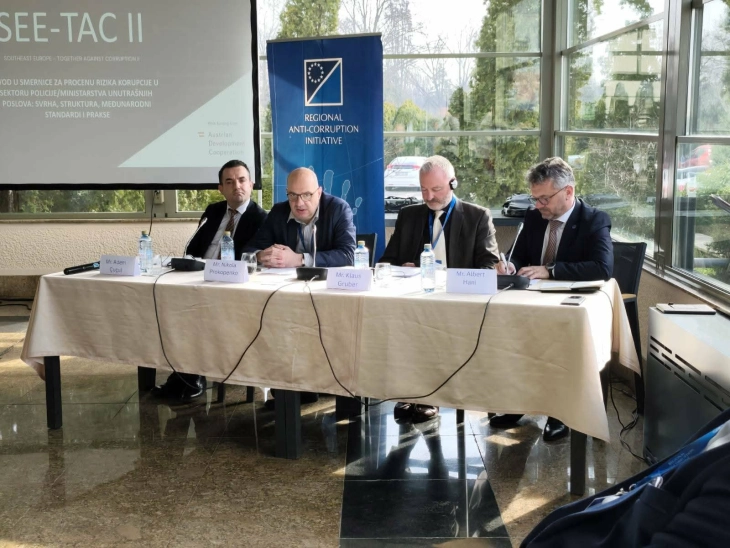
Skopje, 2 March 2026 (MIA) - To establish and effective and efficient system for the prevention and tackling of corruption and conflict of interests in the country, a systemic approach is necessary by the relevant authorities to identify corruption, prevent it, prove it, and sanction it. Such an inclusive approach, involving all stakeholders, is necessary since the fight against corruption is a collective responsibility, said the head of the State Commission for the Prevention of Corruption, Adem Chuchulj, in his opening address Monday at a corruption risk assessment and corruption proofing of legislation training event organized by the Regional Anti-Corruption Initiative (RAI) for representatives of the police and the Interior Ministry.
The SCPC head said the principles of legality, integrity, and equality should serve as fundamental postulates in the exercise of all public posts and in the official duties of all public sector employees.
“The assessment of corruption risks, their identification and management, is a key preventive mechanism which, as of December 2024, has become a legal obligation for the public sector, in order to determine strategic and corruption risks, as well as operational risks of corruption,” Chuchulj said.
He stressed that the focus of the fight against corruption is the five-year strategy adopted by the SCPC and approved by Parliament. Chuchulj noted that despite the importance of this strategic anti-corruption document for the country, without a prior assessment of sector specific regulatory risks of corruption, it is impossible to identify priority problems in different sectors of society and plan activities to overcome them.
The Director of the Regional Anti-Corruption Initiative, Albert Hani, said they are currently running training in the areas of security and environmental protection, which, he said, were selected on the basis of an expert analysis by RAI that identified these areas as the most sensitive ones when it comes to corruption. He noted that RAI has previously worked in the country in education and culture.
Hani thanked the Austrian Embassy for its support of RAI, especially the current project, which, he said, aims to achieve significant results on a regional level. However, he noted that the Initiative is aware that corruption is not just a regional challenge, but also a global one.
Nikola Prokopenko, state advisor at the Ministry of Justice, stressed that the country has undertaken significant activities in the field in recent years, noting that in 2021 an international agreement was drafted for the exchange of data to verity property ownership, which was signed the same year, adding that North Macedonia was one of the few countries that initiatied this process.
Representatives from relevant ministries and institutions were involved in the drafting of the document, and, according to Prokopenko, “Macedonia was the first country to ratify this international agreement and is already in the process of implementing it”.
Klaus Gruber, Police Attaché at the Austrian Embassy in the country, underlined that Austria supports the project in Southeast Europe focused on the rule of law, good governance, and integrity.
“Strong, independent, and accountable institutions are essential for the citizens’ trust, stability, and sustainable development. It is very important for the country to cooperate with citizens in the fight against corruption,” Gruber said.
He added that Austria’s experience should be transferred into everyday practice, and that this Initiative and the specific training are intended to make that possible.
Gruber stressed that for North Macedonia, as well as for all Balkan countries, the foundations for EU membership – law, justice, rule of law, the fight against corruption, and public administration – are not merely topics for negotiations with the Union, but the basis for better conditions for citizens and for building trust in the state.
Photo: MIA


