My innovative method sheds third of excessive weight, world-renowned doctor Ivo Boshkoski tells MIA
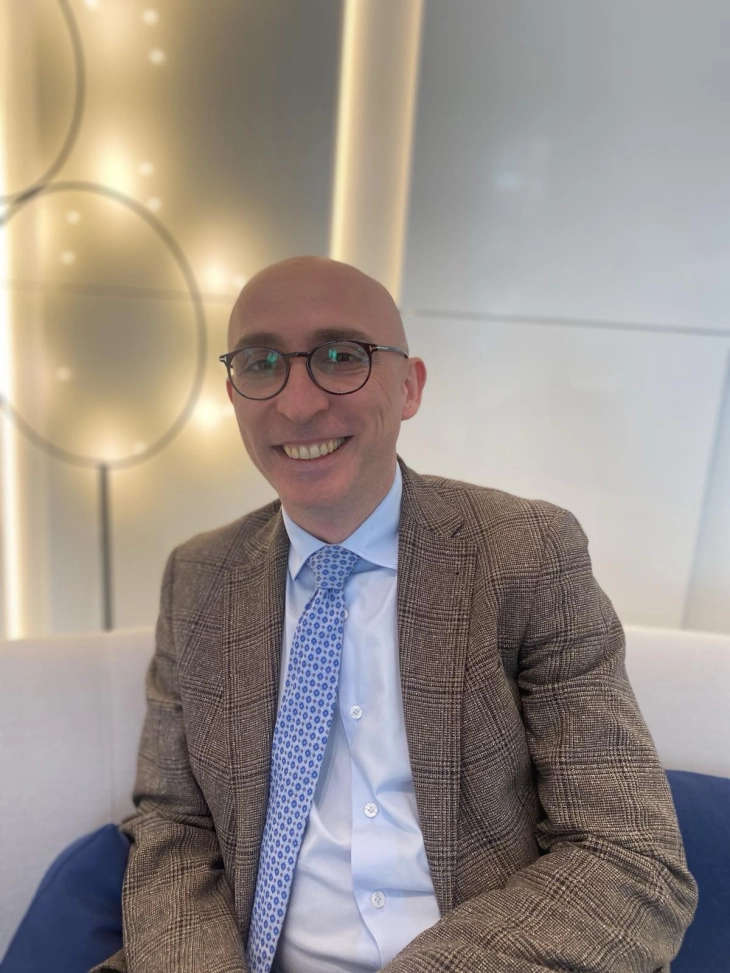
Skopje, 9 August 2025 - Macedonia is a small country with very smart people. A lot of families cook at home, preparing healthy food for the children and themselves, rather than buying something in packaging. All of this is very important in the fight against obesity. It is better to eat less and feel healthier than overeat and experience health problems, says world-renowned doctor, Tetovo-born Ivo Boshkoski, who is heading a revolutionary slimming method in the "Gemelli" hospital in Rome.
Doctor Boshkoski tells MIA he is the first to introduce an innovative method using special gastroscopy that eliminates the hunger hormone. The method produces exceptional results in the weight-loss process.
Boshkoski says that obesity is a disease defined by the World Health Organization, not an aesthetic problem, and if a country invests in reducing the number of obese patients, then its population will be healther and its workforce will be happier.
According to him, every country needs to regulate its own obesity problem noting that media should contribute by putting constant pressure on the avoidance of eating unhealthy food, unhealthy beverages, alcohol, thus solving one part of the problem, the other being home education by parents.
Italian newspaper "La Repubblica" recently published an article about you and your slimming method used in the "Gemelli" hospital in Rome. Could you tell us more about it?
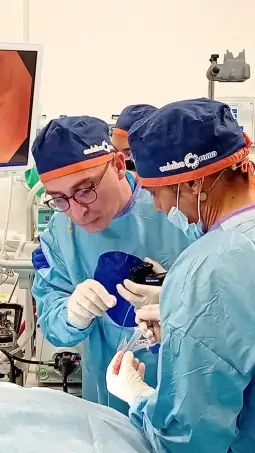
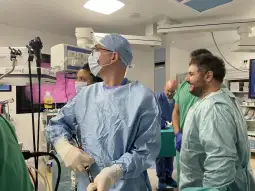
It is a procedure called endoscopic vertical gastroplastics, which I introduced back in 2013 in Italy, after it was first used in the United States a year earlier. We have been doing it since on a regular basis, approximately nine procedures a week on patients suffering from diabetes, high blood pressure etc. It is a mini-invasive procedure and we are fighting constantly to make it one that can cover all obese patients. I introduced this method od ablation i.e. burning the upper section of the stomach, which hosts cells of hormore ghrelin, an appetite-regulating hormone. We have discovered that these cells are hypertrophic among obese patients, producing a lot of the hormone. We have done an electronic microscopy and for us it is very easy to endoscopically burn those hormones, which results in the mucosa falling off and restoring itself. The new mucosa has healthy cells and this method provides a booster to the vertical endoscopic gastroplastics. The results are very good - weight loss of 28 percent to the initial BMI after 12 months and up to 32 percent after 18 months. An official publication is due in October. Meanwhile, Erbe Elektromedizin has produced the Moviva probe and Catholic university "Gemelli" has promoted our results. Over 40 Italian media outlets, including La Repubblica, ANSA news agency, Il Messaggero and other web-portals have published the news.
You are seen as the first doctor in the world to introduce this innivative method that produces exceptional results in the weight-loss process. What does this mean to you?
Yes, I introduced the procedure titled Endosleeve in 2013 and I am among the first doctors to promote it on a global scale, my innovation being the stomach ablation. I am pleased to be able to help the patients. The mini-invasive procedure can be made with full anesthesia, mild sedation, both with the pediatric and geriatric population. The oldest patient I have operated on was 85 years of age. I am also satisfied from the research we have done in the field.
Testing in the Gemelli clinic has shown positive results. What are the preliminary results?
The preliminary results are very, very good. We hope they will remain so in time, considering this is a chronic disease. As I said, we have seen an up to 32 percent of weight-loss, which is sensational for a mini-invasive procedure of 30 minutes. I believe this is a great result.
We have seen people, especially young ones, doing the gastrectomy procedure in recent years. Such operations are primarily done in Turkey, which has become a popular medical destination for this purpose. How much does your method differ from this one and what are its advantages?
There is an enormous difference between the two methods. The one you mentioned involves cutting part of the stomach and tubularizing it. Endosleeve, the one I am doing, is endoscopic reduction from the mouth, the stomach folds from the inside and nothing is cut. With endosleeve plus ablation, complications amount to less than one percent. It is very rare, maybe less than one in 1,000 patients, to have a perforation, unlike with the gastrectomy, which is surgical and complications are higher, sometimes even fatal, but also resulting in chrnoic problems, plus patients often experience a reflux that can lead to precancerous states.
Both procedures are performed on patients that have relapsing chronic disease - obesity. When you have such a patient, you must follow him on a monthly basis, then every three and six months, along with diet, psychological re-education etc. Before that you have an endocrinologist, psychologist, nutricionist, hepatologist, who evaluate patients in order to give them an indication for an operation. Now, can you imagine a patient going abroad and paying for an operation, how can he/she be monitored afterwards for a chronic disease?. Nevermind a complication that is often surfacing a month later. Who will work on that? These are issues that are quite complex to solve for patients operated abroad.
Our procedure is free of charge for the patients, fully covered by the health system. Of course, as in every hospital, there are paying options, but the health insurance pays for a vast majority of patients because this is a disease defined by the World Health Organization, not an easthetic problem. Obese patients have many underlying illnesses - psychological problems, hypertension, diabetes, osteoarticular diseases etc. They often do not have a job, have to frequently take sick leaves, take a lot of drugs and are a burden for the state. If the country invests in reducing the number of patients suffering from obesity, then it will have a healthier population and a happier working population.
According to the World Obesity Federation, over half of the global population is expected to be overweight by 2035. What is your advice for prevention of this health problem and solutions for those already facing it?
Do you remember the battle against smoking about 20 years ago? The battle is still ongoing. Every pack of cigarettes now reads 'Smoking harms your health'. When our children watch TV, there are ads for all types of unhealthy food, fast food, soft drinks etc, but it does not say anywhere that this food or beverages are not good for your children's health or you. There are several petitions to the European Parliament to do this, a strong lobbying effort is needed, as was the case with the tobacco. Nevertheless, every country needs to regulate the national obesity problem by itself.
The other part of the problem is education at home. When children don't want to eat anymore, parents should not insist on them finishing their plate. This is seen in the south of Italy and the Balkans, where parents think that the child is ill or won't grow up if it does not eat. Education by parents and grandparents is very important, because education on a proper diet starts from birth. Of course, a proper diet also depends on the family's economic circumstances, meaning healthy cooked food. It does not mean that food is healthy because it is expensive, there are a lot of cheap things that are very healthy, but also the way they are prepared is very important.
Besides the state and the family, the school is the third pillar, where children should be educated about healthy food and caring for the environment. All of this is connected, this is a chain between food, environment, education, and all stakeholders should support it.
United States Health Secretary Robert Kennedy Jr. says one in five children in the U.S. are overwight, compared to one in twenty in the 1980s. He puts the blame on processed food full of artificial sugars given to children, and has launched "warfare" against food companies. Do you have any data on the state of play in Italy and Europe?
No one has a better appetite regulation than a child. The child knows when it is enough. It is better they eat less, more frequently. I am not a nutricionist but this is the key aspect. This is a global pandemic and the fight starts from the child's birth, meaning proper education for a proper diet. According to The Economist, the number of obese children in 2022 or 2023 is larger than the malnourished ones, a completely opposite trend compared to 20 years ago. Of course, all of this is owed to processed food, which is given to children by parents and the family. Yes, food at McDonalds is much cheaper than in a restaurant. People often have access to cheap food that is very unhealthy as well, but cheap food can also be good - peas, beans, vegetables.
Obesity is also directly linked to Diabetes 2. Why don't countries pay much more attention to prevention, even if they go into conflict with large food companies, rather than spend billions for diabetes treatment afterwards?
This is related to the previous two questions. The battle is with multinational companies for softdrinks, unhealthy food, sugar... A lot of preservatives and artificial dyes are used and substances that destroy the gut microbiota, especially the large intenstine, and this has a great impact on obesity, especially among children. When it comes to unhealthy diet among adults, this includes processed food, alcohol etc.
You are a world-renowned scientist in the field of gastroentherology. How can your knowledge and experience be applied in our country?
Macedonia is a small country with very smart people. A lot of families cook at home, preparing healthy food for the children and themselves, rather than buying something in packaging. All of this is very important in the fight against obesity. It is better to eat less and feel healthier than overeat and experience health problems. Various methods can be applied in Macedonia. First and foremost, the economic status is key to eat healthy, but healthy food is not necessarily expensive. This is all related.
You are heading the Department of Digestive Disease and Endoscopy at the Gemelli hospital and a professor in gastroenterology. How did you come to work in this renowned clinic?
I am responsible for the research and the scientific protocols in the clinic. I own a lot of patents, including a regenerative endoscopy, which was released in many prestigious global journals. I was also a member of the managing board of the European Association of Endoscopic Surgery.
My path is a rather long one. I studied medicine in Skopje for a couple of years and then transferred to Perugia, Italy, where I completed my studies. It is very difficult when you go abroad, I had to both study and work in order to pay off loans, got a scholarship, but you can make it if you have a goal. It is shocking to me when I see a lot of young people nowadays neither working nor studying. There are so many opportunities our there, the world gives a chance for everyone to be successful.
Gemelli is the most prestigious clinic and a Catholic university in Italy. I decided to go there because I wanted to challenge myself. It is extremely difficult to enter a residency programme, I was doing mine at University Campus Bio-Medico, which is close to Gemelli, and from there I did my PhD at Gemelli. I specialized in endoscopy, gastroenterology, and I am currently among the top five or six endoscopists in the world. Gemelli is the global training center for this branch, with people coming from all over the world to learn these methods. I am very pleased to see people from Macedonia but also the Balkans coming for training here.
Pandorka Arsovska Gacova
Photo: Ivo Boshkoski private files


