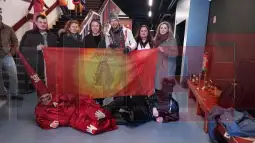
Vevchani inspiration for Berchem - carnivals bring community together through masks, street parades, fun and creativity
Skopje, 22 February 2026 (MIA)
Last week, the carnival Corso de las Luces (Company of the Light) took place on the streets of Berchem, a municipality of about 40,000 citizens in the southwest area of Antwerp, including masks coming from Vevchani.
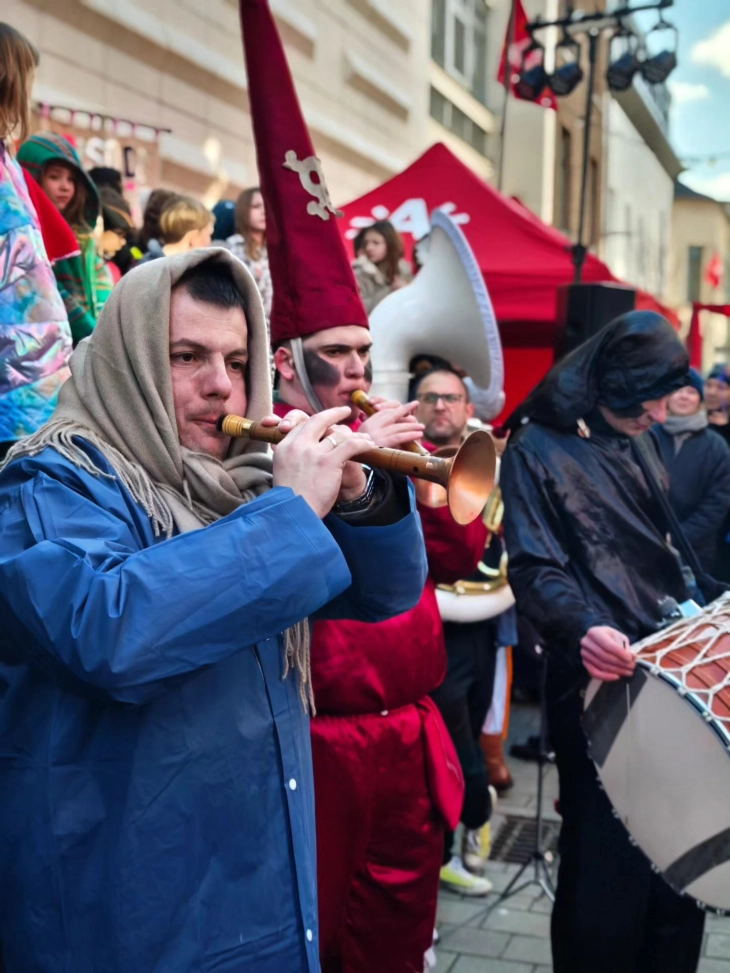
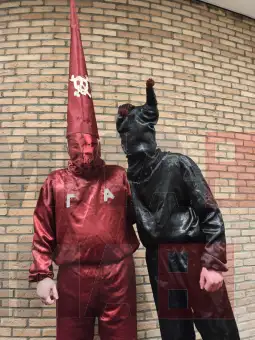
Vevchani citizens Viktor Peshinoski and Grigorij Plukoski, dressed in one of the most famous masks of the Vevchani carnival - the Dumb August and the Devil - playing music on a zurna and a drum, attracted the attention of the Berchem residents.
Aleksandra Velkoska, one of the organizers of the Vevchani carnival, has told MIA that the participation in this local festival is owed to the cooperation set up within an Erasmus+ project of the European Union for exchange of carnival experiences.
"Our carnival in Vevchani is unique and very old, and that is why it always attracts many guests. The group organizing the carnival in Berchem has done a lot of research on our carnival. Their representative attended the Vevchani carnival a few years ago and this is the time when we first discussed the idea of exchanging carnival experiences. They applied to their municipality with a project, which was approved and received funding from the Erasmus+ programme. They were our guests this year, had a great time, witnessed all customs and saw what the event means to all of us. They went together with the carnival-goers to the homes and witnessed all rituals," said Velkoska, who was part of the Vevchani Carnival delegation attending the Berchem festival.

The Vevchani Carnival is celebrated each year on Orthodox New Year (January 13-14), the belief being that evil spirits are chased away with loud music, masks that are scaryt but also criticize society, politicians and historical figures.
"The goal of the carnival is to chase away everything that was bad in the previous year and to start the new year with a clean slate," says Velkoska.
Unlike our carnival, she adds, the Berchem festival is recent, and the group organizing the event did some research before hosting the Corso de las Luces.
"The group is multinational and so the music is multinatiuonal. They come from Argentina, Mexico, Spain, Belgium, they all carry their own traits and contribute to the carnival customs, masks and music. Carnivals are always diverse, the colors are always bright," said Velkoska.
The Vevchani delegation also took part in a workshop, where they had the opportunity to present the Vevchani carnival in the best possible way.
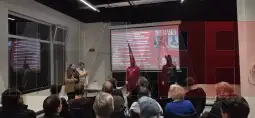
Velkoska notes that the goal of the Berchem organizers is to spread the knowledge to other carnival cities, so they get to know the similarities and differences, as well as the meaning of rituals and masks.
Fun and creativity of carnival in bringing community closer
Enrique Noviello, one of the five enthusiasts who organize the Berchem carnival, tells MIA more about the event - how long it exists and the idea behind it.
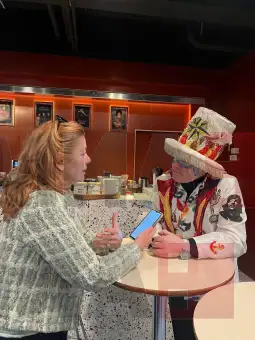
"The story goes 20 years back when together with a colleague of mine, we had this idea to reproduce a street manifestation typical from Buenos Aires in Argentina, where we were born. We did it for 10 years in Belgium, and then because of economical reasons mostly, we had to stop. And five years ago, together with my band, La Murga Armada, we came to visit this cultural center, and we went to talk to the municipality with the idea of developing a festival that would be for the whole family, to be able to work with schools, to be able to work with these homes for old people, and to make it as popular as possible, that everybody would feel welcome. This is the fourth edition, and our dream would be to invite the population of our neighborhood to be part of this celebration, to share the streets, to share a moment of meeting each other, talking to each other. And I think for us, that's the most important thing. Carnival is an excuse to bring people together," says Enrique, or Kike as he is called.
They are satisfied with the response of the local community and the residents of Antwerp, which is home to 160 nationalities.
"The response is great. But why is the response great? Because, again, you know, and this is also something we confirmed when we went to visit Vevchani’s Carnival. Carnival is, I think personally, the popular fest. It's the party where everybody is welcome, no matter the color of your skin, no matter your nationality, if you're rich, if you are poor, if you are beautiful, if you are ugly, everybody is welcome. And during Carnival, and this I experience a lot, people who may be shy, and then they start dancing, and they shine. People who may be quiet, and then they start writing, and they write the best poems for Carnival. So I believe, I'm completely convinced, that Carnival is a creative space of liberation, of popular liberation. And we have experienced this in our neighborhood as well. You have to know that in Antwerp, we live together with 160 different nationalities. So there are a lot of challenges but also a lot of potential, depending how you want to look at it, you know? And I see it as a potential, says Noviello.
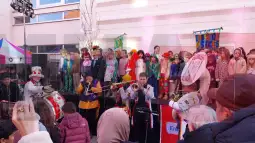
Part of their project is the cooperation with schools. This year, they worked together with five schools, and about 1,500 children participating in a parade in the neighborhood.
"And we wrote one song for the schools and for the neighborhood. That's the song that we were singing in the beginning. So we work together with the schools, and the schools, they decide, 'We will work with the kids from first, second, and third grade,' or, 'We will work with the older ones' because, of course, the schools, they have their own programs, and for the teachers, it's already sometimes very difficult to fulfill the program. But I think we will try next year to go for a full-year program with the schools. That we can really invite the schools in a participative, creative process that will take a whole year to create the costumes, to work on lyrics, to work on choreographies, to really involve the kids in a whole creative process," says Noviello.
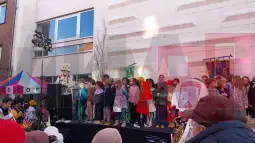
Regarding the carnival's name, he explains that the Corsos in Latin America are the carnival companies.
"Every Carnival company is a Corso. In other places of Latin America, the Corsos are also specific manifestations with horns, instruments, et cetera. Corso de las Luces is a combination of many different things. On the one hand, our cultural center is called Corso. Secondly, we have this link between the Latin American nominative name for Carnival companies. And, “de las Luces” - because we wanted to make a reference to the light as to the fire. Because the fire brings heat and light. But the fire is also where, through the ages, the people came together to tell stories to each other, sitting around the fire. It was the place where you were safe, when you was warm, and when you would find each other. Where the stories were told from father to son, from generation to generation, where traditions were built. And we found it a very poetical image of using the light and the fire. Corso de las Luces would mean something like the company of the light," says Noviello.
On the cooperation with the Vevchani Carnival
Noviello says it came about because of two reasons, one personal and one more professional.
"The personal reason is my girlfriend is from Macedonia. She's from Skopje. So I was visiting Macedonia a lot the last years. And I'm always researching about carnivals. I love to go to visit carnivals. And then I found that in Macedonia, in Vevchani, of all places, is one of the oldest carnivals of the world. Because the oldest carnivals are in Europe, and this is one of the oldest carnivals of Europe, thus of the world. And I was completely intrigued, so I start to look for videos online, etc... We went to visit the carnival the last year. That's when I met Aleksandra. And we made a proposition to Erasmus+, which is a European program for adult education. We make an appliance to get foundation, and they approve our project. So we were able to visit Vevchani during carnival, and to participate in their carnival. We even got our passports there. I have three citizenships now: Argentina, Belgium, and Vevchani. Now I need the Macedonian passport," says Noviello.
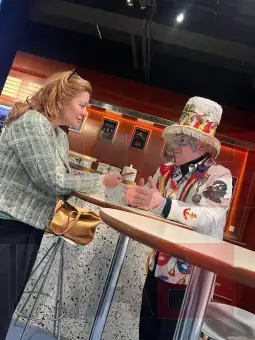
He notes that the exchange program was to travel to Vevchani to learn from the traditions and the way they live the carnival "and they come to us to tell us stories, and to share expertise and know-how about traditions and organization".
"Two days ago, the Vevchani delegation, they were presenting their carnival to the neighborhood. And it's really inspiring when you see how little stories, for me, are really significant. This is the first step into a bigger program of international carnival collaboration. The opportunities are open. I'm convinced that carnival is a creative laboratorium, where beautiful things can happen that might improve the living quality of a community," says Noviello.
Asked to describe the Vevchani Carnival in a few words, he says "go, get a costume, and be part of it".
"Don't go as a witness. Live it. Get wet, as we say. Just go and get wet. Jump into the experience. Jump into the experience, because that's the only way to understand why traditions are so important for a community," says Noviello.
Violeta Gerov
Photo: Corso de las Luces, Aleksandra Velkoska, MIA