EU membership without voting rights - bypassing status quo in enlargement or a road to nowhere: MIA analysis
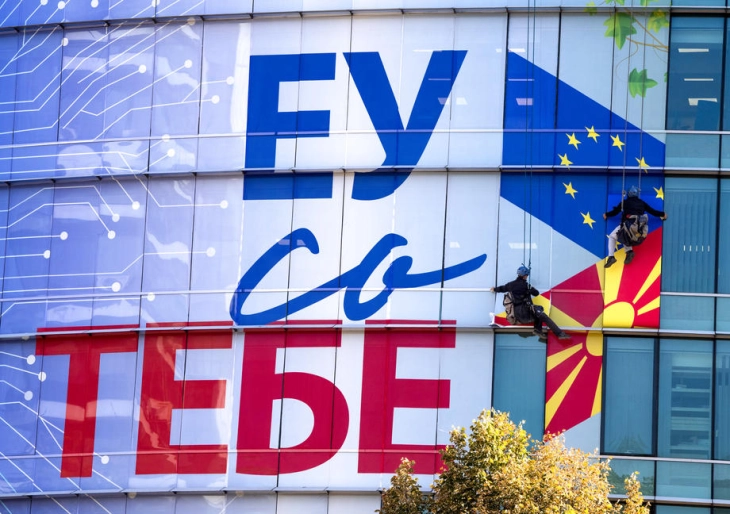
Skopje, 3 March 2026 (MIA) - Discussions for a sooner accession of new member-states and changes to the existing rules have been gaining momentum in Brussels in recent months. Following the Russian invasion of Ukraine, European Union enlargement has become a security issue. The European Commission is looking into ways to swiftly bring Ukraine into its fold as part of a peace deal, with the country not getting full-fledged membership at once but through a transition process. The idea of a "two-tier Europe", meaning accession without full voting rights in the first stage of accession, should also include countries of the Western Balkans.
The idea of EU phased accession has circulated in Brussels since last October, when the web portal "Politico" reported that the proposal is in the early stages and would require approval from all member-states, citing three European diplomats and an EU official. According to the report, the idea is for new member-states to obtain full rights after the Union. The idea is that new members would have full rights once the EU has overhauled the way it functions to make it more difficult for individual countries to veto policies.
MIA asked three analysts - Ivica Bocevski, Zhidas Daskalovski and Vasko Naumovski - what it would mean for the country if this proposal is formalized, and if the idea is tangible, considering the Union's consensus requirement.
Ambassador and former deputy PM for European affairs Ivica Bocevski says the key for realization of this proposal lies in the Russia-Ukraine peace deal, leading to Kyiv's accelerated path to full-fledged EU membership.
"In times of turbulent geopolitical realities, and especially after the Greenland crisis that is still not fully finished, the key EU countries will certainly not miss out on the opportunity offered by the Ukraine peace deal to close the Union's geostrategic area from a security, political and economic standpoint. In other words, Skopje and other capitals in the Western Balkans should closely follow what will be offered to Ukraine, since the same will be on the table for this region and Moldova as well," says Bocevski.
According to him, if this new 'temporary' form of integration includes Macedonia's entry into the single market, then the offer should be seized.
"The single market is in the core of European integration and the country's accession into the area is all it needs from an economic and civil aspect because of the availability of the four freedoms - people, commodities, services and capital. The entry into the single market is the 'holy grail' of European integration. Of course, it is of enormous importance that the country has access to the European development funds," says Bocevski.
He is certain that full-fledged EU membership would soon follow the entry into the single market, because one cannot be sustained without the other.
"Even the most skeptical voices in the EU members will see that the Western Balkans is a home of Europeans, who do not pose a threat to the European project, whereas the Union is benefiting from the area's full integration," says Bocevski.
On the issue of constitutional changes, the ambassador says an important battle lies ahead while noting that the country should push for constitutional amendments that would enter into force once it joins as a full-fledged member.
"If the proposal is a new propaganda trick or a bombastic announcement devoid of content, such as the high-level dialogue announced by former enlargement commissioner Štefan Füle, then it should be immediately rejected because it puts the country and the Western Balkans back on the road to nowhere. On the contrary, if the proposal includes swift integration into the single market, with clear dates, deadlines and a roadmap, then it should be embraced," concludes Bocevski.
Professor Zhidas Daskalovski says the idea of a "two-tier Europe" is not new in European politics, and has been ever-present since the debates on the Maastricht Treaty, and especially after Brexit and the eurozone crisis.
"Is this feasible? In formal terms, there is no such status in the Union treaties. Therefore, for it to happen, these treaties need to be amended or a sui generis (unique) solution is required. Both options require unanimity. This is the problem - the same unanimity that is an obstacle today will be an impediment tomorrow. Hungary and even Bulgaria have the power to block this format as well, if they wish to do so. Nevertheless, when the political will in Brussels is strong enough, the EU knows how to find legal solutions. What is important is that such arrangements must be tied to a clear, time-bound path to full-fledged membership," says Daskalovski.
The key question for Macedonia, he adds, is not the form of membership but the political logic of putting conditions.
"Our country, even in a model of phased membership, would continue to be under pressure of meeting the requirements it has already accepted. If a model of gradual membership opens, it is realistic to expect that the requirement for constitutional changes remains in place. The EU rarely relativizes the already set criteria, especially when they are part of the formally adopted negotiating framework. The reality is that whatever the option, Bulgaria will insist on the constitutional revision - not because of technicalities but because of sovereign political interest. We witnessed that the now-former Bulgarian president Radev, just a few days ago, clearly reiterated that the requirement is still in place. The European Commission is not in a position to circumvent the demands of member-states," says Daskalovski.
He adds that even if the two-tier EU is formalized, it does not mean that the door is open for Macedonia.
"The conditions will still be valid - unless there is a fundamental change in Bulgaria's position or Sofia is put under political pressure amid the new global circumstances. My assessment is that we should not hope for such an outcome. We have to try and communicate with Bulgaria, initiate a discussion on the so-called protocols from the governments' joint sessions that are a bigger problem than the constitutional changes. Several proposals and papers are already available, linked to the conditional implementation of Euro-accession requirements," says Daskalovski.
He notes that if the country does not manage to take the fast lane, while Ukraine, Montenegro and Albania join the EU, even a second-tier one, Macedonia will stay isolated and face rising pressure for the constitutional change.
"This would be a geopolitical and historical failure. Blockades from individual states would reduce if the EU made reforms that restrict the veto rights. This would make Macedonia's position easier, but this is a long-term scenario. In conclusion, Macedonia must continue to implement reforms, find ways to solve the Bulgaria problem so it does not linger on the Union's sidelines," underlines Daskalovski.

Ambassador and former deputy PM for EU integration Vasko Naumovski agrees that the two-tier idea has been here for a while, with certain forms and various degrees of integration of member-states already in place, such the Schengen zone, the common currency etc. Still, he believes that a membership of a country without voting rights in the Council is not a familiar option, adding that the European bureaucracy is inventive in several fields, and the idea is an attempt to bypass the status quo in enlargement.
"If formally proposed, a consensus is required, which is not the case for the time being. This concept is part of the efforts for Ukraine's accelerated accession into the Union, and even if it happens, EU's credibility in the region will drop further if all countries in the Western Balkans don't join at the same time," says Naumovski.
According to him, the possible acceptance of this idea would mean that Macedonia joins as a member having temporary restricted authorities, in order for the country to finish the required reforms within a transitional period. These transitional periods for integration in certain areas existed before, such as the seven-year transition on free movement of workers from the new member-states that joined in 2004 and 2007.
"The idea to restrict voting rights is, among other things, owed to EU's fear that the Balkan states would block each other in various areas, as well as possible outside influence in the foreign policy of some regional countries, thus endangering the consensus within the European Common Foreign and Security Policy," says Naumovski.
He adds that the full analysis of the benefits and the costs of the idea would be possible once it became clear whether it could be implemented, its details, timelines and legal amendments of the founding treaties," concludes Naumovski.
Neda Dimova Prokikj
Translated by Ivan Kolekjevski
MIA file photo


