Mickoski: Professional and sustainable civil society, true partner in creating and implementing state policies
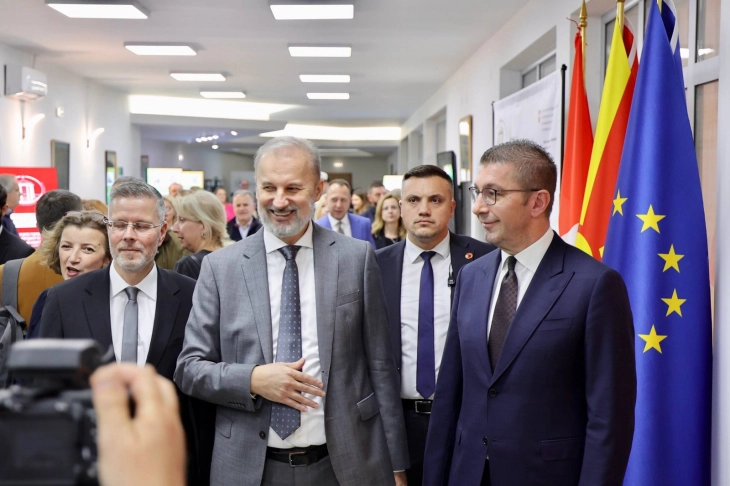
Skopje, 26 November 2025 (MIA) - No government, no matter how strong, can bring about change alone. No civil society, no matter how developed, can fulfil its role without institutions that are open, transparent and ready for dialogue. That is why today we can proudly say that Macedonia is building a mature, structured and responsible model of cooperation, Prime Minister Hristijan Mickoski told Wednesday's second national forum on cooperation between government and civil society.
The PM noted that the Government at its 90th session held on July 8, 2025, adopted a Strategy for Cooperation and Development of Civil Society along with an Action Plan (2025–2028).
"This is not a document drafted in an office, but a strategic framework created through a transparent and participatory process. Representatives of civil society organizations actively participated in its preparation, consultations were conducted through the ENER platform, two public debates were held, and the Council for Cooperation between Government and Civil Society gave a positive opinion, reaffirming our common direction. The vision is clear: a strong, independent, professional and sustainable civil society - a true partner in creating and implementing state policies. A sector that strengthens democracy, protects the rights of citizens, monitors the work of institutions and helps to close the gap between institutions and the people," said Mickoski.
He noted that the Strategy is based on three guiding principles. "First, inclusiveness and participatory planning, because policies must be built with those who work on the ground every day. Second, security and responsibility, because civil society must have a stable legal framework and clear rules of the game and third, openness and transparency, because only an open state can establish trust and equality before the law. The adoption of this strategy means a better legal framework, greater mechanisms for participation, higher financial sustainability and stronger democratic standards. We also plan the establishment of a guarantee fund, a new instrument that will enable civil society organizations to have more access to co-financing for European and international funds such as IPA, Horizon Europe, InvestEU, Digital Europe, etc. Thus, we are paving the way for more numerous, more serious and higher quality projects," said the PM.
According to him, reviving the Council for Cooperation between the Government and Civil Society is also particularly important.
"After extensive consultations, we have optimized its composition, included deputies for greater efficiency and strengthened the obligation for transparency. With the constitutive session held on April 7, we ended a three-year boycott and today the Council is actively functioning. Five sessions have been held so far, all materials and minutes have been published. The Council has already nominated 13 representatives of the civil sector in advisory and working bodies of the Government, which represents a real, substantial influence of the sector in the development of policies. In parallel, we are also working on a new Law on Associations and Foundations that is modern, European, functional, and created in partnership with the sector. The working group led by the Ministry of Justice held several meetings, and our goal is for the text to be published on the ENER platform and submitted to the Venice Commission by the end of the year. This is not a law of the Government, this is a law that we are creating together with you," said Mickoski.

This is not just an administrative process. This is a change in political culture. This is a message that the state finally treats civil society organizations as equal partners, as factors that bring development, stability and control, rather than strangers in political processes, Mickoski pointed out.
Swiss Ambassador Christoph Sommer said Switzerland has been cooperating with the country for more than two decades.
"Switzerland and North Macedonia have been working with civil society through the Civica Mobilitas program for 20 years," Sommer said. He pointed out that the goal of Civica Mobilitas is to enable positive changes in civil society, such as improving the management of organizations and fostering constructive dialogue with decision-makers and institutions.

Head of the Macedonian Centre for International Cooperation (MCIC), Aleksandar Krzhalovski, noted that the MCIC has been measuring trust in institutions for about 20 years, adding that it is most accurately reflected in elections.
"In that sense, this ruling coalition recently confirmed the trust it received last year in the elections, which allows for deep fundamental reforms to be made, and which we are also advocating for to a large extent," said Krzhalovski.
Photo and video: Government


