Macedonian citizens are using e-government services more, but remain below EU average

Skopje, 17 March 2026 (MIA) - In 2025, 71.9% of people in the EU aged 16 to 74 used websites or apps of public authorities, marking an increase of 1.9 percentage points compared with 2024, according to Eurostat data.
In Macedonia, 32.32% of citizens used e-government services. The most commonly used services were downloading or printing official forms (17.11%), requesting official documents or certificates (15.44%), accessing public databases or registers (12.94%), and accessing personal information (10.96%).
Compared with other countries in the region, e-government services were used most by citizens in Greece (71.99%), Croatia (65.68%), Serbia (64.23%), Montenegro (52.39%), Bosnia and Herzegovina (37.87%), and Bulgaria (35.95%). No data is available for Albania or Kosovo.
Minister of Digital Transformation Stefan Andonovski recently reported that the services portal is recording record results and is becoming the central hub for citizens’ electronic services.
According to 2025 data, the portal saw a 290% increase in services provided and a 166% growth in users. Andonovski said this clearly shows that citizens recognize, accept, and increasingly use the portal, which he emphasized is a dynamic platform generating 3–4 new services each month.
The EU countries with the highest uptake of e-government services were Denmark (98.0% of people used public authority websites or apps), the Netherlands (96.2%), Finland (96.1%) and Sweden (96.0%). By contrast, Romania (24.1%), Bulgaria (36.0%) and Italy (57.7%) recorded the lowest shares.
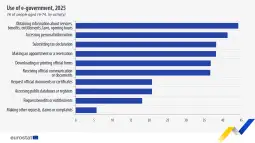
The most common usage of e-government services was obtaining information about services, benefits, laws, opening hours, or similar topics (44.2%). Accessing personal information was the second most common activity (41.3%) and submitting tax declarations came in third (38.2%).
People in the EU also used e-government services to make an appointment or a reservation (38.1%), download or print official forms (36.7%), receive official communication or documents (36.6%), request official documents or certificates (20.8%), access public databases or registers (20.7%), request benefits or entitlements (18.1%) or make other requests, claims or complaints (5.7%).
Photo: Eurostat


