Decarbonisation guide launched for SMEs focusing on investments in energy efficiency and renewable energy projects
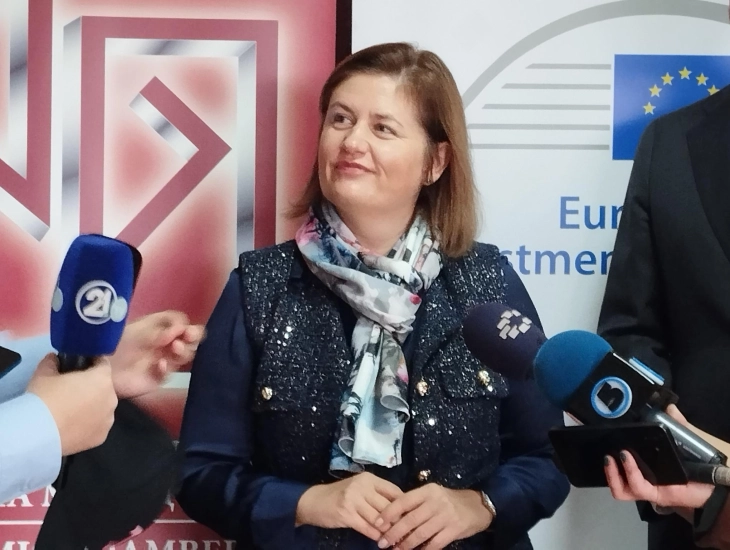
Skopje, 22 October 2025 (MIA) – Macedonian companies need to move toward to more sustainable and low-carbon operations in order to reduce their carbon footprint and achieve carbon neutrality. Since the EU will apply the “polluter pays” principle starting January 1, 2026, to products from third countries, including North Macedonia, depending on their production-related carbon footprint, the Economic Chamber and the European Investment Bank, in cooperation with the EU and the Ministry of Energy, Mining and Mineral Resources, have launched a new online decarbonisation guide designed for small and medium-sized enterprises (SMEs) in the country, offering a practical tool to improve their understanding of the capital required for investments in energy efficiency and renewable energy sources.
According to Minister Sanja Bozhinovska, the Ministry of Energy supports the initiative of the Economic Chamber and the European Investment Bank to promote the decarbonisation platform and guide. Bozhinovska pointed out that it is still not clear what the changes as of January 1, 2026, will specifically mean and announced that next week, the Director of the Energy Community Secretariat, Artur Lorkowski, will visit the country for a meeting on the matter.
“We were informed that Macedonia’s overall energy mix will be taken into account. This means that last year, 40% of our electricity production came from renewable sources, and that mix will be applied. It will not be assessed individually, but for the country as a whole. That’s what was said last time, however nothing has been finalized. There are no precise details or data yet, we will also discuss this with the Ministry of European Affairs, as they are in communication with Brussels, and we hope to have more information next week,” Bozhinovska said.
When asked if the tax coming into force on January 1, 2026, will apply to all products exported from the country or just two sectors - steel and cement, Bozhinovska stated that it should be limited to those two sectors. She emphasized, however, that there should be a transition period, market alignment, and exemptions, on which, as she clarified, cooperation with Greece is already underway. “The EU has slightly moved the deadlines. This will be discussed at the meeting on December 18, but before then, we must obtain all the necessary information,” Bozhinovska noted.
Bozhinovska noted that the ministry is in charge of preparing the legislation, but cannot do it on its own, and that they receive assistance from the European Investment Bank and support from the EU to help companies better understand the process and the many benefits it offers.
“Of course, there is support from the EU as well. This shows we are on the right path, as all EU experiences have been transferred to us, an important step since our green transition, being part of the Just Transition until 2030, will further benefit businesses. Under this initiative, we have brought together financial institutions such as Bloomberg, the French Development Bank, and the Italian Development Bank to assist Macedonian SMEs. I hope that training sessions will be organized so that smaller and medium-sized enterprises can benefit as well. We intend to discuss organizing such trainings by the end of the year and applying EU best practices to support domestic companies,” Bozhinovska said.
EIB Representative to North Macedonia, Björn Gabriel, noted that recent surveys show around 40 percent of Macedonian companies still lack knowledge about the green economy and its benefits.
“Still, awareness is on the rise: 27 percent of Macedonian companies see green investments as a way to become more competitive, and approximately 30 percent believe they could achieve revenue growth. This indicates a clear business outlook — green transitions can bring growth. Investments in the green transition modernize operations, improve productivity, reduce expenses, and aid in building new export chains,” Gabriel said.
The CEO of the Economic Chamber, Antoni Peshev, underscored that the chamber follows trends and all necessary changes and reforms in our economy.
“There is no simple or fast solution to the broader challenge of decarbonisation, but the chamber is here to provide its members with direct access to information, helping companies slowly engage in the process,” Peshev stated.
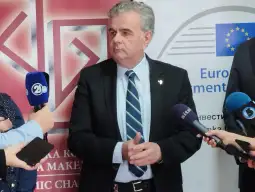
“Obligations are obligations,” Peshev emphasized, adding that if companies face difficulties, discussions can take place on how much of a delay they need to catch up. However, opting out of the process is not possible, because as a country we have also undertaken commitments that must be fulfilled.
“However costly it may be, this will have to become a fundamental part of the companies’ future. Unfortunately, if costs are involved, we will need to discuss with the government on favorable loans and how to facilitate this process,” Peshev noted.
The Economic Chamber of Commerce and the European Investment Bank launched on Wednesday a new online decarbonisation guide for small and medium-sized enterprises (SMEs) in the country, as a practical tool to support their transition to more sustainable and low-carbon operations.
Photo: MIA


