Wave of civil disobedience sweeps Serbia, roads blocked in many cities
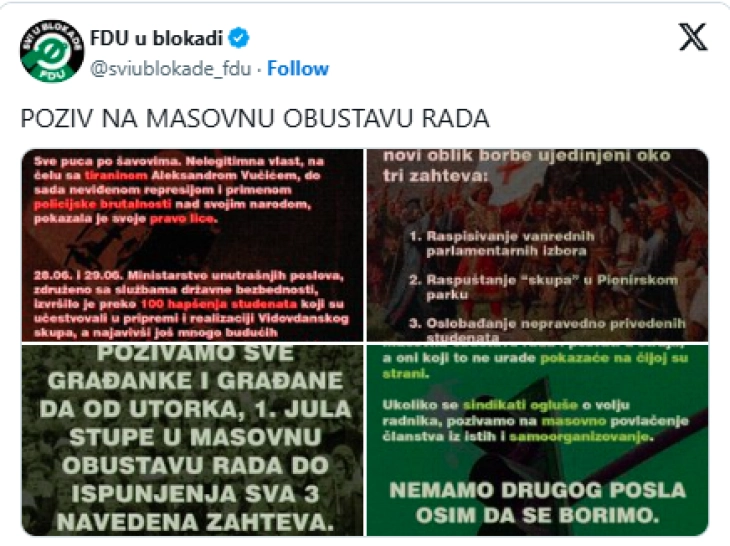
Zagreb, 1 July 2025 (Hina/MIA) - A wave of civil disobedience, triggered by a student movement during Saturday's mass protest in Belgrade, spread Monday across Serbia as thousands took to the streets demanding early elections.
The blockades of major roads and intersections, which began Sunday in protest over the arrest of eight students, were broken up by police before dawn Monday without the use of physical force. However, a video circulated on social media showing four police vans charging at protesters at high speed and forcing them to flee.
At the same time, arrests continued on charges of disturbing public order, plotting to overthrow the constitutional order and obstructing police officers in the line of duty. According to figures released by the students involved in the blockades, more than 30 of their fellow students were arrested Monday.
The civil initiatives ProGlas and Free Organisations of Serbia SOS strongly condemned what they described as police brutality against citizens following the mass protest in Belgrade on Saturday, saying the wave of arrests - largely targeting students - "confirms that Aleksandar Vučić's regime has entered a phase of open violence".
In the afternoon, sporadic blockades continued in central Belgrade and Zemun. In the evening, protests were still ongoing in several districts of the capital. Roads were also blocked in Novi Sad, Niš, Čačak, Šabac, Valjevo, Kruševac, Užice, Kragujevac, Zrenjanin, Smederevo, Subotica, Ruma, Pančevo and Gornji Milanovac.
The protesters' strategy is to outmaneuver the police using so-called "dispersed blockades". When police and municipal workers remove barricades, students and citizens re-erect them, move to new locations or repeatedly cross nearby pedestrian crossings without pause, thus bringing traffic to a halt.
On social media, students advised fellow protesters to respond non-violently to police presence, to increase the number of protest sites and to frequently change locations to overwhelm the authorities. The tactic sometimes led to the situation where the police, by forming cordons, effectively enforced the blockade themselves.
"This isn't just police repression - it's the repression of the entire state apparatus against all citizens," said Predrag Voštinić, activist and leader of the Local Front civic organization from Kraljevo.
A bomb threat was allegedly reported Monday at the Faculty of Technical Sciences in Novi Sad, which is currently under student blockade. The building was evacuated, and protesters accused the authorities of "insulting people's intelligence".
Protesters pointed out that similar bomb threats were used ahead of the mass demonstrations on March 15 and June 28, when threats against the state railway led to the cancellation of all passenger trains, preventing people from traveling to the protests.
"They're driving our children off the streets and out of universities, while paying their own supporters for months to camp out in tents in Pionirski Park (in front of Vučić's office) and outside the National Assembly (where traffic has been blocked since April). 'Hypocrisy' isn't the right word - this is an insult to people's intelligence," said one protester, who identified himself to reporters as a teacher.
"All institutions have been captured, the only thing left is the street," said another participant at Monday night's protest in Kraljevo, where the bridge over the River Ibar was blocked.
Commenting on the growing number of arrests of students and protesters, he said, "There aren't enough prisons for all the discontented people, and there will only be more of us."


