Truck drivers continue to block freight transport at borders in protest against new EU entry rules
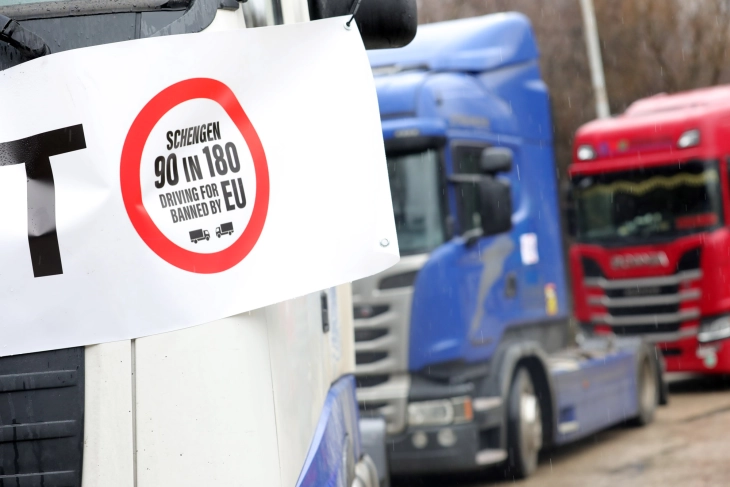
Skopje, 27 January 2026 (MIA) – Transporters are blocking the freight border crossings in the country for a second day as part of a joint protest by Macedonian truck drivers, who have joined truck drivers from the Western Balkans in demanding a solution after the electronic entry and exit check system (EES) will be enforced as of April in the Schengen zone in line with the 90/180 rule (90-day stay out of any 180-day period).
Passenger transport isn’t interrupted due to the blocked freight transport in border crossings within the Schengen zone, expected to take place for seven days.
Truck drivers from the Western Balkans, including the country as well as Serbia, Montenegro and Bosnia and Herzegovina, believe that EES is discriminating them compared to those in the EU. They demand that they should be approved a special status when entering the EU.
"The point is not to stall our own economic activity, but to show what can happen in a certain period of time. When Turkey and other countries join, there will be over a million tons of goods moving or waiting, and that should be a clear signal to everyone. But we cannot set up blockades for months, nor do we want to harm our producers, traders and the population. If a solution is not found, other forms of pressure will be sought. If the European Union cannot take this situation for a month, then it is clear that these measures cannot last longer," "Makam-Trans" secretary general Biljana Muratovska told reporters on Monday.
She mentioned that our country has signed bilateral agreements related to transport allowing access and transit across their territory.
She added that if their demands are not met by April, they will not hold protests because the trucks will be there, but there will be no one to drive them. "Then the consequences will be far more extensive and felt far and wide," Muratovska stressed.
On Monday, European Commission spokesperson for internal affairs, Markus Lammert, said the EC is aware of the concern voiced by truck drivers in the Western Balkans and is closely monitoring the situation involving blockades of freight border crossings.
“We are aware that a large number of professionals from third countries may need to stay in the Schengen area for more than 90 days within a 180-day period. This includes highly mobile professions, such as truck drivers, but also athletes and artists. This is also related to national rules and existing bilateral agreements. This is an issue to which we are fully committed and on which we are working and reflecting in the context of preparations for the upcoming Visa Strategy, which we will publish this week,” said Lammert.
EES, he reiterated, does not introduce any new regulations and no new requirements related to the length of stay in the Schengen area, but only provides better implementation of existing rules and systematic detection of irregular practices.
“According to Schengen rules, citizens of countries that do not need a visa to enter the EU have the right to stay in the Schengen area for 90 days within a 180-day period in any country. Beyond this, the stay must be covered by a visa or by national arrangements,” added Lammert.
According to him, it is important to note that these rules are not new, but have been in force for years equally throughout the entire territory of the Schengen area, and that they already provide for a certain flexibility with regard to some categories of workers.

Transport Minister Aleksandar Nikoloski, who visited yesterday the Blace border crossing to show support for the protest of truck drivers, said the warning comes on time calling on February and March to be used for the Schengen zone members to find a solution.
"In essence, there are three possible solutions. The first solution is to postpone the implementation of the new Entry/Exit System (EES) rules for transporters. The second solution is to increase the number of days, allowing transporters to stay in the Schengen area for at least 250 days, appropriately distributed in cycles, instead of the current 90/180 days. The third solution is to treat professional drivers and transporters not as tourists, but as professionals. This could be arranged through special rules or through work visas, as Switzerland currently does, which would allow them free transit through the Schengen countries," said Nikoloski.
Anything other than this, Nikoloski added, will have major consequences - not only for the Macedonian and regional economy, but also for the European economy.
MP Antonio Miloshoski, chair of the parliamentary Commission on European Affairs, urged Cyprus’ Ambassador to the country, Andreas Photiou, to include the truck drivers’ protests on the agenda in Brussels.
“Mr Ambassador, on December 17, 2025, Commissioner Marta Kos signed a memorandum in swift integration and swift and uninterrupted transport with Western Balkan countries and with Moldova, Greece, Bulgaria, Italy. This memorandum is in line with the EU’s growth plan policy, aimed at better integration on the market of Western Balkan countries and its stronger integration into the EU market with each passing month and year,” said Miloshoski speaking yesterday at a committee session in which the Ambassador of Cyprus presented his country's priorities during its six-month EU Presidency.
The chambers of commerce and the business federation of Macedonia have also warned about the consequences from the blockade and the implementation of the new EES.
Photo: MIA


