Pendarovski at NCEU-MK conference: Ethical leadership in institutions needed to fight against corruption
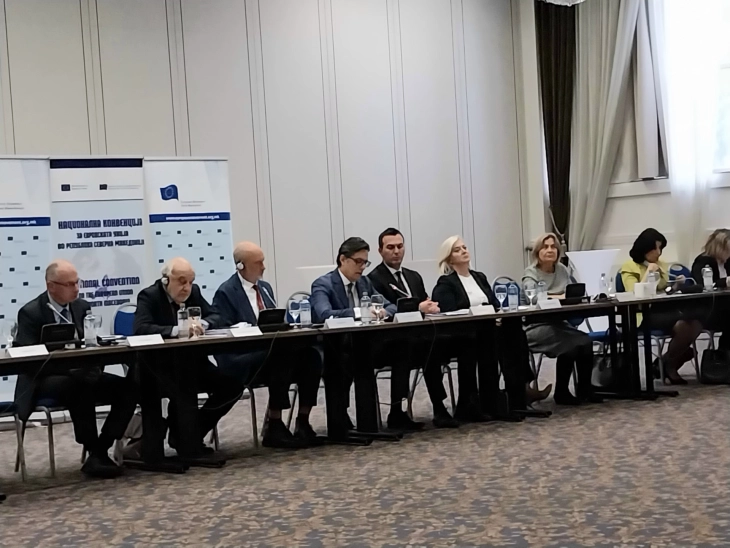
Skopje, 13 December 2023 (MIA) - In order to fight corruption we need ethical leadership in the institutions themselves, and we must insist on timely investigations and final judgments. I call on all political stakeholders to get constructively involved in this process, President Stevo Pendarovski said on Wednesday in his address at the sixth plenary conference of the National Convention on the European Union in the Republic of North Macedonia (NCEU-MK) under the theme "National Convention on the European Union: Fundamental social values for the European future".
"As you know, the screening process on the alignment of the Macedonian legislation with the EU acquis was completed. We expect that this process diagnoses all our systemic flaws and shortcomings so that they are used as a roadmap in the future. However, the general conclusion was that not enough has been done regarding the key chapter - rule of law and fundamental rights, which are the alpha and omega of European integration," Pendarovski said, adding that negotiations begin and end with both of them, as they are interwoven in every sphere.
He also pointed out that the European Commission's report concluded that no progress was made in this area, adding that where the law doesn’t rule, money does.
"It is obvious that the language of corruption is spoken quite frequently in our country. According to the public opinion survey conducted by the Macedonian Center for International Cooperation at least one third of Macedonian citizens were exposed to corrupt pressure this past year, and sadly, research shows that the language of corruption is spoken by "a quarter" of our citizens who have been the victims of pressure and have taken part in a corrupt transaction for money, ties or influences. I am not talking only about large, but also small, seemingly negligible sums. Corruption is corruption, regardless of whether it is Mden 500 or 500,000," Pendarovski said.
Unfortunately, he added, many doors open, and many services become available for those who also speak this language, and those who do not know it are often times discriminated against because they are unable to use their rights and services that are theirs by law.
"The effects of corruption are intensified by legal loopholes and ambiguities that are easily abused for corruption or to shift responsibility. It becomes even more concerning when the application of law depends on the interpretation "skills" of those who implement it, so often the legal terminology gets a different and sometimes even an opposite meaning from the original. At the end of the day, those who have sinned are held accountable before the law, but who have nothing to "trade" to buy their freedom," the President stressed.
The indecisiveness of individuals, he adds, from competent institutions to enforce proceedings against those for whom there are grounds for suspicion, but who seem untouchable in society, is one of the main contributors to this worrisome situation.
"One gets the impression that the United States and the EU are the more zealous fighters against corruption in our country than some of our institutions and individuals. In addition to the fact that they invest in training employees in the Macedonian justice system, they occasionally resort to sanctions like the so-called blacklist for people believed to have been involved in corruption. However, foreign sanctions are not enough because they are not supported by domestic sanctions. Namely, we face a much more serious problem, seeing as how corruption, in the meantime, has become a way of live for many, or as the Dutch ambassador recently described it- it is people's mentality that must change. At the same time, we should not leave out other elements," said Pendarovski.
He pointed out that even when investigations and processes of high corruption were initiated, they are slow and uncertain, and the defence uses every procedural tool to prolong the trials that is always approved by part of the judges, which reinforces people's perception that justice is slow, but not unattainable.
"Secondly, even the few successfully completed proceedings are limited to specific persons and actions made in a specific time period, where there is almost always a lack of continuity on the state's actions, especially after the changes in government on a central and local level. These vacuum periods practically nullify the effects of the rare successfully completed court proceedings of corruption among public office holders," the President stated.
Third and most important, according to him, are the institutional practices and culture that facilitates systemic corruption can only be changed from within, or with an ethical leadership in institutions themselves.
"In order to drastically reduce corruption, we have to insist not only on investigation, but also on final judgments that illustrate that laws apply to everyone equally, even the rich and powerful," Pendarovski concluded.
NCEU-MK national coordinator and president of the European movement, Mileva Gjurovska, said that from the perspective of the judiciary, this year was specific and turbulent.
"Now we are able to see more clearly what is really happening with the judicial system - in charge of ensuring equality of all before the law. The general conclusion from the dialogues is that our democracy is in dire need of an effective and independent legislative and judicial authority," Gjurovska pointed out.
The voice of the judiciary is transmitted throughout the Convention, and other civil initiatives that demand to receive its alienated judicial power.
"There is no other force that can quench the need of non-institutional political centres to own or rule with institutions. Our society is already in a state of deep anomie, i.e. a society where rules are not important, as sociologists call it and as it states in the European Commission's report - although the vocabulary is different. The dialogue must continue for the voice to become stronger - so that institutions are returned to citizens," Gjurovska stressed. ssh/nn/


