Exclusive to MIA, maestro Yeruham Sharowsky after leading Macedonian Philharmonic in Musikverein concert: Performing at that holy place felt like history is watching us
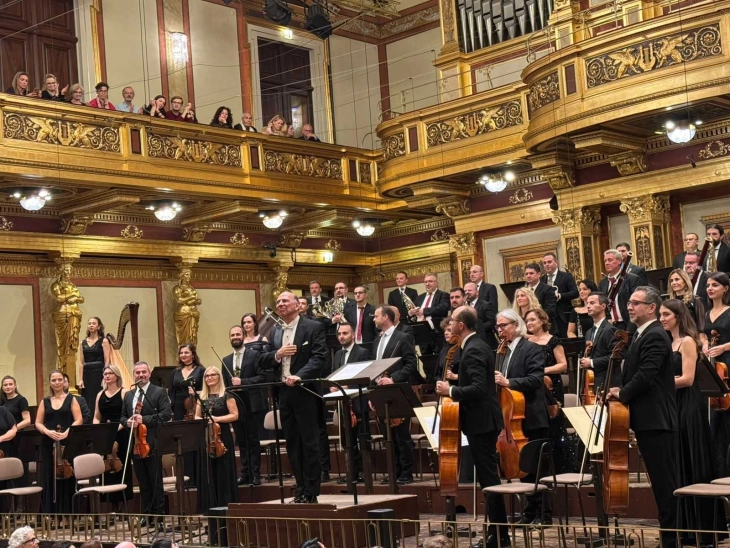
Skopje, 12 November 2025 (MIA) — When you perform in this kind of great, historic and legendary halls, you feel great respect for all the great musicians that had performed there over the years. You feel a great responsibility, the Macedonian Philharmonic Orchestra's artistic director Yeruham Sharowsky said in an exclusive interview for MIA.
The renowned conductor, who is currently in South Africa doing rehearsals, recently led the Philharmonic in its first performance at Vienna's Musikverein Hall.
Maestro Sharowsky, you conducted the Macedonian Philharmonic Orchestra at the Musikverein Golden Hall in Vienna, home of the Vienna Philharmonic and one of the most important concert halls in the world. Was this your first performance on this stage and what are your impressions now, some ten days after the performance?
Yes. It was my first time in the Musikverein of Vienna. I have performed before in great halls like the Lincoln Center, the Berlin Philharmonic, the Munich Philharmonic, Sala San Paolo, a great hall in Brazil, then of course Teatro Colon in Buenos Aires and Santa Cecilia in Rome, which is very important as well. When you perform in this kind of great, historic and legendary halls, you feel great respect for all the great musicians that had performed there over the years. You feel a great responsibility. You feel a great and deep compromise with the music because you feel like history is watching you.
But at the same time, you feel happy to be there to express your music in such a holy place. I was happy that my opportunity was with the Macedonian Philharmonic Orchestra. It is really a great orchestra. We have spent a long time together. I have conducted this orchestra since 2008 in different opportunities, in different situations. We have done tours in China and in Israel together and we have a very good and very deep symphony and understanding with each other.
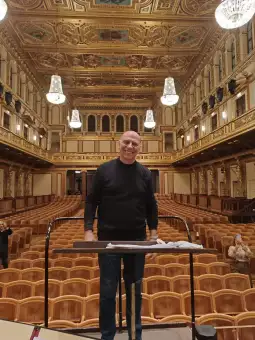
This concert marked the Macedonian Philharmonic's 80th anniversary, an exceptional experience worthy of respect. What can you tell us about the concert program chosen for the Musikverein?
The concert program was done together with the previous general director, Aleksandar Kotevski. A few months ago, we thought about it together. He had a very good suggestion to include in the first part Macedonian music by Macedonian composers, and then Macedonian songs sung by two of the greatest Macedonian singers, Ana and Igor Durlovski. It was a great pleasure, a great honor, to have them as our soloists, especially since they are so representative of the excellent Macedonian talent at the highest level of performance. And the Macedonian songs were very symbolic because they are nostalgic, beautiful and representative of the Macedonian soul, the Macedonian feeling.
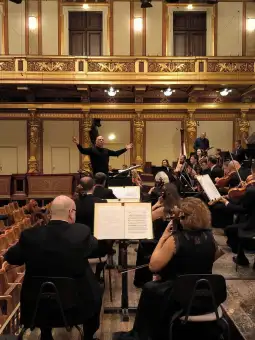
The second part of the concert included an international symphony that is on the repertoires big orchestras perform at this kind of events. You first play your music, but you finish with a great repertoire symphony that lets you evaluate the level of the orchestra as an international orchestra because the best orchestras from all over the world have been on this stage. The Macedonian Philharmonic showed up at its highest level, sensibility, deep understanding of the music, and a very, very sensitive and sophisticated performance with details, nuances and monumental orchestral sound. Because they have one very important thing when they play. It is passion. I have conducted more than 70 orchestras around the world and this orchestra is special because of its passion for music, their involvement in the music at the time of the performance.
How would you describe your cooperation with the Philharmonic, considering this is your second year as its artistic director and considering your vast experience in conducting many famous orchestras in Europe and beyond?
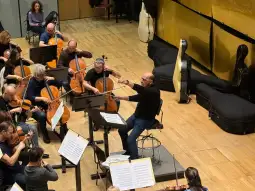
Of course, after so many years working together, I have a great relationship with the many musicians of the orchestra. It is a great pleasure to meet them not only on stage but also just to meet them because they are great human beings I am glad to meet every time. There is a very good understanding in general with the orchestra, and we have done important things together, such as our two tours in China and in Israel that I mentioned, and our collaborations in general.
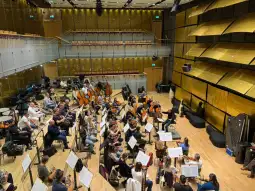
There is one problem I would like to mention: The instability of general directors. They change too often. In two years, I have worked with five different general directors. That poses a problem for the artistic director in making a long-term program because every director who comes wants to do different things. And when you have special ideas like tours or have a program to tour South America or other places, those are projects you have to work on a long time in advance. But when a director comes and doesn't know how long he will be there for, he will not agree to begin a long-term program because he doesn't know if he will be there for it.
So that should be improved so the orchestra can have a director for a longer period, of four years at least. Then he will know exactly how to manage things and the artistic director can plan long-term programs for the future.
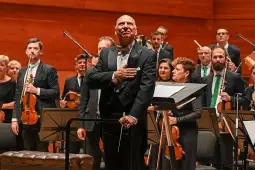
That is the only thing I think the orchestra should change. But of course, this is not up to me or the orchestra. It is up to the government, the Ministry of Culture. With that exception, my relationship with this orchestra has been very good and positive. And I will be glad to continue contributing to this great orchestra.
Violeta Gerov
Photos: Courtesy of Yeruham Sharowsky


