EU integration of Western Balkans not only a political question, but a geopolitical necessity for Europe: discussion
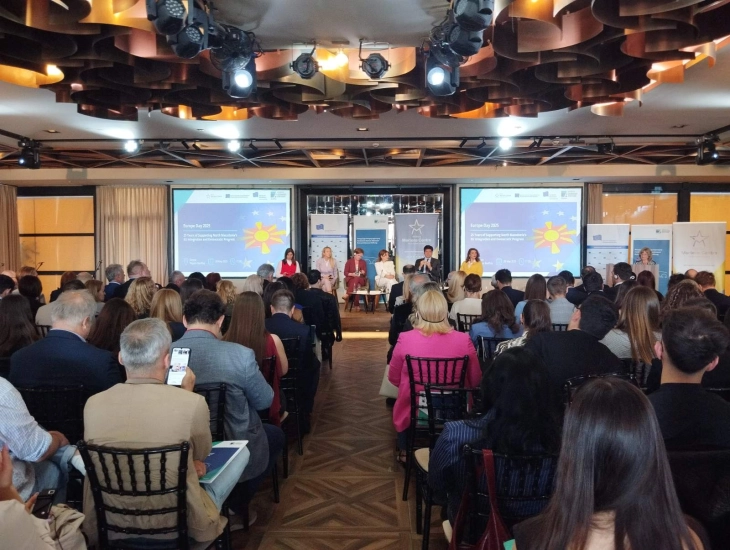
Skopje, 28 May 2025 (MIA) - The enlargement of the European Union is a geostrategic investment in peace, security and stability. North Macedonia has never given up on its path to European integration, but it has faced real challenges and obstacles that have slowed down its path. The integration process is a project that demands daily commitment, political patience and deep faith in the shared values, said speakers Wednesday at the panel discussion “Shaping the Future - EU Integration as Path Forward for North Macedonia”.
The discussion was organized by Konrad Adenauer Foundation (KAS) in cooperation with the European Movement in the Republic of North Macedonia and the Wilfried Martens Centre for European Studies to mark Europe Day and the 25th anniversary of active engagement of KAS in the country.
Addressing the discussion, Parliament Speaker Afrim Gashi said regional crises have demonstrated that the European integration of the Western Balkans is not only a regional political question, but a geopolitical necessity for all of Europe.
“I am firmly convinced that North Macedonia, as it has demonstrated it can do so in the past, will overcome these challenges as well, but this requires sincere and stable support from our international partners. Together with the institutions, organizations and citizens we must continue to build North Macedonia up. As Speaker of Parliament, I guarantee my commitment to keep this institutional house a pillar of democracy and a place for dialogue, and not a place for divisions and arenas for narrow interests,” Gashi said.
Norbert Lammert, Chair of the Konrad Adenauer Foundation and the 12th President of the German Bundestag, said the enlargement of the European Union is a geostrategic investment in peace, security and stability.
“At our last Summit we reached a conclusion that there is a new momentum in the enlargement process as well as significant progress. In my view, I think we are more faced with discrete stagnation instead of obvious progress. Potential member states should fulfill certain criteria which are necessary for EU accession,” Lammert said.
The Former Prime Minister of Slovakia and current President of the Wilfried Martens Centre for European Studies, Mikuláš Dzurinda, said he believes that North Macedonia’s EU path will be successful.
“I say this with full awareness of all the challenges that Macedonia has faced until now and all challenges that the country will probably continue to face in the future. I am really aware, and I can imagine the frustration felt by the Macedonian leaders who are hoping for European membership while also being aware of all the inconsistencies that the country has faced,” Dzurinda said.
Dzurinda stressed that the accession of Western Balkan countries is a high priority.
“A lot of work awaits us. The blocked process should be unblocked. North Macedonia has already shown it understands the need for compromise. The story of your country is a testimony to this ability, willingness and determination and that seemingly unsolvable issues can be solved,” Dzurinda added.
Photo: MIA


