Björn Gabriel for MIA: Energy systems vulnerable to climate change, adaptation measures essential
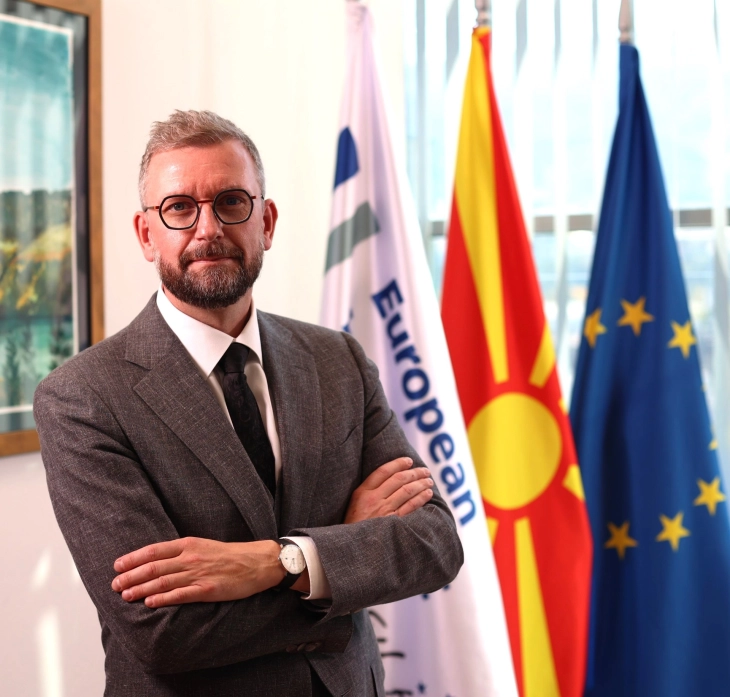
Skopje, 15 June 2025 (MIA) - Ten percent of small and medium-sized enterprises in the Western Balkans report losses from natural disasters, while green investments remain limited, according to the European Investment Bank’s Investment Survey. The EIB Representative to North Macedonia, Björn Gabriel, told MIA in an interview that key barriers include perceptions of low profitability, restricted access to finance, and underdeveloped green management practices.
In cooperation with the Development Bank of North Macedonia and local commercial banks, the EIB has invested EUR 100 million through the so-called Green Credit Line to support companies in meeting their investment needs, especially in projects for energy efficiency and renewable energy.
This initiative, according to Gabriel, is already yielding tangible results with Macedonian companies investing in the modernization of their production capacities, achieving energy savings of up to 70 percent, while simultaneously reducing their dependence on fossil fuels.
In the interview given ahead of the Energy Forum in Skopje, the EIB representative assessed that energy systems in the Western Balkans, and in North Macedonia, are very vulnerable to extreme weather conditions due to the outdated infrastructure and poor maintenance.
“In the Western Balkans, as well as in North Macedonia, the impacts of climate change are already visible. The country faces rising temperatures, more frequent droughts and floods, severe air pollution in urban areas, and increasing water stress due to outdated infrastructure and limited reserves. The World Bank estimates that the Western Balkans will need at least $37 billion over the next decade to build climate resilience,” Gabriel said.
Adaptation measures, such as reinforcing transmission lines, elevating substations, and upgrading systems, according to Gabriel, are essential for improving resilience.
“Rising temperatures are increasing electricity demand for cooling, straining grids and risking overloads. In countries like North Macedonia, where hydropower is vital, changing rainfall and droughts threaten energy supply. To maintain energy security, adaptation must include diversifying energy sources, improving water efficiency, and investing in smart grids, storage, and decentralized systems to manage the variability of renewables.,” Gabriel stressed.
According to the EIB representative, the Law on Energy which came into effect in May 2025, is timely and aligns the country’s energy policies with the EU’s Clean Energy Package, while also introducing significant reforms to accelerate the energy transition and streamline the development of renewable energy capacities.
The country, according to Gabriel, has demonstrated strong decarbonisation ambitions, becoming the first country in the Western Balkans to adopt a National Energy and Climate Plan (NECP) in 2022. However, electricity production is still largely reliant on fossil fuels, which make up around 70 percent of the energy mix.
“I am hopeful that annual planning for energy projects, simplified authorization processes, the envisaged expansion of energy storage, market coupling with neighboring countries and other measures will help the country meet its ambitious renewable energy targets with the support of its international partners such as EIB,” Gabriel said.
Below is the interview in full:
Mr. Gabriel, in mid-May an Energy Forum will be held in our country, where you, as a financial institution, will take an active part and speak about the role of international institutions in promoting the green transition and decarbonization of the region. How far along is North Macedonia in this area?
North Macedonia has demonstrated strong decarbonisation ambitions, becoming the first country in the Western Balkans to adopt a National Energy and Climate Plan (NECP) in 2022. The plan outlines a 38% increase in renewable energy in gross final consumption, with a target of 66% renewable electricity generation, primarily through investments in solar and wind energy. The country aims to reduce overall greenhouse gas emissions by 51% and net emissions by 82% by 2030, compared to 1990 levels. The NECP is currently undergoing a revision and we hope the country’s ambition will remain high.
Despite having the second-highest solar energy potential in the Western Balkans, wind and solar accounted for only 2.5% of total electricity generation in 2023, with hydropower reaching 25% (OECD). Since 2019, the country has conducted renewable energy auctions using feed-in tariffs and feed-in-premium models. Electricity generation though remains heavily reliant on fossil fuels, comprising around 70% of the energy mix. However, the share of lignite has declined from 76% in 2000 to 46% in 2023. To compensate for this reduction, electricity imports have increased but the anticipated expansion of renewable capacity is expected to help balance this dependency and enhance energy security.
At the same time, regulatory frameworks should provide further support to renewable energy development and grid upgrades to accommodate intermittent sources, accompanied by targeted investment. Governance in state-owned enterprises can be improved significantly, while policies should be set to ensure fair competition. Support measures such as tradeable green certificates and workforce reskilling are also critical to a just transition.
In this context, North Macedonia’s Law on Energy which came into effect in May 2025 is both timely and highly relevant. It aligns the country's energy policies with the EU’s Clean Energy Package, introducing significant reforms to accelerate the energy transition and streamline the development of renewable energy capacities. I am hopeful that annual planning for energy projects, simplified authorization processes, the envisaged expansion of energy storage, market coupling with neighboring countries and other measures will help the country meet its ambitious renewable energy targets with the support of its international partners such as EIB.
The EIB is one of the international financial institutions that continuously invests in North Macedonia. What do the results of your investments so far show when it comes to the green transition?
As the financial arm of the European Union, the European Investment Bank (EIB Global) has been a steadfast partner to North Macedonia, committing over €1.6 billion in loans and grants to date. These investments aim to improve living standards and business environment across the country. The Bank is playing a pivotal role in North Macedonia’s green transition, backing sustainable infrastructure and green investments among the private sector. In collaboration with the Development Bank of North Macedonia and local commercial banks, we are deploying a €100 million green credit line to support companies in meeting their investment needs, particularly in energy efficiency and renewable energy projects.
This initiative is already yielding tangible results. Macedonian firms are investing in modernising production facilities and machinery, achieving energy savings of up to 70%, while decreasing their dependence on fossil fuels. By working closely with the government and financial institutions, we are helping businesses scale, adopt new technologies, and remain competitive – in particular when it comes to evolving requirements of EU value chains. These efforts are translating into job creation, stronger communities, and a more resilient economy. Since 2009, EIB’s €650 million worth financing has supported over 2,500 companies and helped sustain around 140,000 jobs across the country.
Beyond SME support, the EIB is also financing critical environmental infrastructure to increase climate resilience and protect public health. This includes municipal water projects that have improved access to water and sanitation for over one million people across 80 municipalities, while also strengthening flood protection systems. In Skopje, we are funding the construction of a wastewater treatment plant that will provide over 70% of the country’s required treatment capacity, an essential step toward greater environmental sustainability.
What are the EIB’s plans for the region and for North Macedonia in terms of supporting the development of innovative green technologies?
According to the International Energy Agency, one-third of the emissions reductions required to meet climate targets will depend on technologies that are either not yet commercially viable or still in development. Bridging this innovation gap is essential. Europe boasts a strong research base and industrial capacity, yet innovative firms often struggle to secure the funding needed to scale. As the EU’s Climate Bank, the EIB plays a pivotal role by supporting both mature and emerging technologies. Through the provision of risk-tolerant and patient capital, we help lower the cost of capital for clean technologies and catalyses private sector investment at scale.
In the Western Balkans, EIB Global is actively supporting research and development sector leading to the modernisation of scientific institutions, innovation centres, and universities. This includes the construction of several cutting-edge science and technology parks. They serve as hubs for collaboration between start-ups, academia, and industry, accelerating the commercialisation of local innovations on the global stage. Another notable example of our support to innovation is the “EU for the Green Agenda in Serbia” initiative. Since its launch in 2022, the programme has supported the scale-up of over 60 green innovations across key areas such as decarbonisation, circular economy, air quality, biodiversity, and sustainable food systems.
By mobilising €204 million under the InnovFin (EU’s initiavative for for innovative businesses and research projects), we have supported 909 companies in North Macedonia. Currently, we are unfolding the Guarantee for SME Resilience Initiative under the Western Balkans Investment Framework. In North Macedonia, this facility is expected to deploy a total of €60 million worth of loans available at favourable lending conditions to some 1 100 small businesses, while sustaining over 15 000 jobs.
Looking ahead, we are preparing to launch the Innovation and Green Transformation Facility for companies across the Western Balkans. This initiative will combine €170 million in favourable credit lines, €17 million in performance-based grants, and comprehensive technical assistance to accelerate the green and digital transition of the private sector. The facility will be open to companies that are pursuing product or process innovation, sustainable agricultural practices, pollution prevention technologies, as well as water efficiency and wastewater treatment projects. By blending financial incentives with expert support, the facility aims to unlock private investment, enhance innovation, and drive measurable environmental impact.
Given the increasingly evident effects of climate change, in your opinion, how important is it to adapt both existing and new energy capacities to climate change?
In the Western Balkans, as well as in North Macedonia, the impacts of climate change are already visible. The country faces rising temperatures, more frequent droughts and floods, severe air pollution in urban areas, and increasing water stress due to outdated infrastructure and limited reserves. The World Bank estimates that the Western Balkans will need at least $37 billion over the next decade to build climate resilience.
Due to outdated infrastructure and poor maintenance, energy systems in the region are also highly vulnerable to extreme weather events. Adaptation measures like reinforcing transmission lines, elevating substations, and upgrading systems are essential to improve resilience. Rising temperatures are increasing electricity demand for cooling, straining grids and risking overloads. In countries like North Macedonia, where hydropower is vital, changing rainfall and droughts threaten energy supply. To maintain energy security, adaptation must include diversifying energy sources, improving water efficiency, and investing in smart grids, storage, and decentralized systems to manage the variability of renewables.
As one of the world’s largest financiers of climate action, the EIB has stepped up its response, phasing out fossil fuel financing in 2019 and delivering a record €50.7 billion in green finance in 2024. This includes €4.6 billion dedicated to climate adaptation, more than triple the amount in 2021. These investments are critical for building resilience in cities, infrastructure, water systems, agriculture, and public health. Every euro invested in adaptation is estimated to save €5 to €7 in future damage costs. Acting quickly will increase the resilience of our societies and reduce the long-term costs of inaction.
What are the current trends among European enterprises when it comes to investing in energy efficiency, the use of renewable energy sources, and addressing climate change?
According to the latest EIB Investment Report, while 77% of EU firms cite energy costs as a barrier to investment, energy efficiency improvements are largely driven by national policy frameworks. Firms in countries with more ambitious and well-enforced climate policies are significantly more likely to invest in energy efficiency; and to benefit from it through higher profitability, productivity, and innovation.
In 2024, renewables supplied 48% of the EU’s electricity, contributing to a 13% reduction in power sector emissions. European firms are capitalising on this momentum, with exports of low-carbon technologies rising 65% since 2017, outpacing the United States (22%) but still trailing China (79%). Yet, a growing gap persists between mitigation and adaptation investment: while 66% of firms report being affected by extreme weather, few have invested in resilience or insurance. Barriers remain, notably access to finance and skilled labour.
The EIB Group continues to play a pivotal role in financing the green transition. In 2024, over 60% of its lending supported climate action, including a doubling of investment in power grids and interconnectors, and support for breakthrough technologies. Maintaining Europe’s competitive edge will depend on consistent policy signals, targeted incentives and financing, as well as accelerated infrastructure deployment.
Where does North Macedonia stand compared to EU countries, and what steps should it take to move forward?
Climate risks are no longer theoretical, they are already affecting businesses throughout the region. According to the EIB Investment Survey, while 10% of SMEs in the Western Balkans report losses from natural disasters, green investments remain limited. Key barriers include perceptions of low profitability, restricted access to finance, and underdeveloped green management practices.
The upcoming introduction of the EU’s Carbon Border Adjustment Mechanism (CBAM) in 2026 is set to reshape North Macedonia’s decarbonisation path. Roughly 20% of the country’s EU-bound exports (particularly in carbon-intensive sectors like steel, aluminium, and cement) will fall under CBAM. Without domestic carbon pricing, the aluminium and steel industries could see output fall by nearly 2%, with up to 1,500 jobs at risk (the World Bank). In response, North Macedonia has adopted new climate legislation back in 2022 to set the path to industrial transformation.
Financial institutions such as the EIB are central to enabling this transition both through financial and technical support. Through its Greening Financial Systems programme, EIB Global is working with the National Bank of North Macedonia to strengthen climate risk regulation and supervisory capacity. Four of the country’s six largest banks have already joined the initiative, helping them better assess climate exposure and guide companies toward sustainable practices, also in relation to the CBAM.
To further support small businesses, together with the Chamber of Commerce and the EU Delegation, we are preparing to launch a Decarbonisation Guide. This digital tool for companies aims to raise awareness and build capacity for green investment. The platform will offer practical guidance on carbon accounting and energy efficiency, helping firms align with EU standards and maintain access to European value chains.
And lastly, with our seventh EIB Green Credit Line for SMEs fully disbursed in the coming months, we hope to be able to continue this long-standing partnership with the government, the Development Bank of North Macedonia and our commercial banking partners to the benefit of Macedonian companies and jobs.
Biljana Anastasova-Kostikj
Photo: European Investment Bank


