Nikoloski for MIA: We’re the only country in the region to sign UK agreement, ready to implement capital projects

Skopje, 25 May 2025 (MIA) - Our goal is to be different from past governments and to implement projects, especially infrastructure ones. We are ready and very motivated. Actually, the quick pace at which we finalized these two agreements - government-to-government and strategic partnership - is the best proof of this. I’m particularly proud this is the first time the UK has signed such an agreement with any country in the region, showing that Macedonia is its strongest partner here, Deputy Prime Minister and Minister of Transport Aleksandar Nikoloski said in an interview with MIA.
“The best proof of what we are saying is that on the other side is the United Kingdom. It’s the world’s second greatest power, a nuclear state, a Security Council permanent member, a victor in WWII, and the only surviving royal empire in the world. So, it’s no coincidence that they are signing agreements with us, and they don’t sign agreements with just anyone. As I said, we are the only country in the whole region with which they have signed such agreements,” Nikoloski said when asked about public doubts regarding the government’s capacity to implement projects under the agreement with the UK Government.
During the interview, he discusses the funding conditions from the agreement, the expected start date for the initial fieldwork on the planned projects, and reveals the prospect of launch of the low-budget Irish airline Ryanair in Macedonia.
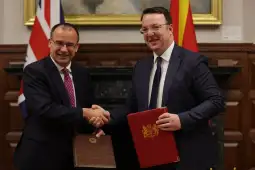
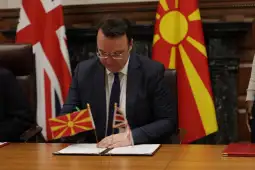
Deputy Prime Minister and Minister of Transport Aleksandar Nikoloski and UK Minister for Services, Small Business and Exports, Gareth Thomas signed Thursday in London the agreement on partnership for implementation of infrastructure projects, under which the country will have access to a historic amount of £5 billion for the realization of capital projects. The projects from the agreement and strategic partnership are expected to drive economic growth, improve citizens’ lives, and raise bilateral relations between the two countries to a new level.
Nikoloski noted that the second strategic partnership agreement between Macedonia and the United Kingdom, which sets out the full political and economic framework for cooperation, will soon be signed by the two prime ministers, Hristijan Mickoski and Keir Starmer.
Read the full interview below:
A government-to-government agreement was signed between Macedonia and the United Kingdom, under the strategic partnership, granting Macedonia access to £5 billion for capital investment. Can you elaborate on the terms of the deal?
Like I said, we are talking about two key agreements. One is a government-to-government agreement between the Republic of Macedonia and the United Kingdom, which is intended to enable the exchange of expertise and experience in both the public administration and business sectors. UK representatives will provide support in both areas, which I believe will raise the standards of Macedonia’s public administration and business sector. Included in this agreement is a £5 billion framework, made available to Macedonia through the UK Export Finance. These funds are intended to support the realization of strategic infrastructure projects in sectors such as transport, healthcare, education, energy, and environment. This involves project financing, which I believe will take Macedonia’s development to a completely new level. The second agreement, a strategic partnership between the two countries, is expected to be signed by both prime ministers in the coming period and outlines the overall political and economic framework for cooperation between the states. I’m particularly proud this is the first time the UK has signed such an agreement with any country in the region, showing that Macedonia is its strongest partner here. We’re NATO allies, but this is something else entirely, a new kind of partnership. It’s not about loans, it’s about financing concrete projects. As those projects take shape, so will the funding, and we’ll make sure to share all the details with the public once everything is in place. Generally, four key stages are necessary to realize a project. The first is to have the project in place, which we already do. The second is to establish the legal framework - finalized today. The third involves securing financial resources, which we will address in the coming period. The fourth step is to select a contractor to execute the project. Accordingly, I expect that by this summer, we will have secured the funding and selected the contractors for the high-speed rail project along Corridor 10, the construction of a new hospital and healthcare centre in Kichevo, the full reconstruction of the Clinical Hospital in Shtip, as well as the construction of a Medical Faculty and student dormitory in Shtip.
Macedonia previously signed a government-level loan agreement with Hungary for €1 billion under highly favourable conditions?
I wouldn’t compare them. They’re entirely different agreements. What we have now is a strategic partnership - a broader political cooperation framework. The one with Hungary was strictly a loan agreement for borrowing one billion euros. So, they really can’t be compared. This is project-based financing. It depends on the maturity of the projects, when they will be implemented, and the level of funding required. But what I can say is that these will be the best terms Macedonia has ever received from any partner, conditions that no other relevant Western international institution can currently offer. So far, the maximum Macedonia has managed to secure is €350 million, and here we're initially talking about projects exceeding €2 billion, and eventually up to €6 billion. As projects come forward, we will define the framework and inform the public accordingly.
The issue that raises the most public interest concerns the terms under which the funds from the Agreement with the United Kingdom will be used.
This is project-based financing. It depends on the maturity of the projects, when they will be implemented, and the level of funding required. But what I can say is that these will be the best terms Macedonia has ever received from any partner, conditions that no other relevant Western international institution can currently offer. So far, the maximum Macedonia has managed to secure is €350 million, and here we're initially talking about projects exceeding €2 billion, and eventually up to €6 billion. As projects come forward, we will define the framework and inform the public accordingly.
So far, three sets of projects in railways, healthcare, and education have been confirmed, valued at around €2.2 billion. When can we expect the first concrete activities on the ground?
We are quite ambitious here. Our plan is to complete the selection of contractors and secure financing by the end of the summer. After that, the contractors will need a few months to mobilize, and I expect the first activities on the ground to start by late autumn.
Do you think the local elections scheduled for this fall might influence this agenda, since there are limits on making financial decisions?
I don’t think so. The decisions we’re making now are still before the election period begins. We will, of course, respect the election period.
One of the questions often raised in public is about the Government’s capacity to implement big infrastructure projects, given that the country doesn’t always meet the planned capital investments in the budget?
Our goal is to be different from past governments and to implement projects, especially infrastructure ones. We are ready and very motivated. Actually, the quick pace at which we finalized these two agreements - government-to-government and strategic partnership - is the best proof of this. The best proof of what we are saying is that on the other side is the United Kingdom. It’s the world’s second greatest power, a nuclear state, a Security Council permanent member, a victor in WWII, and the only surviving royal empire in the world. So, it’s no coincidence that they are signing agreements with us, and they don’t sign agreements with just anyone. As I said, we are the only country in the whole region with which they have signed such agreements.
In your opinion, how will this agreement support or enhance the country’s objectives related to EU integration?
I wouldn’t connect this to EU integration. It’s a bilateral cooperation. The United Kingdom is not an EU member.
Yes, but it does provide support for EU accession.
That is correct, but regarding the EU, we will of course engage with the EU and conduct the process there.
During your visit to London, you met with the CEO of Ryanair regarding the possibility of launch of new flight routes to and from Skopje and Macedonia.
Our ambition is to grow traffic at both airports. When I took office last year, both were declining rapidly, 25 to 30 percent fewer passengers annually. We decided to turn that around. In just a few months, we've obtained 10 new routes thanks to a new subsidy policy. We are also in talks with Ryanair to start routes and enter the Macedonian market. So far, they have not been present here, but I expect their presence will significantly increase direct connections. As I said, we secured 10 new routes in a matter of months. sk/
Violeta Gerov
Photo: Ministry of Transport/MIA archive


