Macedonia ranks among top countries in reducing neonatal and under-five mortality

Skopje, 19 March 2026 (MIA) - Macedonia is listed among the top performers globally in terms of reducing neonatal and under-five mortality, according to the 2025 global report by the UN Inter-agency Group for Child Mortality Estimation.
Presenting the report’s findings at a press conference Thursday, Health Minister Azir Aliu said that, according to the report, the neonatal mortality rate has dropped by 87 percent in less than a decade from 8.1 to 1.1 deaths per 1,000 live births, while the under-five mortality rate has declined by 75 percent, from 11.1 to 2.8 per 1,000 live births.
“Our country is highlighted as a global success example in cutting neonatal and under-five mortality, thanks to the joint efforts and coordination of the Safe Motherhood Committee within the Ministry of Health and partners UNICEF, WHO and UNFPA,” Aliu said.
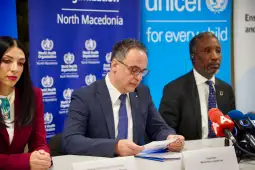
These results, Aliu pointed out, indicate that as a policymaker, the Ministry of Health is on the right path in improving healthcare for mothers and children, thereby reducing the neonatal mortality rate.
“During this period, several measures have been implemented to strengthen emergency obstetric care and newborn care, update clinical protocols, improve neonatal resuscitation practices and infection prevention, and enhance transport readiness. In addition, the 2020–2030 Perinatal Care Masterplan was implemented to operationalize a risk-stratified perinatal network and enable continuous quality improvement at all levels of healthcare,” Aliu added.
Chair of the Safe Motherhood Committee and Director of the Clinic for Gynecology and Obstetrics, Irena Aleksioska-Papestiev, said that the data show that with a systematic approach, international standards in reducing neonatal and under-five mortality can be achieved.
“The report highlights our country as one with exceptional progress. Today we can be proud because perinatal mortality and under-five mortality are key indicators of a well-functioning healthcare system. This achievement is the result of cooperation among all stakeholders, primarily supported by the Ministry of Health, clinical and healthcare institutions such as the Clinic for Gynecology and Obstetrics, which treats the majority of premature infants, the Clinic for Pediatrics and the strong support we receive from WHO, UNICEF, UNFPA and the NGO sector,” Prof. Dr. Aleksioska-Papestiev said.
She noted that among the activities undertaken were the updating of clinical protocols for maternal and neonatal health, improvements in resuscitation and infection prevention, investments in equipment and healthcare personnel, as well as enhancements in patient transport with appropriate referral of high-risk patients to the proper institutions.

“Additional measures were taken to improve national-level coordination, including the establishment of the Safe Motherhood Committee and the National Commission for Perinatal Mortality Review. It was decided that every neonatal death would be reviewed to identify system gaps, enabling policy adjustments and improvements in clinical practice. The 2020–2030 Perinatal Care Masterplan is key tool outlining how to manage all high-risk patients and where they can be treated. If regional health centers cannot provide adequate care, patients are referred to facilities where proper neonatal care is available,” Prof. Dr. Aleksioska-Papestiev said.
She noted that training of healthcare personnel has been a key investment, and that these long-term interventions have contributed to these results.
She further mentioned that the rate of cesarean deliveries is increasing in the country and that clinical protocols need reviewing, as every cesarean carries potential risks for both the mother and the newborn.
The head of the WHO office in the country, Akeem Ali, said that North Macedonia has become one of the world’s most prominent success stories in child survival, demonstrating what is possible when leadership, quality, and evidence-based reforms go hand in hand.
He noted that since 2015, North Macedonia has achieved the largest improvement child survival worldwide, reducing neonatal mortality by 87 per cent and under five mortality by 75 per cent.
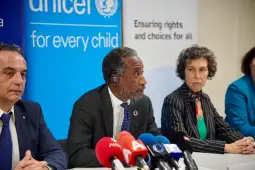
“The results show that rapid progress can be achieved when continuous investment in maternal and child health is prioritized. WHO, UNICEF, and UNFPA are proud to have supported the Ministry of Health throughout this process, and through collaboration we have introduced and expanded innovative interventions, strengthened health systems, and fostered a culture of continuous improvement and accountability. It is essential for the country to maintain its commitment to quality, equity, and resilience in child health. This means high standards of care in every health facility and continuity of care,” Ali emphasized.
He emphasized that vulnerable communities, policies that reinforce skilled health personnel, and investments in strong data systems and regular audits must be prioritized, as these are crucial for achieving sustainable progress. This represents a significant success for the country, Ali said.
UNICEF representatives Leslie Miller and UNFPA’s Jovanka Brajović Grigorijević also attended the press conference.
Photo: Ministry of Health


