Xi and Putin show unity against the West at security summit in China
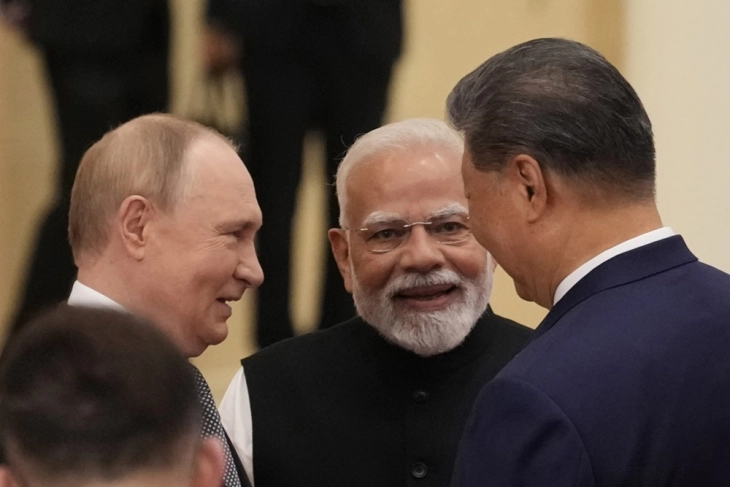
Beijing, 1 September 2025 (dpa/MIA) - At a major Chinese security summit attended by world leaders from Russia, India, Iran and other non-NATO aligned countries on Sunday, China put on a face of unity amid simmering regional conflicts and trade disputes.
"The world is experiencing changes not seen in a century, with significantly increasing instability and uncertainty," Chinese President and Communist Party leader Xi Jinping said at the summit of the pro-Russia Shanghai Cooperation Organisation (SCO).
During a gala dinner in the northern Chinese port city of Tianjin, Xi said the SCO bears an even greater responsibility for maintaining peace and stability in the region.
He made these remarks in front of numerous heads of state and government, including Russian President Vladimir Putin, whom Xi warmly greeted with a handshake.
Upon arriving at the banquet, Xi spoke with Putin, whom he often refers to as an "old friend." The two leaders also stood next to each other in the so-called family photo.
The organization is largely dominated by leaders of authoritarian regimes, who are also criticized internationally for human rights violations.
A meeting of 'old friends'
Once again, the summit provided Putin, who remains isolated in parts of the West due to his war of aggression against Ukraine, with a platform to showcase his strong ties with China and other Asian countries.
However US President Donald Trump had also recently rolled out the red carpet for Putin at a summit in Alaska. During his four-day stay in China, Putin is focused not on tensions with the West but on building a multipolar world order, as he explained in an interview with China's state news agency Xinhua.
Putin will remain in China for several days and is set to attend a military parade on September 3 in the nearby Chinese capital, Beijing, alongside North Korean leader Kim Jong Un. The parade marks the 80th anniversary of Japan's defeat in World War II.
China is considered Russia's most important ally in the war against Ukraine, as Beijing has so far refrained from condemning Moscow's actions and has supported Russian demands in its own proposals for resolving the conflict.
Additionally, according to accusations from Western countries, China supplies Russia with goods that can be used for both civilian and military purposes, thereby supporting the Russian arms industry.
A thaw after a diplomatic freeze
The meeting between Xi and Indian Prime Minister Narendra Modi was also being closely watched amid a decades-long border dispute. As a sign of improving relations, Xi called for closer cooperation with India.
"China and India are partners, not rivals," Xi told Modi. He added that both countries represent opportunities for development rather than threats to each other. Modi said his meeting with Xi was "productive."
After years of tensions, the world's two most populous countries now appear to be moving closer to each other diplomatically again.
The strained relations stem from a decades-long dispute over a region in the Himalayas, which Beijing considers part of southern Tibet and New Delhi views as part of the northern Indian state of Arunachal Pradesh.
In 2020, soldiers from both sides clashed in the region, resulting in the deaths of 20 Indian and four Chinese soldiers. Relations between the two nuclear powers subsequently deteriorated.
India and China also fought a brief border war in 1962 and dispute several sections along their ill-defined, 3,500-kilometre border.
"We agreed that it is important to maintain peace and tranquillity in the border areas," Modi wrote on the online platform X following the meeting in Tianjin.
Xi and Modi held their first talks after the dispute in Russia last year on the sidelines of a BRICS summit, indicating the first major thaw in relations following the deadly clashes.
During a recent meeting in India, the two sides agreed to a 10-point plan to achieve "peace and calm" along their shared border. They also plan to resume tourist visas and direct flights.
A new world order?
The talks in Tianjin are likely to be closely watched by Washington, which recently slapped 50% tariffs on Indian imports to punish New Delhi for continuing to purchase oil from Moscow despite its ongoing invasion of Ukraine.
Ahead of his departure, Putin vowed to reinvigorate the idea of a multipolar world order during his four-day trip to China, where he is also set to attend a large-scale military parade in Beijing.
China remains India's most important trading partner and it is expected that the three leaders might expand cooperation to counter US influence.
However, observers believe it is unlikely that New Delhi will turn its back on Washington entirely, as both countries share security interests.
Both are members of the Quad partnership, alongside Japan and Australia, which aims to push back China's influence in the Indo-Pacific region.
Modi arrived in China on the heels of a visit to Japan, where Prime Minister Shigeru Ishiba agreed to double private investment in India to 10 billion yen ($68 million) over the next 10 years.
Photo: EPA