World No Tobacco Day – Over 46% of men and 27% of women in the country are nicotine users
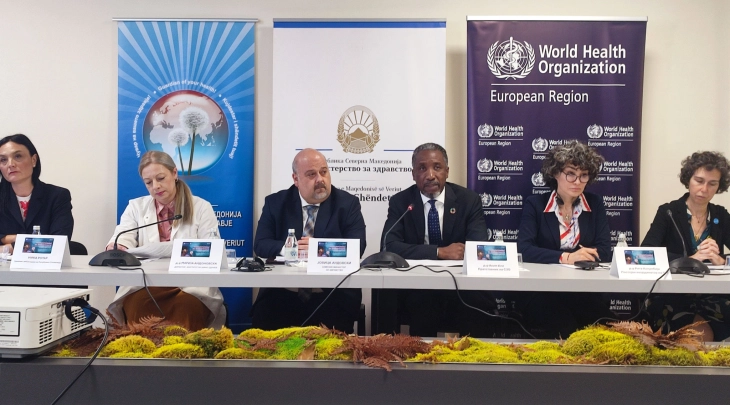
Skopje, 2 June 2025 (MIA) - Data from the World Health Organization shows that the country has a high smoking rate - over 46% of adult men and 27% of adult women use tobacco or some kind of nicotine product, said Deputy Minister of Health Jovica Andovski at a joint press conference held Monday in honor of World No Tobacco Day, alongside the head of the Public Health Institute, Marija Andonovska; WHO representative and Head of Office in North Macedonia, Akeem Ali; and United Nations and UNICEF representatives, Rita Columbia and Lesley Miller.
Andovski emphasized that tobacco use leads to loss of productivity and economic harm, highlighting that every single denar invested in tobacco control brings an 18-denar return in saved healthcare costs.
He stressed the necessity of tobacco control as a major public health imperative and noted that successful enforcement requires the support of all institutions, ensuring proper regulation and consistent application of laws regarding all tobacco and nicotine-related products.
“The data realistically depicts the need of tobacco control as a major public health imperative. However, I would like to note that tobacco control isn’t only up to the health sector. Key aspects include support from all institutions for a consistent implementation of legislation, regulation of all products that use tobacco and nicotine, as well as the implementation of new measures based on the needs,” Andovski said.
The head of WHO’s Office in Skopje, Akeem Ali, stressed that seven million children worldwide are smokers. Even more alarming, he said, is that seven out of ten smokers in the country started smoking at an early age.
"Seven million children worldwide are smokers. It is truly disturbing to know that seven out of ten smokers in North Macedonia started smoking at an early childhood age. You will agree with me that it is unacceptable that out of 100 tobacco-related deaths, one-fifth are due to passive smoking, meaning that smokers are not only destroying their own health but also the health of their children, family members, and the public," said Ali.
Marija Andonovska, head of the Public Health Institute, warned that smoking is one of the leading causes of numerous non-communicable diseases, emphasizing that the public must be continuously reminded about the negative health impacts of tobacco use. She said it is alarming that half of the adult population in the country are active smokers.
“When half of the adult population declares themselves as active smokers, we cannot sit idly by. Immediate measures must be taken to protect public health. As the Public Health Institute, we fight against tobacco use all year round, not just today,” said Andonovska.
UN Resident Coordinator Rita Columbia pointed to the importance of an integrated approach and strict law enforcement to ensure long-term and sustainable effects.
"The integrated approach is a key factor in ensuring long-term and sustainable effects. There is evidence that tobacco affects income and marginalized communities, which means that it is not just a public health issue but also a matter of social justice. We must ensure that tobacco control is inclusive and appropriate, meaning attention should be given to those who are vulnerable," said Colombia.
UNICEF Representative Lesley Miller presented data showing that young people who have friends that smoke are 62% more likely to start smoking, while those with parents who smoke face a 79% probability of becoming smokers.
“This means that pressure and influence come from both parents and friends, and this is of critical importance and must be taken into account when developing future strategies,” Miller said.
Photo: MIA


