SSM to hold public session outside Parliament, demanding €500 minimum wage and higher salaries
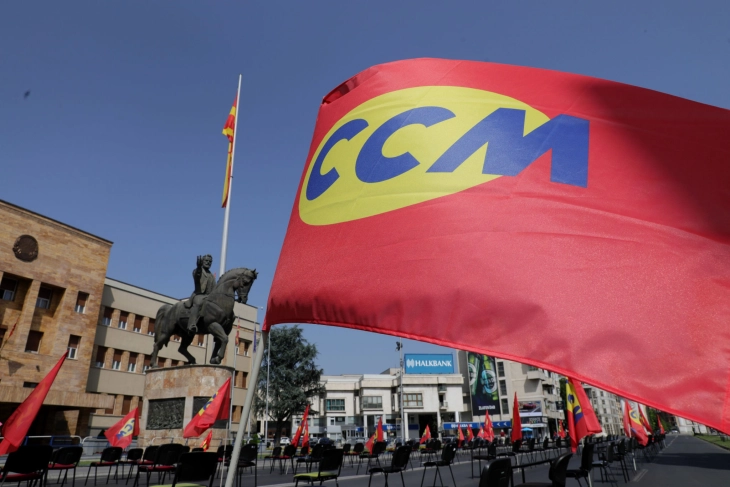
Skopje, 2 April 2025 (MIA) - The Federation of Trade Unions of Macedonia (SSM) is set to hold a public session of its highest bodies Wednesday outside the Parliament before proceeding to the Economic Chamber of Macedonia and the Government. With this move, the union seeks to express dissatisfaction with the decision to raise the minimum wage by Mden 1,800 (EUR 290) without prior discussion in the Economic and Social Council, which it considers unlawful.
Starting at 12:05 pm, when the protest begins in front of Parliament, special traffic regulations will be in effect in this part of the city.
According to the announcements, the public session will start in front of the SSM and then proceed in front of the Parliament, where the union will state that there can be no improvement in the wages of MPs without an improvement in the wages of workers. Next, in front of the Economic Chamber, the SSM will stress that support of workers is essential for the stability of the economy. The final part of the protest will take place in front of the Government, where the union will demand that workers be included in decisions about their wages.
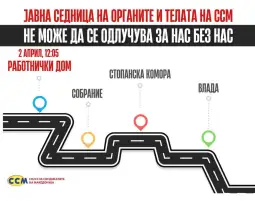
SSM demands that the minimum wage be Mden 30,000 (EUR 500) instead of the proposed Mden 24,300 (EUR 394).
"The inhuman behaviour towards union representatives not only violates the Constitution and laws of Macedonia, but also violates international labour conventions. The International Labour Organization, the European and International Trade Union Confederations, which give full support to SSM, have already been notified of this,” SSM leader Slobodan Trendafilov said on Tuesday.
Attacks towards the Federation of Trade Unions of Macedonia (SSM) will not stop the union from demanding higher wages and better living standards for workers, he noted.
Trendafilov said SSM is concerned about the situation in which 250,000 workers receive a wage of up to Mden 32,000, and 380,000 workers receive a wage below the average wage in the country. He noted that the public session is against the Government's decision to increase the minimum wage by Mden 1,800 only, which the union considers unlawful and insufficient. SSM demands that the minimum wage be Mden 30,000, instead of the proposed Mden 24,300.
On March 14, the European Trade Union Confederation (ETUC) supported the country's unions in their efforts to achieve a higher minimum wage that would ensure a dignified livelihood for workers. ETUC representatives told a press conference in Skopje that the trade unions' demands for a minimum wage increase are more than justified, noting that the minimum wage in North Macedonia is the lowest in the region.

SSM disputes the Government’s decision on the minimum wage, arguing that, under Article 4, Paragraph 5 of the Law on Minimum Wage, the Minister of Labour and Social Policy must announce the gross minimum wage after consulting the Economic and Social Council. They note that this procedure was not followed, as no session was held.
The Economic and Social Council has not held a session this month because the Commission for Representativeness must first determine the representativeness of SSM, which expired last year. Last Friday, the Commission held its first session and is currently reviewing the submitted lists of active SSM members. If it is confirmed that SSM has at least 10 percent of the total number of employees in the country as its members, the Economic and Social Council should resume its work.
According to the Government, the minimum wage is legitimate and established according to the criteria outlined in the Law on Minimum Wage. Last week, Deputy Minister of Economy and Labour Marjan Risteski said at a press conference that the wage amount is based on data from the State Statistical Office, with 50% of last year’s average wage and 50% of last year’s inflation rate used as the basis.
Photo: MIA archive


