Skopje Cultural Diplomacy Forum participants meet with National European Integration Council
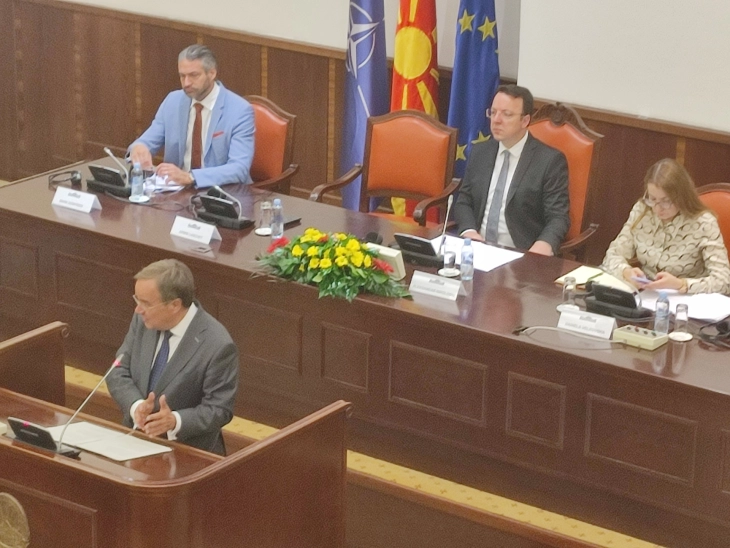
Skopje, 6 September 2023 (MIA) – None of the parties in Germany have any dilemmas, and they all support the EU accession process of the Western Balkan countries. We want these countries, including North Macedonia, to become members of the European Union. The enlargement with the Western Balkans is generally in stagnation, while in the past 20 or so years there have been many issues that aren’t normal for the accession process, said CDU MP Armin Laschet in his address at the session Wednesday of the National European Integration Council during which the participants of the Skopje Cultural Diplomacy Forum 2023 met with the members of the Council.
Laschet highlighted that the accession process is different for each Balkan country, he said it is not a “fair process” when there are discussions about Ukraine becoming an EU member state.
“That’s encouragement for Ukraine, amidst the war, that the door is open for them, but anyone who expects Ukraine to soon become a member of the EU does not understand the European processes. I think the Western Balkan countries should become members before that, and we need to set our priorities,” said Laschet.
The German politician stated that the countries from the region must cooperate because he said, “they are too small to be able to face the great global challenges separately”, and he underscored the need for pragmatic solutions for the current issues, considering, he said, the history.
“And if this is the European perspective, I think we will be able to find a solution for the accession process as well. We need appropriate steps on how to bring the countries closer to the EU… I support the EU membership of the Western Balkans, but in a pragmatic way, it is necessary to overcome the various historical positions and the hate that remains from the past. This is the European perspective,” said Laschet.

Croatian MP Dalija Orešković said the greatest motivation comes from the prospects of change and noted that after two decades of stagnation in the accession process, “voices have been heard from the EU that have set a new reality for the Western Balkan countries.”
Orešković assessed Croatia’s EU accession process as a valuable experience.
“Even after ten years, we still aren’t what we thought we would be. This is a lasting process of progress and regression, ups and downs, and represents an example for the candidates to follow these steps… Considering the challenges and the dilemmas that the candidates are set to face, I believe that significant assistance can be provided by looking further than the adopted laws, i.e., their practical implementation. Even though many of the laws are the same or similar to those from the other EU member states, the implementation can never be the same. If you are inadequately prepared you will face issues in keeping up with the rest of the Union,” said Orešković.
The Croatian MP highlighted that successful progress requires the creation of important pillars of democracy.
“For the nations who are going through a transition and are seeking full-fledged EU membership, I can see three key areas, three pillars of democracy – strengthening of individual identity, strengthening of independent institutions as opposed to clientelism, and strengthening the mutual control of the national powers,” said the Croatian politician.
This year’s Cultural Diplomacy Forum focuses on understanding and peace through cultural diplomacy, which, Scottish MP Michelle Thomson called soft power.

“This is a soft power which knows no borders. We know that Scotland is synonymous with the tartan, whiskey and bagpipes, but at the same time it is a synonymous with universities and the export of quality goods. Many see Scotland as a place where they can develop their business and a country with which they can cooperate. Throughout the centuries, Scotland has maintained trade relations with the Balkans, and we find evidence for this from the 15th century. That was founded on trust, and those foundations facilitate our trade today,” said the Scottish MP.
The Cultural Diplomacy Forum which was held on Tuesday was organized by the Office of the former President of the country, Gjorgje Ivanov, and the International Institute and Academy for Cultural Diplomacy. The participants include former presidents, prime ministers, current and former ministers, MPs and MEPs.
Photo: MIA


